
Black-footed ferret facts for kids
Quick facts for kids Black-footed ferret |
|
|---|---|
 |
|
| Conservation status | |
Scientific classification  |
|
| Kingdom: | Animalia |
| Phylum: | Chordata |
| Class: | Mammalia |
| Order: | Carnivora |
| Family: | Mustelidae |
| Genus: | Mustela |
| Species: |
M. nigripes
|
| Binomial name | |
| Mustela nigripes (Audubon & Bachman, 1851)
|
|
 |
|
| Black-footed ferret range (three small areas on US territory) | |
| Script error: The function "autoWithCaption" does not exist. | |

Script error: No such module "Check for conflicting parameters".
The black-footed ferret (Mustela nigripes) is a type of weasel. It is also known as the American polecat or prairie dog hunter. This animal lives in central North America. It is an endangered species, meaning it is at risk of disappearing forever.
Black-footed ferrets have several natural enemies. These include golden eagles, great horned owls, coyotes, American badgers, bobcats, prairie falcons, ferruginous hawks, and prairie rattlesnakes.
Contents
- History of the Black-footed Ferret
- What Does a Black-footed Ferret Look Like?
- How Black-footed Ferrets Behave
- Reproduction and Development
- What Do Black-footed Ferrets Eat?
- Where Black-footed Ferrets Live
- Dangers They Face
- A History of Survival
- Interesting Facts About the Black-footed Ferret
- Images for kids
- See also
History of the Black-footed Ferret
Long ago, Native American tribes knew about black-footed ferrets. Groups like the Crow, Blackfoot, Sioux, Cheyenne, and Pawnee used them for religious ceremonies and as food.
Modern scientists did not discover the ferret until 1851. It was first described in a book by John James Audubon and John Bachman.
What Does a Black-footed Ferret Look Like?
The black-footed ferret has a long, thin body. It has black markings on its feet, ears, parts of its face, and its tail. Its neck is long, and its legs are short. The toes have sharp claws. Even the bottoms of its feet are covered with hair. This fur helps to hide its claws.
Male ferrets are about 50 to 53 centimeters (19.7 to 21.0 inches) long. Females are usually about 10% smaller than males. These ferrets weigh between 650 and 1,400 grams (1.43 to 3.09 pounds).
Their main color is a pale yellowish or buffy brown. The top of their head and sometimes their neck look darker because of dark-tipped hairs. A wide black band crosses their face, going around their eyes. Their feet, lower legs, and the tip of their tail are also black. A dark brown patch is found between their front and back legs. They have a small light spot above each eye and a thin band behind the black mask. The sides of their head and their ears are a dirty-white color.
How Black-footed Ferrets Behave

Black-footed ferrets usually live alone. They only come together to breed or to raise their young. They are nocturnal, meaning they are active at night. They mostly hunt for sleeping prairie dogs inside their burrows. They are most active above ground from evening until midnight, and again from 4 AM until mid-morning.
Weather usually does not stop ferrets from being active. However, in winter, they might stay inside their burrows for up to six days at a time. Ferrets may travel long distances, up to 11 miles (18 kilometers), to find enough food.
Reproduction and Development

Black-footed ferrets mate in February and March. A mother ferret can have one to five babies, called kits. Kits are born in May and June inside prairie dog burrows. Their mother takes care of them for several months.
Kits first come out of the burrow in July, when they are about six weeks old. Later, they move into their own separate prairie dog burrows near their mother's burrow. Kits grow to adult size and become independent between late August and October. They can start having their own babies when they are one year old.
What Do Black-footed Ferrets Eat?

Up to 90% of a black-footed ferret's diet is made up of prairie dogs. The other 10% of their diet includes small rodents and rabbits. What they eat can change a little depending on where they live.
Where Black-footed Ferrets Live
In the past, black-footed ferrets lived across a wide area. This stretched from southern Alberta and southern Saskatchewan in Canada, all the way south to Texas, New Mexico, and Arizona in the United States.
By 2007, the only known wild black-footed ferret population was found in Wyoming. Since 1990, efforts have been made to bring black-footed ferrets back to many areas. These include places in Wyoming, Montana, South Dakota, Arizona, Colorado, and Canada.
Black-footed ferrets used to live in many different types of grasslands. This included short-grass prairies, mixed-grass prairies, and desert grasslands. They use the burrows of prairie dogs to raise their young, hide from predators, and stay warm.
Dangers They Face
The main reasons ferrets die are losing their habitat, diseases, and problems from efforts to control prairie dog populations. In Wyoming, between 59% and 83% of young and adult ferrets died each year over a four-year period. In fall and winter, 50–70% of young and older animals don't survive. Ferrets in the wild probably live for only about one year, but some can live up to five years. Males often die more often than females. This is because they travel farther when they are most at risk from predators.
Because black-footed ferrets depend so much on prairie dogs, they are very vulnerable when prairie dog habitats are lost. This habitat loss happens because of farming, ranching, and other human development.
Black-footed ferrets can get many illnesses. They are very sensitive to a disease called canine distemper virus. This virus can be carried by animals like striped skunks, common raccoons, red foxes, and coyotes. There is a short-term vaccine for ferrets in zoos. But there is no protection for young ferrets born in the wild. Ferrets can also get rabies and other illnesses. They can also get sylvatic plague. This disease can wipe out entire prairie dog towns, leaving the ferrets without food.
Animals that hunt black-footed ferrets include golden eagles, great horned owls, coyotes, American badgers, bobcats, and prairie rattlesnakes.
Human activities like oil and natural gas exploration can also harm ferrets and prairie dogs. For example, seismic activity can collapse prairie dog burrows. Other problems include leaks, more roads and fences, more cars and people, and more places for birds of prey to perch on power poles. Traps set for other animals like coyotes might also accidentally harm black-footed ferrets.
A History of Survival
Why They Almost Disappeared
For a while, black-footed ferrets were hunted for their fur. But their fur wasn't very valuable. The biggest drop in ferret numbers happened from the 1800s to the 1900s. This was because prairie dog populations decreased. People were trying to control prairie dogs, and prairies were being turned into farmland.
Sylvatic plague, a disease that came to North America, also caused many prairie dogs to die. Ferret numbers dropped even more than prairie dogs, suggesting other problems were also at play. Scientists are working hard to protect ferrets from the plague. They use special dust to treat prairie dog colonies and vaccinate ferrets. Studies in 2023 showed that combining these methods helps prairie dogs resist the plague, which in turn helps ferrets.
Another problem was a lack of variety in their genes, which can make animals less healthy. This happened because there were so few ferrets left. In 1985, a disease called canine distemper badly affected the ferret population in Wyoming. A vaccine made for pet ferrets actually harmed many black-footed ferrets. This showed how sensitive they are to distemper.
Bringing Them Back: Conservation Efforts

The black-footed ferret almost disappeared, but it has been recovering for over 30 years. This recovery happened through special breeding programs in zoos and then by releasing them back into the wild. This ferret is the only one native to North America. Studying its recovery helps scientists understand how a small gene pool affects animals.
The black-footed ferret was listed as endangered in 1967. After being thought extinct in 1979, a small group was found in Wyoming in 1981. This group grew to 130 ferrets. But then, diseases like sylvatic plague and canine distemper almost wiped them out again. Only 18 animals were left. These survivors were captured from 1985 to 1987. They became the parents of all black-footed ferrets alive today. Seven of those 18 ferrets had offspring that survived and reproduced.
The black-footed ferret is a great example of how science helps conservation. A breeding program started in 1987, using artificial insemination. This was one of the first times this method helped save an endangered species. Since 1991, many groups have worked together to release ferrets back into the wild. These groups include the U.S. Fish and Wildlife Service, state and tribal agencies, landowners, and zoos.
Reintroduction started in Wyoming and spread to Montana, South Dakota, Arizona, Utah, Colorado, Canada, and Mexico. The Toronto Zoo has bred hundreds of ferrets, and most were released. In May 2000, Canada listed the black-footed ferret as an "extirpated" species (meaning it was gone from Canada). But in October 2009, 35 ferrets were released into Grasslands National Park in Saskatchewan. In July 2010, newborn kits were seen there! This showed the reintroduction was working.
.jpg)
In September 2006, South Dakota had about 420 ferrets. Arizona's ferret population was over 100. By August 2007, a report in the journal Science counted 223 ferrets in one area of Wyoming. The population was growing by 35% each year from 2003 to 2006. This was much faster than expected for many endangered species. It seemed the ferrets were overcoming past problems with disease and lack of food. As of 2007, there were over 650 wild ferrets in the U.S., plus 250 in zoos. In 2008, the IUCN changed the species' status to "globally endangered." This was a big improvement from 1996, when it was thought to be extinct in the wild.
As of 2013, about 1,200 ferrets were thought to live in the wild. These wild populations are possible because of the breeding program. This program releases extra animals to reintroduction sites. Biologists then watch these sites to check on the ferrets' health and growth. However, the species can't rely only on zoo breeding forever. Over time, problems like lower pregnancy rates have appeared in zoo-bred ferrets. This is thought to be due to having very similar genes, which can happen in small populations.
Some people, like ranchers, have disagreed with conservation efforts. They have traditionally tried to control prairie dog populations. In 2005, the U.S. Forest Service started using treatments to manage prairie dogs near ferret habitats. This caused disagreements between different government groups and conservationists. Eventually, the plan to use widespread treatments was stopped.
The Future is Bright: Cloning for Conservation

In 2020, black-footed ferrets were part of testing an experimental COVID-19 vaccine in Colorado. This was done for important conservation reasons. Scientists worried that this highly endangered species could be very vulnerable to the virus. Ferrets are known to get respiratory illnesses easily. The coronavirus also spreads easily among related animals like mink.
Scientists from the San Diego Zoo, Revive & Restore, ViaGen Pets and Equine Company, and the U.S. Fish and Wildlife Service worked together to clone a black-footed ferret. In 2020, they cloned a female named Willa. Willa had died in the mid-1980s and had no living descendants. Her clone, a female named Elizabeth Ann, was born on December 10, 2020. She was the first endangered species from North America to be cloned!
Scientists hoped that Elizabeth Ann's genes would help the black-footed ferret population. They believed her genes could reduce problems from having very similar genes. They also hoped it would help ferrets better fight diseases like the plague. Experts think Elizabeth Ann's genes have three times more variety than any modern black-footed ferret. In October 2022, Elizabeth Ann had a surgery due to health issues common in ferrets. These issues were not believed to be from the cloning process. Elizabeth Ann remained healthy and acted like a normal adult ferret.
In April 2024, the U.S. Fish and Wildlife Service announced the birth of two more black-footed ferret clones: Noreen and Antonia. They were cloned from the same genetic material as Elizabeth Ann. Noreen was born in Colorado, and Antonia was born in Virginia. In June 2024, Antonia gave birth to three kits after mating with a male ferret. Two of these kits, a male named Red Cloud and a female named Sibert, survived and are doing well. These cloning efforts are a big part of helping the black-footed ferret survive and thrive!
Interesting Facts About the Black-footed Ferret
- In 2020, black-footed ferrets were part of a study for an experimental COVID-19 vaccine in Colorado.
- A study in 1983 found that one adult female ferret and her babies need a lot of prairie dogs to survive each year.
- Scientists have successfully cloned a black-footed ferret! In 2020, a team of scientists cloned a female ferret named Willa, who had died in the 1980s. Her clone, a female named Elizabeth Ann, was born on December 10, 2020. This made her the first endangered species in North America to be cloned.
- Activities like oil and natural gas drilling can harm black-footed ferrets. The vibrations from drilling can cause prairie dog burrows to collapse. Other problems include oil spills, more roads, and more human activity. Also, traps set for other animals like coyotes can accidentally harm ferrets.
Images for kids
-
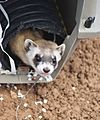
Black-footed Ferret Release
-
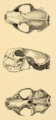
Skull, as illustrated in Merriam's Synopsis of the weasels of North America
-
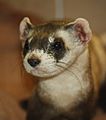
Black-footed ferret at the Louisville Zoo
-

Skeletons of black-footed ferret (left) and prairie dog (right) articulated to show the predator-prey relationship between the two. (Museum of Osteology)
-
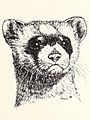
Head of a black-footed ferret by Carol Snow, 1972
.jpg)


.jpg)
_(page_1_crop).jpg)
See also
 In Spanish: Turón patinegro para niños
