
2026 FIFA World Cup facts for kids
| Coupe du Monde de la FIFA 2026 (French) Copa Mundial de la FIFA 2026 (Spanish) |
|
|---|---|
 |
|
| Tournament details | |
| Host countries | Canada Mexico United States |
| Dates | June 11 – July 19 |
| Teams | 48 (from 6 confederations) |
| Venue(s) | 16 (in 16 host cities) |
| Final positions | |
| Champions |  Spain (2nd title) Spain (2nd title) |
| Runners-up |  Argentina Argentina |
| Third place |  England England |
| Fourth place |  France France |


_closeup.jpg)


The 2026 FIFA World Cup is the 23rd edition of the FIFA World Cup, a major international men's soccer tournament which happens every four years. For the first time ever, three countries are hosting the World Cup together: Canada, Mexico, and the United States. Matches are being played in 16 cities across these three nations. This World Cup is also special because it's the first to include 48 teams, which is more than the previous 32-team format.
The tournament started on June 11, 2026, and will finish on July 19.
Several teams made their World Cup debut this year, including Cape Verde, Curaçao, Jordan, and Uzbekistan.
This tournament has set a new record for the highest total attendance in World Cup history. On June 25, 2026, during a group match at MetLife Stadium, the total number of spectators reached over 3.6 million. This broke the previous record from the 1994 World Cup.
Contents
More Teams and New Structure
Beginning with this 2026 tournament, FIFA officially increased the number of participating teams from 32 to 48. The 48 teams are divided into 12 groups of 4. This structure ensures that, just as before, every team is guaranteed three matches in the group stage. However, the path to the knockout rounds has a new strategic twist. The top two teams from each of the 12 groups advance, but they are now joined by the 8 best third-place finishers. This means that a total of 32 teams move forward, which introduces a brand-new phase of the tournament: the Round of 32.
This is a historic change, as the World Cup had not altered its fundamental format since the 1998 tournament in France. In another significant shift, the total number of matches has grown substantially from 64 to 104. As a result, a team that reaches the semifinals will now play 8 matches instead of the previous 7!
Exciting New Rules for Fair Play
The 2026 FIFA World Cup introduced some new rules to make the game fairer and reduce time-wasting. These rules include:
- 10-second substitutions: If a player is being replaced, they must leave the field within 10 seconds. If not, their replacement has to wait one minute before entering the game.
- 5-second restarts: For throw-ins and goal kicks, the referee can show a 5-second countdown. If the ball isn't put into play in time, the other team gets the ball.
- Medical treatment: If a player gets medical help on the field, they must leave and wait one minute before returning to play.
- Expanded video assistant referee (VAR): VAR can now help correct clear mistakes for red cards from a second yellow card, wrongly given corner kicks, and some attacking fouls.
- Mouth-covering red cards: Players who cover their mouth while arguing with an opponent will be sent off. This stops them from hiding what they are saying.
- Leaving the field in protest: Players or officials who leave the field to protest a decision will be sent off.
The rules for breaking ties in the group stage also changed. Now, the first tiebreaker is the points earned in matches between the tied teams. It is no longer based on goal difference.
Teams and Qualification

The three host countries, Canada, Mexico, and the United States, automatically qualified. This was confirmed by the FIFA Council on February 14, 2023. Six teams from North and Central America (CONCACAF) qualified in total.
FIFA also approved a playoff tournament for the last two World Cup spots. Six teams played in these playoffs. This included one team from each confederation (except Europe) and an extra team from CONCACAF. The playoffs were held in Mexico. This is the first World Cup where all six football confederations have at least one guaranteed spot.
Of the 48 qualified teams, 26 also played in the 2022 World Cup.
- Cape Verde, Curaçao, Jordan, and Uzbekistan are playing in the World Cup for the first time.
- Qatar qualified through games for the first time. Their only previous appearance was as host in 2022.
- DR Congo and Haiti are back after last playing in 1974.
- Iraq returns after their only previous tournament in 1986.
- Austria, Norway, and Scotland are back after last playing in 1998.
- Turkey qualified for the first time since finishing third in 2002.
- Czech Republic qualified for the first time since 2006.
- New Zealand, Paraguay, and South Africa (2010 World Cup host) return after last playing in 2010.
Four-time champion Italy did not qualify. They lost in a playoff, making it their third World Cup in a row to miss. Italy was the only former champion not to qualify.
The qualified teams are listed below by region:
AFC (Asian Football Confederation) (9)
- Australia (27)
- Iran (20)
- Iraq (57)
- Japan (18)
- Jordan (63) (debut)
- Qatar (56)
- Saudi Arabia (61)
- South Korea (25)
- Uzbekistan (50) (debut)
CAF (Confederation of African Football) (10)
- Algeria (28)
- Cape Verde (67) (debut)
- DR Congo (46)
- Egypt (29)
- Ghana (73)
- Ivory Coast (33)
- Morocco (7)
- Senegal (15)
- South Africa (60)
- Tunisia(45)
CONCACAF (Confederation of North, Central American and Caribbean Association Football) (6)
- Canada (30) (co-host)
- Curaçao (82) (debut)
- Haiti (83)
- [Mexico]] (14) (co-host)
- Panama (34)
- United States (17) (co-host)
CONMEBOL (South American Football Confederation) (6)
OFC (Oceania Football Confederation) (1)
- New Zealand (85)
UEFA (Union of European Football Associations) (16)
- Austria (24)
- Belgium (9)
- Bosnia and Herzegovina (64)
- Croatia (11)
- Czech Republic (40)
- England (4)
- France (3)
- Germany (10)
- Netherlands (8)
- Norway (31)
- Portugal (5)
- Scotland (42)
- Spain (2)
- Sweden (38)
- Switzerland (19)
- Turkey (22)
.jpg)
Group Stage Matches
The group stage was played in twelve groups (A to L) of four teams each. Matches took place from June 11 to 27, 2026. Teams earned three points for a win, one for a draw, and none for a loss. The top two teams from each group, plus the eight best third-place teams, moved on to the knockout stage.
Knockout stage
Because there were so many teams, the "Knockout Stage" was bigger than ever. It started with the Round of 32. In a knockout stage, there are no second chances. If you win, you move forward. If you lose, you go home.
The knockout stage began on June 28. With 32 teams left, the pressure was on. By the time we got to the Round of 16 (July 4–7), only the best of the best were left. This is where the "heavyweights" of football—teams like France, Brazil, England, and Argentina—really started to show their power.
Quarter-Finals: The Battle for the Final Four

The Quarter-finals are where the tournament gets really serious. Only eight teams were left, and they played in four massive games.
France vs. Morocco (July 9 in Boston)
France, the 2018 champions, faced the "Atlas Lions" of Morocco. Morocco had a huge following of fans who wore red and green and sang the whole time. However, France’s experience was too much. They won 2-0, showing that they are ready to try and take the trophy home again.
Spain vs. Belgium (July 10 in Los Angeles)
This was a game of strategy. Spain kept the ball for a long time, while Belgium tried to score on fast counter-attacks. In the end, Spain’s young players found a gap in the defense and scored a late goal to win 2-1.
Norway vs. England (July 11 in Miami)
This was a very special game because Norway had one of the best goal-scorers in the world, Erling Haaland. But England’s defense was like a brick wall. England managed to score two goals and held on to win 2-1, sending their fans into a frenzy of joy!
Argentina vs. Brazil (July 11 in Kansas City)
The biggest rivalry in South American football happened right here in the USA! It was a game full of magic tricks, dribbling, and amazing saves. After a 1-1 tie in regular time, it went to penalties. Argentina, the defending champions from 2022, showed their cool heads and won the shootout!
Semifinalists: The Final Four
Four teams that made it to the Semifinals were:
The Grand Finale
On July 19, 2026, the world stopped to watch the final match at the MetLife Stadium in East Rutherford, New Jersey. The two teams left standing were Spain and Argentina. The game was tied 0–0 for a long time. Both teams were exhausted. Then, in the 82nd minute, the Spanish midfielder Rodri intercepted a pass, moved the ball forward, and after a series of lightning-fast passes, he found himself in front of the goal. With a powerful strike, he sent the ball into the corner of the net. Spain won 1–0, becoming the Champions of the World for the second time in their history!
Key Players
- Kylian Mbappé
- Lamine Yamal
- Jude Bellingham
- Lionel Messi
- Erling Haaland
- Ousmane Dembélé
- Harry Kane
- Vinícius Júnior
- Julián Quiñones
- Ismaïla Sarr
- Cristiano Ronaldo
- Yoane Wissa
- Raúl Jiménez
- Charles De Ketelaere
- Kai Havertz
- Matheus Cunha
- Brian Brobbey
- Ismael Saibari
- Mikel Oyarzabal
- Folarin Balogun
- Elijah Just
- Deniz Undav
- Jonathan David
- Romelu Lukaku
Awards and Prizes
Prize Money for Teams
In April 2026, FIFA announced the prizes for all teams. The total prize money for this expanded tournament is $871 million, almost double the previous World Cup. The winner will receive $52.5 million. Even teams eliminated in the group stage receive $12.5 million.
| Place | Teams | Amount (in millions) | |
|---|---|---|---|
| Per team | Total | ||
| Champions | 1 | $50 | $50 |
| Runners-up | 1 | $33 | $33 |
| Third place | 1 | $29 | $29 |
| Fourth place | 1 | $27 | $27 |
| 5th–8th place (quarter-finals) | 4 | $19 | $76 |
| 9th–16th place (round of 16) | 8 | $15 | $120 |
| 17th–32nd place (round of 32) | 16 | $11 | $176 |
| 33rd–48th place (group stage) | 16 | $10 | $160 |
| Total | 48 | $671 | |
Individual Player Awards
- Golden Boot: For the player who scores the most goals - Kylian Mbappé (France).
- Golden Glove: For the best goalkeeper - Unai Simón (Spain).
- Golden Ball: For the best overall player - Rodri (Spain).
- FIFA Young Player Award: For the best player under 21 years old - Pau Cubarsí (Spain).
- FIFA Fair Play Trophy: For the team with the best sportsmanship that reached the knockout stage - Netherlands national football team.
Also, a "Superior Player of the Match" trophy is given after each game to the player who performed best. Fans vote for this award online.
Tournament Symbols
Official Mascots

The official mascots for the tournament were revealed on September 25, 2025. They are Maple, Zayu and Clutch. Maple is a moose from Canada, Zayu is a jaguar from Mexico, and Clutch is a bald eagle from the United States. They represent the unique cultures of their home countries.
The Match Ball
.jpg)
The official match ball is called Adidas Trionda. Its design features red, green, and blue colors, which represent Canada, Mexico, and the United States. A white wave connects these colors, and "Trionda" means "three waves" in Spanish. The ball also has national symbols like a maple leaf for Canada, a golden eagle for Mexico, and a five-pointed star for the United States.
NASA even conducted experiments on the International Space Station in June 2025 to study how soccer balls move in space. This research helped in developing the official match ball for the 2026 World Cup.
Interesting Facts about the 2026 FIFA World Cup
- The official languages of the tournament are English, Spanish, and French (because Canada has two official languages).
- Of the 48 qualified teams, 26 also played in the 2022 World Cup.
- Teams in this World Cup travel an average of 5,146 miles (8,281.7 km). This is less than the travel distances in the 2014 Brazil World Cup (7,054 miles) and the 2018 Russia World Cup (5,441 miles).
- Mexico has hosted the World Cup twice before, in 1970 and 1986. The United States hosted in 1994. This is Canada's first time hosting the tournament.
- To help players stay healthy, FIFA introduced mandatory 3-minute hydration breaks in every half for all matches. These breaks were first used in the 2014 World Cup in Brazil.
- The organizers of 2026 decided to make the tournament as beneficial for the planet as possible. There is almost no single-use plastic in the stadiums. Everything fans buy (bottles, plates) is made of materials that can be recycled.
- Many stadiums have installed rainwater collection systems for watering the pitch. The pitch, by the way, is natural grass in all stadiums — FIFA strictly monitors that the turf is perfect for play.
- The Golden Trophy is made of solid 18-karat gold and weighs 6.1 kilograms. The winners get to hold it, but then it's taken to a museum, and the team is given a gold-plated replica.
- The official emblem for the 2026 World Cup was revealed on May 17, 2023, in Los Angeles. It shows the FIFA World Cup Trophy in front of the numbers "26". This is the first time the actual trophy has been used in the emblem.
Images for kids
-
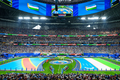
DR Congo vs Uzbekistan at Mercedes-Benz Stadium

See also
 In Spanish: Copa Mundial de Fútbol de 2026 para niños
