
Cockayne Farm Preservation Project facts for kids
Quick facts for kids |
|
|
Bennett Cockayne House
|
|

 Location in West Virginia

Location in the United States
|
|
| Location | Glen Dale, West Virginia |
|---|---|
| Area | 0.6 acres (0.24 ha) |
| Built | c. 1850 |
| Architectural style | I-House |
| NRHP reference No. | 02001521 |
| Added to NRHP | December 12, 2002 |
The Cockayne Farm Preservation Project is a special effort. It is run by the city of Glen Dale, West Virginia and the Marshall County Historical Society. The main part of this project is the Bennett Cockayne House. This house is a historic place listed on the National Register of Historic Places. Samuel Cockayne left the house to the city in his will in 2001. A group was then formed to protect the house. This led to the house being added to the National Register. It also helped the Historical Society lease the property.
Contents
History of the Cockayne Farm
In 1798, Samuel Cockayne moved from Annapolis, Maryland. He was one of the first European settlers in the Glen Dale area. By the time he died in 1854, Samuel owned over 500 acres of land. He divided this land between his sons, Bennett and Vincent.
Bennett had already bought land north of his father's property. Around 1850, he built the farmhouse you see today. Bennett's daughter-in-law, Sarah, named it "Glendale Farm." Bennett was the local postmaster for many years. He also ran a school inside his house, besides farming. Vincent received the southern part of the land. This included Samuel's original home. Vincent called his farm "Valley Farm."
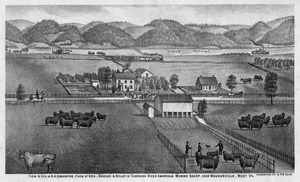
Bennett's son, Samuel A.J., made "Glendale Farm" famous worldwide. In the 1860s, Samuel A.J. started raising Merino sheep. He worked hard to breed sheep that produced the best wool. His efforts paid off in a big way. In 1876, he won a medal for his fine Merino wool. This was at the Centennial Exposition in Philadelphia. In 1878, he won more awards for his wool. This time it was at the Exposition Universelle in Paris.
The farm then passed to Samuel A. Cockayne, also known as "Zan." Samuel A. also worked as the postmaster of Glen Dale. He was also a member of the local school board. When he died in 1953, the farm went to Samuel A.J. Cockayne. This Samuel A.J. served in the Pacific Theater during World War II. After the war, he spent his life working on the farm. In 1967, he sold most of the farmland. It was used to build a new high school. Samuel A.J. lived a quiet life until he passed away in 2001.
Restoring the Historic House
Why the House is Special
When the city took over the house in 2002, leaders saw its potential. The Cockayne House could be a unique historical treasure. Samuel A.J. had lived only in two back rooms. He had added only basic electricity and water. The house was still heated by a wood-burning stove. Because of this, the house was like a "time capsule." It showed how things were long ago.
City and county leaders decided to lease the house. The Marshall County Historical Society would manage it. This group created the Cockayne Farm Preservation Project. The project aimed to fix the outside and structure of the house. It also wanted to save the inside and all the old items found there. Before starting, they studied what the house needed. They also did an archaeological survey. All the objects in the house were checked and listed.
Fixing the Outside
The first step was to fix and protect the outside of the house. Grants, donations, and volunteers helped raise money and support. Luckily, a study showed the house's structure was strong. But major work was still needed. The goal was to make the house look like it did in the late 1800s or early 1900s. They also wanted to keep it in good shape for the future.
A new slate roof was the most urgent need. This was finished in 2004. The old slate was so old it crumbled when workers walked on it. After the roof, the front porch was fixed and rebuilt. By 2009, enough money was raised. This allowed them to restore and paint the outside of the house. In 2010, a small building behind the farmhouse was also restored.

Working on the Inside
Many old objects and items were found inside the house. The first step was to make the house weatherproof during renovations. As work continued, important items were found. These items helped tell the story of the Cockaynes and Marshall County. One discovery was a school roster and other papers. They showed the farmhouse was the site of Glen Dale's first school.
Old wallpaper throughout the house was damaged. But it gave lots of clues about how rooms looked in the late 1800s. They found different layers of wallpaper. This helped them figure out when rooms were redecorated. The project plans to clean and protect the wallpapers. This way, visitors can see what they really looked like. You can see how much dust and smoke built up over years of daily use.
Under the old carpets, they found more clues. There were paper records, pictures, and newspapers. If not damaged by water, these items were in good shape. They were stored flat and away from sunlight. All objects, including the carpeting, were removed in 2012. This was to install a new climate control system in 2013. This system will be hidden from visitors. It will use the chimneys, attic, and cellar.
The Ancient Mound
Behind and to the west of the farmhouse is an ancient Indian Burial Mound. It seems the Cockayne family protected this mound for many years. However, at some point, the land it sits on was sold. In 2005, the Cockayne Farm Preservation Project bought the mound. This was to protect this Native American site for future learning. Studies show the mound is like others in the area. There are no plans to dig into the mound. This means no buried objects will be disturbed.
Learning and Education


Education has been very important since the project began. The project leaders have partnered with several schools and colleges. These include West Virginia University, Wheeling Jesuit University, Belmont Technical College, and John Marshall High School. These partnerships help the project get materials and expert advice for free. They also give students real-world experience.
John Marshall High School is right across from the farm. They have done many projects to help the preservation effort. For example, an advanced art class created art to sell for the project. An AP English class designed a brochure. For several years, the FFA club has designed and cared for raised garden beds on the farm. The food grown there is used at the high school. The long-term goal is to have many learning projects. These will connect schools and the farm. They will also offer learning chances for people of all ages.
West Virginia University students have helped with projects. They worked on finding and studying old items. The Interior Design department scanned the house. They made 3D models of the inside and objects for future study. The Landscape Architecture Department also made a 3D computer model. This was for a future plan for the farm's outdoor areas.
A class from Wheeling Jesuit University used the farm. They created four lesson plans for different age groups. These lessons met West Virginia education standards. Finally, a class from Belmont Technical College helped restore the outbuilding. This gave students hands-on learning. They practiced what they learned in real conditions. They even found some parts of the building were more damaged than first thought.
