
Exploratory Hands-on Science Centre facts for kids

Brunel's original Great Western station building (pictured in 1994), former home of the Exploratory
|
|
| Lua error in Module:Location_map at line 420: attempt to index field 'wikibase' (a nil value). | |
| Established | 1987 |
|---|---|
| Dissolved | 14 September 1999 |
| Location | Bristol, England |
| Type | Science museum |
| Visitors | 200,000 a year |
The Exploratory Hands-on Science Centre was a special science museum in Bristol, England. It was the first museum in the United Kingdom where visitors could touch and interact with the exhibits. This made learning about science fun and exciting.
The idea for the Exploratory came from Richard Gregory in 1981. He was a professor at Bristol University who studied how the brain works. Professor Gregory wanted to create a place where people could learn science by doing experiments themselves. He was inspired by a similar museum called the Exploratorium in San Francisco. He believed that "hands-on science" helps people understand how things work by trying them out.
Contents
The Exploratory's Journey and Impact
Starting the Science Adventure
The Exploratory project received its first money from the Nuffield Foundation and the Gatsby Charitable Foundation. These groups helped make Professor Gregory's idea a reality. From 1987 to 1989, the interactive science exhibits were shown in a temporary spot. This was at the Victoria Rooms in Bristol.
Finding a Permanent Home
In 1989, the Exploratory moved to its permanent home. It was located at the historic Bristol Temple Meads railway station. The museum took up two floors of the original station building. This building was designed by the famous engineer Isambard Kingdom Brunel. The exhibits were called 'plores,' which came from the word 'explore.' The friendly helpers in red shirts were known as 'pilots.'
Learning and Fun for Everyone
The Exploratory was open every day of the week. It welcomed the public and also offered special learning programs for school groups. More than 200,000 people visited each year. About 60% of these visitors were children, eager to learn and explore. The museum's goal was to make science popular and easy to understand. The well-known TV astronomer Patrick Moore supported this mission.
In 1993, the Exploratory hosted an exhibition about the popular BBC television series Doctor Who. This was a big hit with visitors. The museum space was also used by the BBC to record science discussion shows.
The Exploratory's Legacy
The Exploratory closed its doors in September 1999. This happened because its lease on the building ended. However, its spirit lived on! A new, larger science centre called At-Bristol opened in 2000. This new centre is now known as We The Curious. It continues the Exploratory's mission of making science fun and accessible.
One special exhibit from the Exploratory found a new home. This was a giant Baroque guitar. It was so big that it earned a spot in the Guinness World Records in 1995. Today, you can still see this amazing guitar at the Deutsches Museum in Munich, Germany.
Images for kids
-
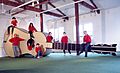
The giant guitar, a record-breaking exhibit

See also
- List of science centers#Europe
