
Gilbert Horseley facts for kids
Quick facts for kids
Captain
Gilbert Horseley
|
|
|---|---|
| Other names | Gilbert Horsley |
| Era | Elizabethan |
| Known for | raids in Veraguas and Honduras |
| Opponent(s) |
|
| Partner(s) | Sylvester / French corsair |
| Piratical career | |
| Type | Privateer |
| Allegiance | England |
| Years active | 1574–1575 |
| Rank | Captain |
| Base of operations | |
| Commands | John |
Gilbert Horseley was an English privateer who led attacks in areas that are now Veragua and Honduras. Privateers were like legal pirates. They were sailors who had permission from their government to attack enemy ships and towns during wartime. Horseley was active around 1574 to 1575.
Contents
Horseley's Adventures
Starting the Journey
In September 1574, a French privateer named Sylvester left a port in France with a ship and many fighters. By December, they were attacking the Veragua region. They learned from local people about Spanish merchant ships nearby. So, in early 1575, Sylvester's group split up. They planned to meet up with local groups of people who had escaped from forced labor, called cimarrones. They went to the San Juan River to capture Spanish ships there.
Gilbert Horseley likely left Plymouth, England, in November 1574. He had a crew of 25 on his ship, the John. This ship was a small, fast vessel called a pinnace. It weighed about 25 tonnes. Horseley probably met Sylvester's group just before they headed north to the San Juan River. Horseley's ship was described as fast and well-equipped. It had 22 harquebuses (an early type of gun) and seven cannons.
The Expedition
Southern Travels
When Horseley's English crew reached Veragua, they also connected with the cimarrones. Working together, Horseley and Sylvester, guided by a Portuguese pilot named Luis Marquês, sailed up the San Juan River. Their goal was to attack the city of Granada.
However, before reaching Granada, they found some Spanish ships. These ships were carrying people who had been forced into labor from an area called Olancho to Veragua. Horseley and Sylvester decided that this was enough treasure for them. They stopped their plan to attack Granada and returned to the open sea.
After securing their captured goods at the San Juan River, Horseley and Sylvester sailed back to Veragua. After this, the two groups went their separate ways. Horseley sailed back towards the Bay of Honduras.
Northern Travels

Horseley arrived in the Bay of Honduras on April 2, 1575. He landed near Puerto Castilla under the cover of night. After midnight, his crew used a small boat called a launch to quietly approach Trujillo. However, a sharp-eyed guard at the Santa Bárbara fortress spotted them right away. The city's soldiers and residents quickly organized a defense. Their strong resistance convinced Horseley to give up on attacking the city. The fort fired at his crew to make sure they retreated. Even so, Horseley managed to capture a Spanish ship that was in the port.
The next morning, on April 3, 1575, the fort's guards saw Horseley, now on the captured Spanish ship, heading towards Puerto Caballos. They believed he planned to raid the port and the ships there. A warning boat was immediately sent from the fort. But Horseley's crew spotted it and captured it about 20 leagues (about 60 miles) into its trip. Later that afternoon, Horseley captured another Spanish ship. This ship was full of valuable goods worth over 3,000 ducats (a type of gold coin). The people on this ship were treated very harshly by Horseley's crew. They were questioned for information about gold and sailing routes.
After this, Horseley continued towards Puerto Caballos with his ship and the launch. When they reached El Triunfo de la Cruz, they met two Spanish merchant ships. Horseley's crew tried to board these ships, but the merchants fought back with heavy cannon fire. This forced the English to give up their attack.
Horseley then headed for Cape Camaron, about 20 leagues east of Trujillo. He reached it on the night of April 5, 1575. The crew stopped there to get fresh water. During this time, two of their Spanish prisoners managed to escape. These prisoners reported that Horseley had warned he would return another year with an even larger force.
The Return Home
Horseley, now quite wealthy from his adventures, arrived back in Plymouth, England, in June 1575. He had 15 of his men with him. From Plymouth, he immediately traveled to Arundel to unload his treasure quietly, without attracting too much attention.
What Happened Next
Diego López, a Spanish official, reported the damage and losses to the Spanish King. He wrote that Trujillo had suffered greatly from these attacks and felt weak because it didn't have enough ways to fight back. He asked the King for more resources and soldiers to defend the port. He described the city as "miserable" and "frequently attacked by enemies," saying it was now without resources.
The King thanked López for his service. He also gave orders for money to be sent to the Real Audiencia of Guatemala (a high court in the Spanish colonies). He also instructed officials in Seville, Spain, to send cannons and other artillery to help defend Trujillo.
Horseley's Legacy
Horseley and Sylvester's journey up the San Juan River was seen as very brave and daring. It was compared to some of the most famous exploits of other explorers like Francis Drake. This was because the river, unlike the open sea, didn't offer an easy escape route for the captains. They completed this difficult journey with only a small crew and a small ship.
Images for kids
-
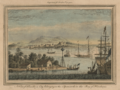
A view of Truxillo Bay and city on the coast of Honduras / 1796 drawing
