
List of New York State Historic Markers in St facts for kids
New York State Historic Markers in St. Lawrence County
Welcome to St. Lawrence County, New York! All around this area, you can find special signs called historic markers. These markers are like outdoor history books. They tell us about important people, places, and events that happened right where the sign stands. They help us remember the past and understand how our communities grew.
This article will explore some of these interesting markers in St. Lawrence County. Each one shares a unique story about the history of this part of New York State.
Contents
Important People from St. Lawrence County
Some markers celebrate famous people who lived here.
Silas Wright: A Leader for New York
In the town of Canton, there's a marker for Silas Wright. He was a very important person in New York's history. Silas Wright served as a United States Senator from 1833 to 1843. Later, he became the Governor of New York from 1844 to 1846. He was a true statesman, meaning he was skilled in government and public affairs. This marker was placed on June 18, 1856, to honor his contributions.
Newton Martin Curtis: A Civil War Hero
Near De Peyster, you can find a marker about Major General Newton Martin Curtis. He was born in 1835 and lived until 1910. Curtis was a brave soldier and a legislator, which means he helped make laws. He fought with great courage during the American Civil War. This marker points to the spot where he was born, about 5½ miles southwest of Heuvelton.
Early Life and Settlements
Many markers tell us about how towns first started and what life was like long ago.
Massena's Beginnings
The town of Massena has several markers that share its early history.
- First Settlement: The very first settlement in Massena began in 1792. A sawmill was built then, which was very important for building homes and businesses. Today, a stone house built in 1825 by Captain Haskell stands on this historic spot.
- First School: Imagine going to school in 1803! The first school in Massena was built that year on Water Street. Gilbert Ree was the teacher who helped educate the early settlers' children.
- First Grist Mill: In 1808-1809, Stephen Reed and Calvin Hubbard built Massena's first grist mill. A grist mill grinds grain into flour, which was essential for making bread and other foods.
- Early Hotels: Massena also had early hotels. The United States Hotel was built in 1848 by Benjamin Philips. Another, the Harrogate House Hotel, was built in 1822 by Ruel Taylor. People came to this hotel to drink water from the Massena Spring, which was thought to have healing properties.
- Naming of Massena: The town of Massena was officially formed on March 3, 1802. It was named after Andre Massena, a famous Marshal in the French Army who lived from 1758 to 1817.
Potsdam: One of the First Towns
The marker for the Town of Potsdam tells us it was one of ten towns created in 1787. The Clarkson Family bought land here in 1802. Benjamin Raymond, a land agent, helped settle the area in 1803. The town was officially established in 1806.

Parishville's Firsts
The town of Parishville also has markers about its early days.
- First Church: The first church in Parishville was built in 1828. It was later moved to Parishville Village in 1846.
- First Bridge: In 1809, the first bridge made by white settlers in Parishville was built. Bridges were crucial for travel and trade.
- First Settler's Cabin: Luke Brown was the very first settler in Parishville. He built his log cabin in 1810. You can find a marker near where his cabin once stood.
- First Road: The first road in Parishville was cut through in 1809. It was called the Luke Brown Road, named after the earliest settler.
- Parish Tavern: The Old Parish Tavern was built in 1815 by David Parish. It was an important gathering place but sadly burned down in 1875.
Waddington's St. Paul's Church
In Waddington, there's a marker for St. Paul's Episcopal Church. This beautiful church was built in 1818. It was designed to look like St. Paul's Church in New York City. The first rector, Reverend Amos G. Baldwin, led the church, and it was dedicated by Bishop Hobart.

War of 1812 and Early Industry
Some markers recall conflicts and important businesses.
British Raid in Hopkinton
In February 1814, during the War of 1812, British troops raided the village of Hopkinton. They seized 300 barrels of flour that belonged to the U.S. government. This flour was stored in the barns of Colonel Hopkins, near a brook. This event shows how the war affected even small communities.
Military Road to Sackets Harbor
Also in Hopkinton, a marker points out a Military Road that led to Sackets Harbor. This road was important during the War of 1812 for moving troops and supplies. The marker also notes that the first frame house in the area was built opposite this spot in 1806 by Roswell Hopkins, who was a founder of the town and a colonel in the Revolutionary War.
America's First Talc Mill
In the village of Fowler, there's a marker for the Site of the First Talc Mill in the United States. This mill was built in 1876 by the Agalite Fibre Company. It could produce 8 tons of talc daily! Talc is a soft mineral used in many products, from cosmetics to paper.
Art and Culture
Markers can also highlight cultural landmarks.
Remington Art Memorial in Ogdensburg
In Ogdensburg, several markers direct visitors to the Remington Art Memorial. This memorial is located at the corner of Washington and State Streets. It was dedicated on July 19, 1923. It celebrates the work of Frederic Remington, a famous American artist known for his depictions of the Old American West.
Images for kids
-
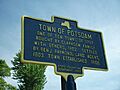
A historic marker for the Town of Potsdam.
-
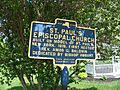
The historic marker for St. Paul's Episcopal Church in Waddington.
