
Sonoran coral snake facts for kids
Quick facts for kids Micruroides euryxanthus |
|
|---|---|
 |
|
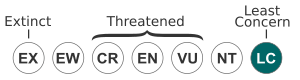
| Conservation status | |
Scientific classification  |
|
| Kingdom: | Animalia |
| Phylum: | Chordata |
| Class: | Reptilia |
| Order: | Squamata |
| Suborder: | Serpentes |
| Family: | Elapidae |
| Genus: | Micruroides K.P. Schmidt, 1928 |
| Species: |
M. euryxanthus
|
| Binomial name | |
| Micruroides euryxanthus (Kennicott, 1860)
|
|
| Script error: The function "autoWithCaption" does not exist. | |
| Synonyms | |
|
|
Script error: No such module "Check for conflicting parameters".

The Sonoran coral snake (scientific name Micruroides euryxanthus) is a small, colorful, and venomous reptile. It belongs to the family Elapidae, which also includes famous cobras and mambas. Scientists place it in its own special genus called Micruroides. Because it is the only species in this group, scientists call it a monotypic group. The snake is also known by the common name western coral snake or Arizona coral snake. In Mexican Spanish, people call it coralillo. This reptile lives in the dry areas of the southwestern United States and northwestern Mexico.
Contents
What Does the Sonoran Coral Snake Look Like?

The Sonoran coral snake is a slender animal that usually grows between 11 and 24 inches long. Its body features bright bands of red, black, and white or yellow. These colorful bands go all the way around its body, though they look a bit lighter on its belly.
The reptile has a blunt, black head. The dark color covers its snout and extends back past its eyes to the parietal scales on its skull. Right behind this black head band, you will see a ring of white or yellow. Next comes a bright red ring, followed by another light ring and a black ring.
Herpetologists, who are scientists that study reptiles, count scales to identify different snakes. This snake has smooth dorsal scales arranged in 15 rows across the middle of its back. On its belly, it has between 214 and 241 wide ventral scales. Under its tail, it has 21 to 34 subcaudal scales that come in pairs. The protective anal plate over its waste opening is divided into two pieces.
This species looks very similar to its eastern cousin, Micrurus fulvius. However, the Sonoran coral snake has wider white or yellow rings. It also has fewer black rings on its tail, usually having only two. Another easy clue is that the first colored body ring behind its light neck ring is red, while in Micrurus fulvius that first ring is black.
Where Does the Sonoran Coral Snake Live?
This colorful reptile makes its home across a wide range in North America. It lives from central Arizona and southwestern New Mexico down south to Mazatlán in Sinaloa, Mexico. Naturalists have found isolated groups living in the Chocolate Mountains of western Arizona's La Paz County. Others live on Tiburón Island, a rugged island located in the Gulf of California.
The snake thrives in arid and semiarid wild places. Its favorite habitat includes rocky upland deserts, dry plains, and lower mountain slopes. It can live anywhere from sea level all the way up to 5,800 feet high in the hills.
Scientists recognize three different subspecies:
- Micruroides euryxanthus euryxanthus, first described by Kennicott in 1860, living in southern Arizona, New Mexico, Chihuahua, and northern Sonora.
- Micruroides euryxanthus australis, described by Zweifel and Norris in 1955, found in southern Sonora and southwestern Chihuahua.
- Micruroides euryxanthus neglectus, described by Roze in 1967, living further south in Sinaloa.
Secretive Habits and Hunting Diet
Daily Behavior
The Sonoran coral snake is a very shy creature that spends most of its life underground. It burrows beneath loose soil, hides in deep rock crevices, or rests under fallen desert plants. Because the desert sun gets extremely hot, it is mainly active during cool nights. However, a gentle summer rain shower will often coax it out to explore during the daytime.
Hunting and Diet
When it gets hungry, this small hunter searches for other small, slender creatures. Its main prey consists of tiny, blind burrowing snakes from the genus Rena. It also hunts other small ground snakes from several different genera, including ground snakes in Sonora, black-headed snakes in Tantilla, and sand snakes in Chilomeniscus. In addition to snakes, it will occasionally catch small lizard species like smooth-scaled skinks.
Defense and Venom Power
Unusual Defense Strategy
Because this snake is so small, bigger predators sometimes try to attack it. When it feels threatened or startled, it will quickly tuck its head safely beneath its coiled body. Then, it lifts its tail and curls it into a tight knot to confuse enemies.
While holding this defensive pose, the snake makes a loud, popping sound. It forces air quickly out of its cloaca, which is the body opening used for waste and reproduction. This noisy habit is called cloacal popping. Along with the surprising sound, the snake releases a very unpleasant odor that helps drive curious predators away.
Venom Strength
The Sonoran coral snake has neurotoxic venom, which means its toxins affect the nervous system of its prey. This venom is extremely potent. Even though its venom is powerful, the snake is small and has tiny, fixed fangs at the front of its mouth. Because of its tiny size, the snake produces only a tiny drop of liquid when biting. No human deaths have ever been reported from its bite. Still, people should always treat wild snakes with respect and admire them from a safe distance.
Reproduction and Life Cycle
Like many other coral snake species in the New World, such as members of Micrurus and Leptomicrurus, this reptile is oviparous. This means the female reproduces by laying eggs rather than giving live birth.
An adult female typically lays up to 3 eggs during the late summer months. She hides them carefully in moist soil or inside sheltered underground spots. When the tiny babies hatch, each young snake measures about 7 to 8 inches long. They emerge with the exact same bright red, yellow, and black colors as their parents, completely ready to begin life on their own.
