
Termite facts for kids
Quick facts for kids Termite |
|
|---|---|
 |
|
| Formosan subterranean termite (Coptotermes formosanus) Soldiers (red-coloured heads) Workers (pale-coloured heads) |
|
Scientific classification  |
|
| Kingdom: | Animalia |
| Phylum: | Arthropoda |
| Class: | Insecta |
| Cohort: | Polyneoptera |
| Superorder: | Dictyoptera |
| Order: | Blattodea |
| Infraorder: | Isoptera Brullé, 1832 |
| Families | |
|
|
Termites are amazing social insects, often called "white ants" because they live in large groups. But they are actually related to cockroaches! These tiny creatures are super important for our planet. They help break down dead plants and wood. Termites live in huge colonies, from a few hundred to millions of individuals. They build incredible homes, some even taller than a house!
Contents
- Termites: Tiny Builders of the Insect World
- Images for kids
- See also
Termites: Tiny Builders of the Insect World
Termites are part of a group called Isoptera. This name comes from Greek words meaning "equal wings." It describes how their front and back wings are usually the same size. They are known for eating dead plant material like wood, leaves, and soil. There are almost 3,000 different kinds of termites known today.
Termites evolved from cockroaches a long time ago. Scientists believe this happened during the Late Jurassic period. This was around the time of the dinosaurs! Termites and a type of wood-eating cockroach, Cryptocercus, are very closely related. They even share similar social behaviors.
Where Do Termites Live?
Termites live almost everywhere on Earth, except for very cold places like Antarctica. You'll find the most types of termites in warm, tropical areas. In places like Africa, they make up a huge part of all animal life! They are vital for recycling dead plants and wood. This helps keep the environment healthy.
Termites like different kinds of homes. Some prefer damp wood, some dry wood, and others live underground. For example, the West Indian drywood termite is an invasive species in Australia.
| Asia | Africa | North America | South America | Europe | Australia | |
|---|---|---|---|---|---|---|
| Estimated species | 435 | 1,000 | 50 | 400 | 10 | 360 |
What Termites Look Like
Most termites are small, usually between 4 and 15 millimeters long. But some queens, like those of Macrotermes bellicosus, can grow much larger. They can be up to 15 centimeters (6 inches) long!
Many worker and soldier termites are blind. They don't have eyes. But some species, like Hodotermes mossambicus, have compound eyes. These help them tell sunlight from moonlight. Winged termites (called alates) have eyes and simple eyes called ocelli.
Termites have antennae that help them feel, taste, smell, and detect heat and vibrations. Their mouths have strong jaws called mandibles. These help them chew wood and other tough plant materials. Most termites have soft, flexible bodies. This is especially true for their bellies, which often look see-through.
Their bodies have three main parts: the head, thorax, and abdomen. Each of the three parts of the thorax has a pair of legs. Winged termites have two pairs of wings on their thorax. These wings are usually the same length.
Termites have ten segments on their abdomen. They also have two short feelers called cerci at the end.


How Termite Colonies Work: The Caste System
Termites live in highly organized societies. They have different groups, or "castes," each with a special job. These castes include workers, soldiers, and reproductives (the king and queen). Unlike ants, bees, and wasps, termites develop gradually. Young termites can change their roles as they grow.
Workers: The Busy Bees of the Colony
Worker termites do most of the work in the colony. They find food, store it, and take care of the young. They also maintain the nest. Workers are responsible for digesting the cellulose in wood. They feed other termites in the colony through a process called trophallaxis. This helps share nutrients and special gut microbes. Workers can be male or female.
Soldiers: The Colony's Protectors
Soldier termites are specialized for defense. They have large heads and strong jaws. These jaws are often so big that soldiers cannot feed themselves. Workers must feed them. Some soldiers have a special "fontanelle" on their heads. This gland sprays defensive chemicals at enemies.
Soldiers use different ways to fight. Some bite, some slash, and some snap their jaws. Others, called "nasutes," have a horn-like nozzle. They spray sticky, toxic liquids at invaders. Soldiers are usually sterile and cannot reproduce.

King and Queen: The Colony's Founders
The king and queen are the primary reproductives. The queen's main job is to lay eggs. Unlike ants, the king and queen stay together for life. They continue to mate throughout their lives. In some species, the queen's abdomen swells up greatly. This allows her to lay many more eggs. Some queens can live for 30 to 50 years!
When a colony is ready, the queen produces winged males and females. These are called "alates." They leave the nest in large swarms to start new colonies. If a king or queen dies, other termites in the colony can sometimes develop into new reproductives. This ensures the colony can continue.

The Termite Life Cycle
A termite's life begins as an egg. They go through a process called incomplete metamorphosis. This means they change gradually, without a pupa stage like butterflies. Young termites are called larvae. They are very dependent on workers for food.
Larvae can develop into alates (winged adults), soldiers, or workers. The time it takes to grow depends on food, temperature, and colony size. Special chemicals called pheromones control which role a termite will take. This prevents too many termites from becoming queens.
Queens can sometimes have babies without a king. This creates new queens that are copies of themselves. This helps the colony grow or replace a lost queen.


What Termites Eat
Termites are mostly detritivores. This means they eat dead plants and decaying materials. They are like nature's recyclers! They break down dead wood, leaves, and even animal waste. Many termites eat cellulose, which is a tough fiber found in plants.
To digest cellulose, termites have special helpers in their guts. These are tiny microbes like bacteria and protozoa. These microbes produce enzymes that break down the food. Termites are also known to eat dead animals sometimes. This helps them get extra nutrients.
Some termites, like Gnathamitermes tubiformans, change their diet with the seasons. They might eat different types of grass depending on the time of year.
Some termite species are "farmers." They grow special fungi called Termitomyces in their nests. They feed the fungi with their waste. Then they eat the fungi, which are full of protein. This amazing farming technique helps them get more food.


Who Eats Termites?
Termites are a popular meal for many animals! They are eaten by birds, mammals, reptiles, and amphibians. Even other insects, like spiders and centipedes, hunt them.
Aardvarks, anteaters, and pangolins love to eat termites. Sloth bears break open mounds to find them. Even chimpanzees use tools to "fish" termites out of their nests!
Ants are one of the biggest enemies of termites. Some ant species specialize in hunting termites. For example, Megaponera ants raid termite nests for hours. They carry many termites back to their own nests. Other ants, like Tetramorium uelense, use their stingers to paralyze small termites.
_and_Winged_Termite_prey_(12640038823).jpg)


Termite Defenses and Communication
Termites are mostly blind, so they use other ways to communicate. They use chemicals, vibrations, and touch. This helps them find food, build nests, recognize each other, and fight enemies.
Talking with Chemicals
One common way termites communicate is through their antennae. They also use special chemicals called pheromones.
- Alarm pheromones warn others about danger.
- Trail pheromones help workers follow paths to food.
When workers find food, they leave a trail of pheromones. Other termites follow this scent to the food source.
_(8439859723).jpg)
Protecting the Colony
Termites have many ways to defend their homes. When a nest is attacked, soldiers bang their heads. This warns other termites and calls for help. Some soldiers block tunnels with their large heads. They might even burst themselves open to release sticky fluids. This traps invaders like ants.
Termites can also tell if a nestmate is sick. They avoid infected termites to stop diseases from spreading. They sometimes carry dead termites away from the nest. This is called necrophoresis and helps keep the colony healthy.

Termite Homes: Nests and Mounds
A termite nest is like a city for termites. It has two parts: the living termites and the structure itself. Termites build their homes using materials like soil, wood, and even their own waste.
Nests can be underground (hypogeal), above ground (epigeal), or in trees (arboreal). Most termites build underground colonies. Primitive termites often live inside logs or dead parts of trees.
Nests protect termites from drying out, light, diseases, and predators. Some nests, called carton nests, are made from digested wood and termite waste. These can be very strong and rain-resistant.
Amazing Termite Mounds
If a nest sticks out of the ground, it's called a mound. Mounds offer even more protection than underground nests. Some mounds are incredibly large. Macrotermes termites build mounds up to 8 or 9 meters (26 to 29 feet) tall! That's like a three-story building!
Some mounds have unique shapes. The "compass termite" (Amitermes meridionalis) builds wedge-shaped mounds. These mounds point north-south. This special design helps control the temperature inside the mound. It keeps the termites cool during the hot midday sun.
-
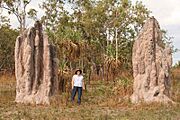
Cathedral mounds in the Northern Territory, Australia
-
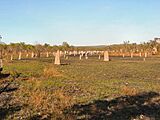
Mounds of "compass" or "magnetic" termites (Amitermes) oriented north–south, thereby avoiding mid-day heat
-
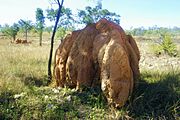
Termite mound in Queensland, Australia
-
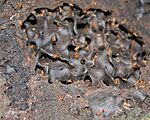
Termites in a mound, Analamazoatra Reserve, Madagascar
-
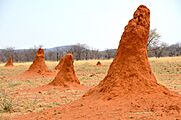
Termite mound in Namibia


Shelter Tubes: Hidden Pathways
Termites also build "shelter tubes" or "mud tubes." These are tunnels made of soil and waste. They start from the ground and can go up walls or other structures. These tubes protect termites from predators, especially ants. They also keep the termites safe from dry air and light. Shelter tubes allow workers to reach food sources they couldn't get to otherwise.

Termites and Humans
Termites have many different impacts on humans, both good and bad.
Termites as Pests
Termites are famous for damaging buildings and wooden structures. They eat wood from the inside, so you might not know they are there until the damage is serious. Out of over 3,000 species, about 180 cause damage. Only 83 species cause serious harm to buildings.
In Australia, termites cause more damage to homes than fires, floods, and storms combined. This costs over $1.5 billion AUD each year. Termites can also damage crops and fruit trees.
Scientists are always looking for new ways to control termites. This includes using special chemicals or tracking their movements. In 2021, the UK successfully got rid of a termite colony. This was the first time a country had completely eradicated termites!
.jpg)


Termites as Food
In many parts of the world, termites are eaten by people. They are a good source of protein and fat. This is especially important in places where food is scarce. People collect winged termites (alates) when they swarm after rain. They often roast or fry them. They are said to taste like nuts!
Termites are eaten in Africa, Asia, and parts of North and South America. Some researchers even think termites could be food for astronauts in space!
Termites in Agriculture
Termites can be pests in farming, especially in Africa and Asia. They can damage crops like corn, cotton, and fruit trees. However, termites can also be helpful to agriculture. Their tunnels in the soil help rainwater soak in. This reduces soil erosion. They also add nitrogen to the soil, which helps plants grow better.
Termites in Science and Culture
Termites have inspired many scientific and technological advancements.
- Biofuel: Scientists are studying termite guts. The microbes inside can turn wood into hydrogen, a clean energy source!
- Robots: The complex mounds termites build have inspired robots. These robots can construct structures on their own. This could be useful for building on Mars or creating flood barriers.
- Architecture: The way termites control mound temperature has inspired buildings. The Eastgate Centre in Zimbabwe uses a termite-inspired cooling system. This helps keep the building cool without air conditioning.
In some African cultures, termites are important symbols. They are also used in traditional medicine to treat various illnesses. In Southeast Asia, people sometimes worship abandoned termite mounds. They believe spirits live inside them and pray for good luck.
Images for kids
-
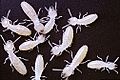
Scientists have developed a more affordable method of tracing the movement of termites using traceable proteins.
-

The pink-hued Eastgate Centre in Zimbabwe, inspired by termite mounds.
-
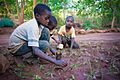
Mozambican boys collecting flying termites.
-

These flying alates were collected as they came out of their nests.


See also
 In Spanish: Isoptera para niños
- Mound-building termites
- Stigmergy
- Termite shield
- Xylophagy
