
David's myotis facts for kids
Quick facts for kids David's myotis |
|
|---|---|
| Conservation status | |
Scientific classification  |
|
| Kingdom: | Animalia |
| Phylum: | Chordata |
| Class: | Mammalia |
| Order: | Chiroptera |
| Family: | Vespertilionidae |
| Genus: | Myotis |
| Species: |
M. davidii
|
| Binomial name | |
| Myotis davidii Peters, 1869
|
|
 |
|
| Script error: The function "autoWithCaption" does not exist. | |
Script error: No such module "Check for conflicting parameters".
David's myotis (scientific name: Myotis davidii) is a tiny bat. It belongs to a group of bats called microbats, which are part of the Vespertilionidae family. These bats live in countries like China, Mongolia, Kazakhstan, and Russia. A scientist named Wilhelm Peters first identified this bat in 1869. For a while, people thought it was just a type of whiskered bat.
Contents
What Does David's Myotis Look Like?
David's myotis is a small bat. Its forearm, which is part of its wing, is less than 36 millimeters long. Their wing membrane connects to the base of their outer toe.
Special Features
- Their ears are brown. The inside of their ears and the base of the tragus (a small flap in the ear) are lighter brown, sometimes even pink.
- The back edge of their ear has a clear dip or curve.
- Their fur has dark bases and lighter tips. It often looks like it has a golden shine.
- Adult bats do not have yellowish-brown hair on the sides of their neck. This makes the color of their belly and back fur look very different.
- Their nose often looks like a heart shape.
Their Teeth
- The second upper premolar tooth is quite small. It's usually less than half the size of the first upper premolar.
- Sometimes, this tooth is slightly out of line with the other teeth.
- The third upper premolar tooth has a small or missing cusp (a pointy part). It is always lower than the second upper premolar.
Where Do David's Myotis Bats Live?
David's myotis bats are mostly found in China. They live in provinces like Hebei, Hubei, Inner Mongolia, Shaanxi, Shanxi, and even Hong Kong.
Expanding Their Range
Recently, these bats have been found much farther north. They have been seen in Siberia and the Southern Urals in Russia. The most northern place they were found was in Bashkortostan, Russia.
How Are They Protected?
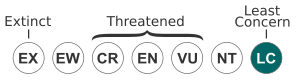
The International Union for Conservation of Nature (IUCN) lists David's myotis as a "Least Concern" species. This means they are not currently in danger of disappearing. However, the IUCN's map of where these bats live does not yet include the newer sightings in the southern Urals.
