
Image: Global-inequality-in-1800-1975-and-2015
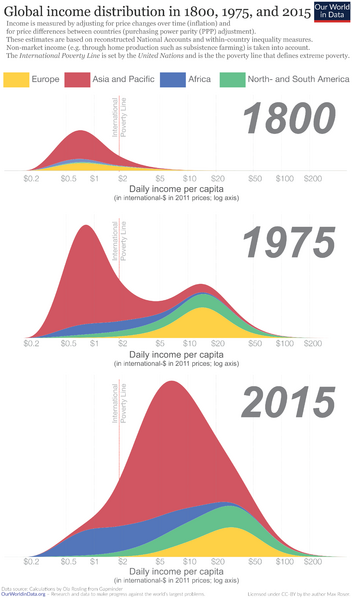


Description: Global divergence followed by convergence The chart shows estimates of the distribution of annual income among all world citizens over the last two centuries. To make incomes comparable across countries and time, daily incomes are measured in international-$ — a hypothetical currency that would buy a comparable amount of goods and services that a U.S. dollar would buy in the United States in 2011 (for a more detailed explanation, see here). The distribution of incomes is shown at 3 points in time: By 1800, few countries had achieved economic growth. The chart shows that most of the world lived in poverty with an income similar to today's poorest countries. At the beginning of the 19th century, the vast majority—roughly 80%—of the world lived in material conditions that we would refer to as extreme poverty today. In 1975, 175 years later, the world had changed—it had become very unequal. The world income distribution was 'bimodal', with the two-humped shape of a camel: one hump below the international poverty line and a second hump at considerably higher incomes. The world had divided into a poor, developing world and a developed world more than 10-times richer.
Over the following 4 decades, the world income distribution has again changed dramatically. There has been a convergence in incomes: in many poorer countries, especially in South-East Asia, incomes have grown faster than in rich countries. While enormous income differences remain, the world can no longer be neatly divided into 'developed' and 'developing' countries. We have moved from a two-hump to a one-hump world. And at the same time, the distribution has also shifted to the right—the incomes of many of the world's poorest citizens have increased, and extreme poverty has fallen faster than ever before in human history.
Author: Max Roser
Usage Terms: Creative Commons Attribution-Share Alike 3.0
License: CC-BY-SA-3.0
License Link: http://creativecommons.org/licenses/by-sa/3.0/
Attribution Required?: Yes
Image usage
The following page links to this image:

