
Newton's laws of motion facts for kids
Newton's laws of motion are three rules that explain how things move. These laws describe the relationship between an object and the forces acting on it. They were first written by Isaac Newton in 1687.
These laws are the foundation of classical mechanics. This is the study of how objects move in our daily lives. Scientists use these rules to understand everything from a falling apple to a rocket launch.
Contents
Newton's Laws of Motion: How Everything Moves
The First Law: The Law of Inertia

The first law is often called the Law of Inertia. It is all about how objects behave when forces act on them. It says:
- If something is still, it will stay still. If something is moving, it will keep moving at the same speed and in the same direction. This will happen until a resultant force pushes or pulls it.
What does "uniform velocity" mean? It means an object is moving at a steady speed without changing its direction. Think of a car driving perfectly straight at 50 miles per hour.
What is a "resultant force"? This means the pushes and pulls on an object are not balanced. If you push a box, and someone else pushes it just as hard in the opposite direction, the forces are balanced, and the box won't move. But if your push is stronger, there's a resultant force, and the box will move.
So, the first law tells us two main things:
- A still object will only start to move if an unbalanced force acts on it.
- A moving object will only speed up, slow down, or change direction if an unbalanced force acts on it.
Let's look at an example. Imagine a table sitting on the floor. It stays still, right? That's because the forces on it are balanced. Gravity pulls the table down, but the floor pushes it up with an equal force. Since these forces are balanced, the table doesn't move.
Now, think about a ball rolling across a flat floor. It eventually slows down and stops. Why? Because of friction and air resistance. These are forces that push against the ball, slowing it down. If there were no friction or air resistance (like in outer space), a ball would keep rolling forever in a straight line once it started moving!
The Second Law: Force and Acceleration
Newton's second law explains how force, mass, and acceleration are connected. It states:
- The resultant force on an object is equal to its mass multiplied by its acceleration.
This law gives us a way to calculate force. It tells us that:
- If you apply a bigger force to an object, it will accelerate more (speed up faster).
- If an object has more mass (is heavier), it will accelerate less when the same force is applied. Think about pushing a small toy car versus pushing a real car!
We can write this as a simple formula:

Here, F stands for force, m stands for mass, and a stands for acceleration.
For example, your weight is a force caused by Earth's gravity. We can calculate weight using a similar idea:

In this formula, W is your weight, m is your mass, and g is the acceleration due to gravity. On Earth, g is about 9.8 meters per second squared. This means that if you drop something, its speed increases by 9.8 meters per second every second!
The Third Law: Action and Reaction
.jpg)
Newton's third law is often stated as:
- For every action, there is an equal and opposite reaction.
This means that forces always come in pairs. When one object pushes on another, the second object pushes back on the first with the same amount of force, but in the opposite direction.
Let's look at some examples:
- When you kick a football, your foot pushes the ball forward. At the same time, the ball pushes back on your foot with an equal force, which is why you feel it!
- Think about a fish swimming. The fish pushes water backward with its fins. In return, the water pushes the fish forward, making it move through the water. The push on the water is the "action," and the push back on the fish is the "reaction."
- When a car drives, its wheels spin and push the road backward. The road then pushes the wheels (and the car) forward. This "action-reaction" pair is what makes cars move!
Forces always happen in these pairs. You can't have a single force acting alone.
Famous Scientists Who Studied Motion
Isaac Newton and the Principia
Isaac Newton was an English scientist who lived in the 17th century. He published his laws in a book called Philosophiæ Naturalis Principia Mathematica. This is often just called the Principia.
Newton used math to prove his ideas. He showed that the same rules apply on Earth and in space. This was a huge discovery for science at the time.
Galileo and Descartes
Before Newton, other scientists had similar ideas. Galileo Galilei studied how objects fall. He realized that things do not just stop on their own.
René Descartes also wrote about inertia. He said that objects want to move in straight lines. Newton took these ideas and turned them into the three laws we use today.
Physics in the Real World
Gravity and Falling Objects

Gravity is a force that pulls objects toward each other. On Earth, it pulls everything down toward the ground. Newton's laws help us calculate how fast things fall.
In a vacuum (where there is no air), all objects fall at the same speed. A feather and a hammer would hit the ground at the same time. This is because gravity acts on them equally.
How Rockets Fly into Space
Rockets are a perfect example of Newton's third law. They carry a lot of fuel to create a powerful push. As the fuel burns, it creates gas that shoots out the back.
This "action" creates a "reaction" that lifts the heavy rocket. Because the rocket loses mass as it burns fuel, it actually speeds up faster. This is explained by the second law.
Images for kids
-
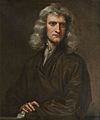
Isaac Newton was a famous scientist who lived in the 1600s.
-
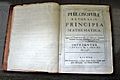
This is Newton's famous book where he wrote his laws.
-
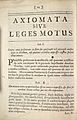
The original laws were written in Latin.
-
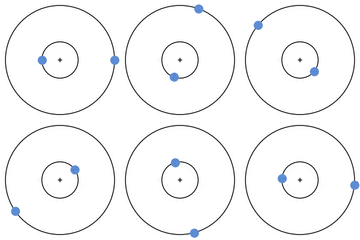
Gravity keeps objects orbiting around each other.
-
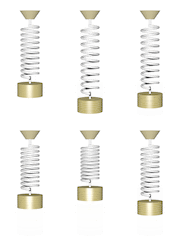
Springs show how forces can cause back-and-forth motion.
-

Rockets lose mass as they burn fuel.
-

A fan on a boat is a great way to study forces.
-
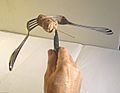
Every object has a center of mass where it balances.
-
Predicting the motion of three objects is very difficult.
-
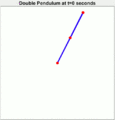
Small changes can lead to very different results in motion.
-
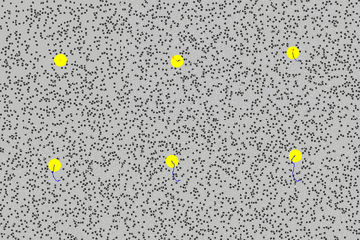
Tiny particles move randomly when hit by even smaller atoms.
-
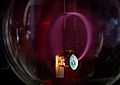
Magnetic fields can make charged particles move in circles.
-

Emmy Noether discovered how math and physics are connected.
-
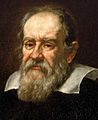
Galileo studied motion before Newton was born.
-
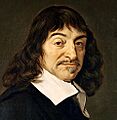
Descartes helped define the idea of inertia.
-
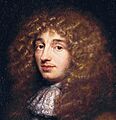
Huygens studied how objects collide and bounce.
-
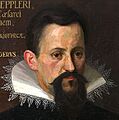
Kepler discovered how planets move in space.


2.jpg)
.jpeg)
.jpg)
See also
 In Spanish: Leyes de Newton para niños
- Euler's laws of motion
- History of classical mechanics
- List of eponymous laws
- List of equations in classical mechanics
- List of scientific laws named after people
- List of textbooks on classical mechanics and quantum mechanics
- Norton's dome
