
Anglo-Persian capture of Qeshm facts for kids
Quick facts for kids Capture of Qeshm |
|||||||||
|---|---|---|---|---|---|---|---|---|---|
| Part of Safavid–Portuguese conflicts | |||||||||
 Portuguese fortress of Qeshm |
|||||||||
|
|||||||||
| Belligerents | |||||||||
 Safavid Persia Safavid Persia East India Company East India Company |
 Portugal Portugal |
||||||||
| Commanders and leaders | |||||||||
| Imam Quli Khan Abdullah Hussain Khan Edward Monnox William Baffin † |
Rui Freire de Andrade |
||||||||
| Strength | |||||||||
| 25,000 Persians 400 boats 9 English ships |
3,000 men | ||||||||
| Casualties and losses | |||||||||
| Heavy | Heavy | ||||||||
The Capture of Qeshm was a big event where English and Persian forces worked together. They successfully took over the Portuguese fort on Qeshm Island after many months of fighting.
Contents
Why it Happened
Portugal's Goals in the Persian Gulf
In 1619, Philip III of Spain wanted to keep Portugal strong in the Persian Gulf. He sent ships to the area. One group, led by Rui Freire de Andrade, had orders to remove the English. They also had to protect Hormuz Island from a possible Persian attack. Rui arrived at Hormuz in June 1620 with two large ships and three smaller ones. He had 2,000 soldiers and 178 cannons.
Growing Tensions
By December 1620, Shah Abbas of Persia tried to calm the Portuguese. He said his dealings with the English were nothing to worry about. But the Portuguese in Goa knew the English would not stop trading in the Persian Gulf. A battle happened on January 7, 1621, near Jask. Rui's ships fought an English fleet of four vessels. The English won this battle.
After this defeat, Rui focused on his second goal: protecting Hormuz from a Persian invasion. To do this, he decided to build a fort on Qeshm Island. This fort would secure the water supply for Hormuz. However, building a fort on Qeshm gave the Persians a reason to attack the Portuguese. Shah Abbas protested this action. Rui was warned not to build the fort, but he ignored these warnings. This was his first big mistake.
Getting Ready for Battle
Persian and Portuguese Forces Gather
On May 7, 1621, a Portuguese force of 2,000 men, helped by 1,000 soldiers from Hormuz, defeated some Persians. The Persians had tried to stop them. After this, the Persians gathered a huge army of 25,000 men. They also had 400 Arab boats along the coast. Abdullah Hussain Khan led the Persians. He was sent by Imam Quli Khan, who was in charge of the whole campaign for Shah Abbas.
While Rui was building the fort, two more Portuguese ships arrived from Goa. These ships were commanded by Manuel de Azevedo and John de Silveira. They were rivals of Rui and had orders to limit his power. Later, these two captains left the island.
Rui's Actions and Their Consequences
After the other captains left, Rui started attacking and looting coastal cities. These included Kong, Jask, and Julfar. His actions made the local tribes on both the Persian and Arabian coasts very angry. Instead of gaining their support, he turned them against the Portuguese.
The Capture of Qeshm

The Long Siege
The Persians surrounded Qeshm for about nine months, from June 1621 to February 1622. They suffered many losses in several attacks, but the fort did not fall. The Persian commanders realized they needed to control the sea around the fort. They decided to ask the English for help.
Nine English ships arrived at Jask from Surat on December 26, 1621. Imam Quli Khan used this chance to pressure the English. He offered them rewards for their help. But he also threatened to take away all their trading rights in Persia if they refused.
English Join the Fight
Rui ordered a Portuguese attack on Jask. This attack destroyed the English trading post there. This was Rui's second big mistake. It made the English even more determined to fight against the Portuguese.
Despite everything, the English agent in Persia, Edward Monnox, agreed to help. The English joined the siege of Qeshm in January 1622. Edward and Rui talked, but they could not agree. Rui reminded Edward that he was helping non-Christians against Christian forces. Edward replied by mentioning the destruction of the English trading post at Jask.
Rui refused to give up, and the fort was bombarded. The attacks did not do much damage. However, the soldiers inside the fort rebelled against Rui. With encouragement from the priests, they surrendered the fort in February 1622.
Rui and his men were sent to Surat as prisoners. But Rui managed to escape to Muscat. The local soldiers who helped the Portuguese had a bad fate. The Persians had promised them safety, but many were killed. Both sides broke the terms of surrender.
What Happened Next
The fall of Qeshm to the English-Persian alliance was very important. Qeshm was a key place for storing supplies for Hormuz. When Qeshm fell, it was the first step towards a crisis for Hormuz. It cut off one of the main water sources for the soldiers and people living in Hormuz.
See Also
- Safavid–Portuguese conflicts
- Hormuz Island
- East India Company
Images for kids
-
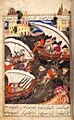
Persian drawing of a battle between Persians and Portuguese
