
Bharatanatyam facts for kids
 |
|
| Genre | Indian classical dance |
|---|---|
| Origin | Tamil Nadu, India |
Bharatanatyam is a beautiful and ancient Indian classical dance form. It comes from Tamil Nadu, a state in India. This dance is known for expressing deep spiritual ideas and stories, especially from Hinduism. It is a classical dance style recognized by important cultural organizations in India.
Bharatanatyam uses a special style with a steady upper body, bent legs, and flexed knees. Dancers use their feet, hands, eyes, and face muscles to create a sign language. The dance is performed with live music and a singer. Often, the dancer's teacher, called the guru, guides the performance.
Contents
How Bharatanatyam Got Its Name
The word Bharatanatyam has a special meaning. Some people believe it comes from three Sanskrit words:
- Bha for bhavam (feelings or emotions)
- Ra for ragam (melody or musical notes)
- Tam for talam (rhythm)
So, Bharatanatyam means a dance that beautifully shows feelings, melody, and rhythm together!
Another idea is that the name means "the dance of Bharata." This refers to an ancient wise person named Bharata. He wrote an important book about performing arts called the Natya Shastra.
In 1932, the dance was officially renamed Bharatanatyam from its older name, Sadiraattam. This was done to give this ancient art form more respect and recognition.
The Story of Bharatanatyam: An Ancient Art
.jpg)
Bharatanatyam has a very long history, going back thousands of years! Ideas for this dance are found in ancient texts like the Natya Shastra, written between 500 BCE and 500 CE. Another old Tamil story, Silappatikaram (around 2nd century CE), also talks about dance training.
Temple sculptures from the 6th to 9th centuries show that dance was a highly developed art form in India a long time ago. Many poses in Bharatanatyam are similar to those seen in ancient sculptures of the Hindu god Shiva in temples. These carvings show 108 different dance poses.
For many centuries, Bharatanatyam was mainly performed in Hindu temples. Dancers, sometimes called Devadasis (meaning "servants of the gods"), dedicated their lives to this art. They performed for religious ceremonies and festivals.
_(14146091479).jpg)

Challenges and Revival of the Dance

When the British colonial government ruled India, they did not fully understand or appreciate Indian classical dances. They viewed these traditional art forms as unsuitable and tried to stop them.
In 1910, the British government in the Madras region officially banned temple dancing. This was a difficult time for Bharatanatyam, and the dance began to decline.
However, many people in India were upset by this ban. They believed a valuable part of their culture was being unfairly targeted. Brave individuals, like E. Krishna Iyer, a lawyer, worked hard to protect and revive Bharatanatyam. He argued that the dance was a beautiful art form, not something to be banned.
During India's fight for independence in the early 20th century, there was a strong movement to rediscover and celebrate Indian culture. Artists like Rukmini Devi Arundale and Balasaraswati played a huge role in bringing Bharatanatyam back to the stage, outside of temples. They helped make it popular again across India.
Today, Bharatanatyam is celebrated worldwide as a rich and important part of Indian heritage.
What Makes Bharatanatyam Special?

Bharatanatyam is traditionally performed by a solo dancer. Musicians and singers accompany the dancer. This dance is considered "classical" because its movements, music, and expressions follow ancient rules. These rules are described in texts like the Natya Shastra and Abhinaya Darpana.
The solo dancer, called ekaharya, wears a colorful sari and beautiful jewelry. They perform a dance synchronized with Indian classical music. The hand and facial gestures are a coded sign language. This language can tell legends and spiritual ideas from stories like the Mahabharata and Ramayana.
In modern performances, Bharatanatyam dance groups may have many dancers. They play specific characters in a story. This helps the audience understand and enjoy the performance even more.
The Three Types of Dance
Bharatanatyam performances have three main parts, each with a different focus:
- Nritta (Pure Dance): This part is all about fast, rhythmic movements. There is no story being told here. It focuses on the beauty of motion, form, speed, and patterns. It is meant to be visually exciting!
- Nritya (Expressive Dance): This is where the dancer tells a story or expresses feelings. These often have spiritual themes in Hindu dance traditions. The dancer uses hand gestures and body movements to communicate words and meanings, set to musical notes. It aims to engage the audience's emotions and mind.
- Natya (Drama): This involves acting out a play or a story. It can be a solo performance or a group effort. The dancer uses specific body movements to show different characters in the story. A Natya includes elements of Nritya.
The Arangetram: A Special Debut

An arangetram is a very important solo performance for a Bharatanatyam dancer. It means "ascending the stage." This event marks the completion of their first stage of formal training.
This special debut usually happens after ten to twelve years of learning. It takes place when the teacher (guru) feels the student is ready for a solo performance. It is like a "coming-of-age" celebration. The arangetram shows the dancer's hard work and skill developed over many years.
During an arangetram, the dancer performs a series of dances. They must build up their concentration and stamina to perform solo for about three hours. Each dance often represents different aspects of Hinduism.
The Dance Sequence

A traditional Bharatanatyam arangetram follows a specific order of dances, called Margam. There are usually seven to eight parts:
- Pushpanjali: The performance typically begins with an "offering of flowers." The dancer offers flowers and salutations to the Hindu deities, the guru, and the audience as a sign of respect.
- Alarippu: This is a rhythmic warm-up dance. It combines a thank you and a blessing from the gods and goddesses, the guru, and the performance team. It helps the dancer loosen their body and focus.
- Jatiswaram: This stage adds melody to the movements of Alarippu. It is a technical dance, pure in form, without any expressed words. Drums set the beat, and the dancer performs sequences to the rhythm.
- Shabdam: Here, words and expressions are introduced for the first time. The solo dancer, vocalist, and musicians present short compositions with words and meaning. This performance praises gods like Krishna, Shiva, Rama, and Murugan.
- Varnam:

This is the longest and most important part of the performance. It can last 30-45 minutes or even an hour. The artist tells the main story or composition. They use codified gestures and footwork, harmoniously with the music and rhythm. The dancer performs complicated moves, telling a story of love or a battle between good and evil.
- Padam: This stage is about reverence and simplicity. It focuses on abhinaya (expression) of a solemn spiritual message or devotional prayer. The music is lighter, and the dance is emotional.
- Tillana: The performance sequence ends with this exciting, rhythmic piece. It returns to the nritta style, with a series of pure movement and music performed rhythmically. This brings the performance to a thrilling close.
- Shlokam or Mangalam: The very last item in the sequence is a prayer for blessings on all the people.
The Dancer's Look

The costume of a female Bharatanatyam dancer resembles a traditional Tamil Hindu bridal dress. It usually includes a sari in bright colors with golden or silver embroidery. The costume is often stitched into separate pieces for comfort and movement. These include pants or a skirt, a pleated piece that opens like a hand fan when the dancer bends their knees, and a top.
Male Bharatanatyam dancers usually wear a sari or a white cotton cloth draped around their legs like a dhoti. Their upper body typically remains bare during performances.
Costumes and Jewelry
Both female and male dancers wear elaborate jewelry on their ears, nose, neck, and wrists. Female dancers wear additional head jewelry that emphasizes their hairline. They also wear smaller pieces on each side of their hair parting, representing the sun and the moon.
Long hair on both male and female dancers is secured by a bun or a braid. Female dancers with short hair often use extensions or hair pieces to create the look of long hair. They also wear imitation flowers, called gajra, around their braids or buns.
Makeup and Bells
All dancers wear makeup, including foundation, blush, lipstick, and thick eyeliner or kohl. This helps the audience clearly see and understand their facial expressions.
Dancers wear leather anklets on each foot, called salangai or ghungroos. These have small bells attached to a strap. The bells jingle with every foot movement, emphasizing the rhythm of the music and the dancer's footwork.
Finally, all dancers outline their hands and feet with red kumkum powder or alta. This tradition helps the audience easily see their hand and foot gestures.
Music and Instruments of Bharatanatyam
The accompanying music for Bharatanatyam is in the Carnatic music style of South India. The vocalist, called nattuvanar, often conducts the entire performance. They may also be the dancer's teacher and play cymbals. The recited verses and text in Bharatanatyam are in Tamil and Sanskrit.
The instruments used include:
- The mridangam (a double-sided drum)
- The nadaswaram (a long type of oboe made from black wood)
- Nattuvangam (cymbals)
- The flute
- The violin
- The veena (a string instrument)
The Meaning Behind the Moves
Bharatanatyam, like all classical dances of India, uses symbolism in its abhinaya (acting) and its goals. The roots of abhinaya are found in the Natya Shastra text. It describes drama as something that brings joy to the viewer through the actor's art of communication.
The communication through symbols uses expressive gestures and pantomime set to music. These gestures and facial expressions convey the ras (sentiment, emotional taste) and bhava (mood) of the story. The dancer successfully expresses spiritual ideas by focusing on four aspects:
- Angika (gestures and body language)
- Vachika (song, recitation, music, and rhythm)
- Aharya (costume, makeup, jewelry)
- Sattvika (the dancer's emotional connection with the story and audience)
Hand Gestures: Mudras


The gestures used in Bharatanatyam are called Hasta or mudras. These symbols are like words. They are used in different ways:
- Asamyuta hastas (single hand gestures)
- Samyuta hastas (two hand gestures)
- Nrtta hastas (dance hand gestures)
In the nritya part of Bharatanatyam, these symbols, when put in a certain order, become sentences with meaning. Emotions are expressed through facial expressions and other acting techniques. The basic standing position in Bharatanatyam is called Aramandi.
Bharatanatyam also includes many poses found in modern yoga. These include Dhanurasana (the bow pose) and Natarajasana (the pose of dancing Shiva). This shows a connection between dance and physical discipline.
In Cinema
- Senthamarai (Tamil, 1962)
- Thillana Mohanambal (Tamil, 1968)
- Paattum Bharathamum (Tamil, 1975)
- Sagara Sangamam (Telugu, 1983)
- Mayuri (Telugu, 1985)
- Manichitrathazhu (Malayalam, 1993)
- Sringaram (Tamil, 2007)
- Kamaladalam (Malayalam, 1992)
- Kochu Kochu Santhoshangal (Malayalam)
Images for kids
-
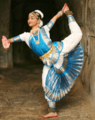
A female dancer doing the Natraja pose
-
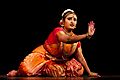
Bharatanatyam is an Indian classical dance originated in Tamil Nadu.
-
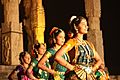
Dancers at Thanjavur, Brihadeshwara temple dedicated to Shiva. The temple has been a major center for Bharatanatyam since about 1000 CE. Bharatanatyam has a huge effect in South Indian peoples' life, parents teach their children this dance form since their childhood and children take this legacy forward to further generations. People of India are proud of this culture.
-
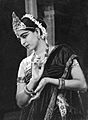
Rukmini Devi Arundale, here in 1940, helped revive Bharatanatyam after Hindu temple dancing was banned by the British colonial government in 1910.
-
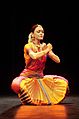
Bharatanatyam requires expression, posture and rhythm.
-
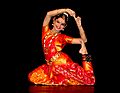
Costumes in Bharatanatyam
-
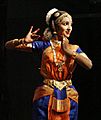
An expression through gesture in Bharatanatyam.
-
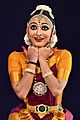
A female Bharatanatyam dancer making an expression.
-
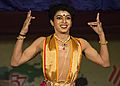
A male Bharatanatyam dancer making an expression.
-
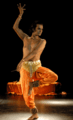
Raja Reddy, a popular Bharatanatyam and Kuchipudi dancer.
-
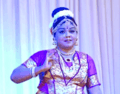
A dancer performing the pose of Goddess Meenakshi
-
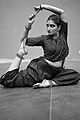
A Bharatanatyam dancer striking a pose during practice
-
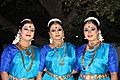
A group of female Bharatanatyam dancers.
-
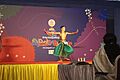
Bharatanatyam Performance at School Kalolsavam 2026, Thrissur


.jpg)


_2-Manas_C_Krishnna.jpg)
See also
 In Spanish: Bharatanatyam para niños
