
Perinet leaf chameleon facts for kids
Quick facts for kids Perinet leaf chameleon |
|
|---|---|
 |
|
| Conservation status | |
| Scientific classification | |
| Genus: |
Brookesia
|
| Species: |
therezieni
|
 |
|
The Perinet leaf chameleon, known scientifically as Brookesia therezieni, is a small lizard. It belongs to the family of chameleons. This special chameleon lives only in the eastern part of Madagascar.
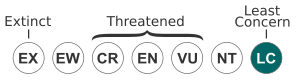
Scientists first described B. therezieni as a new species in 1970. The International Union for Conservation of Nature (IUCN) has listed this species as "Least Concern". This means it is not currently in great danger, even though its population is slowly decreasing.
Contents
About the Perinet Leaf Chameleon
The scientific name, therezieni, was chosen to honor a French scientist. His name was Yves Thérézien, and he studied water life.
Where it Lives
The Perinet leaf chameleon is found only in eastern Madagascar. Its main home is a place called Périnet, which is why it's called the Perinet leaf chameleon.
It also lives in other areas of east-central Madagascar. These places include An'Ala, Ankeniheny, Andasibe, Anjanaharibe, Mantadia, and Imerimandroso. These chameleons live in forests. They can be found at heights between 900 and 1,500 meters (about 2,950 to 4,920 feet) above sea level. Their total living area is quite large, covering about 30,444 square kilometers (about 11,754 square miles).
How it Reproduces
The Perinet leaf chameleon reproduces by laying eggs. This means it is an oviparous animal.
Its Conservation Status
The International Union for Conservation of Nature (IUCN) keeps track of how many animals are left in the wild. They have listed the Perinet leaf chameleon as "Least Concern" on their Red List of Threatened Species.
This is because the chameleon lives across a very large area. Also, there isn't enough proof to show that its numbers are dropping very quickly. However, the total number of these chameleons is indeed going down.
How it Was Discovered
Brookesia therezieni was first described by two scientists in 1970. Their names were Édouard-Raoul Brygoo and Charles Antoine Domergue. According to the Integrated Taxonomic Information System, this species is officially recognized and valid.
