
Chief's Beads facts for kids

Imagine a tiny, bright blue glass bead that was super important hundreds of years ago! These special beads are called Chief's beads. Native American tribes on the West Coast of North America and around the Columbia River called them "ti-a, co-mo-shack". They were used for trading in the late 1700s and early 1800s.
Native American tribes really wanted these blue beads. They liked them much more than beads of other colors. This shows how valuable the blue Chief's beads were. After the famous Lewis and Clark Expedition explored America from 1803 to 1806, Captain Meriwether Lewis said something important. He said if he went back, he would make sure half or even two-thirds of his trading items were these blue beads!
Chief's beads were usually about the size of a small berry or a large pea. They were rarely perfectly round. Each bead weighed about 2 or 3 carats. People traded these beads by the "fathom" (about six feet) or by the yard.
How Were Chief's Beads Made?
Chief's beads were made in three main ways. Each method created a slightly different type of bead. These methods were:
- Reed-wound beads from China
- Furnace-wound beads from Bavaria
- Wire-wound beads from many other places
Reed-Wound Beads
Reed-wound beads were often made in small workshops in China. First, reeds (like tall grass stems) were soaked in a special clay mix. Then, two people would spin the reed. Another person would carefully drip hot, melted glass onto the spinning reed.
Once the hot beads were on the reed, they were laid in a clay bed to cool down. After they were cool, the beads were taken off the reeds. This way of making beads was used for a very long time, from the 700s AD until the 1930s.
Furnace-Wound Beads
Most furnace-wound beads came from a place called Bavaria. To make these, workers used an iron rod. This rod was covered with a special clay called kaolin. This clay helped the beads slide off easily.
The rod was dipped into hot, melted glass. Workers would then take small amounts of glass and shape them into beads. They would slide these beads down the rod. The beads were then put into a warm place to cool slowly. This method might have started as early as the 700s AD and was still used in the late 1960s.
Wire-Wound Beads
Wire-wound beads are made using the oldest method of bead making. This method is still used today! A worker can dip a small amount of melted glass from a hot source using a special tool called a mandrel. Then, they roll the glass to form a bead.
Another way is to use two rods. One rod dips the glass, and the other rod is used to wind the glass around it. The rods get a dark coating from the fire, which helps the beads come off easily. This often gives wire-wound beads a dark brown center.
-
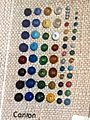
Reed-wound beads.
-
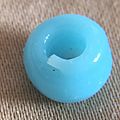
Example of a furnace-wound bead.
-
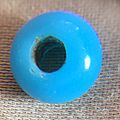
Example of a wire-wound bead.


