
Contrast (vision) facts for kids
Contrast is the difference in brightness or color that makes something stand out. It helps your eyes tell objects apart from their background. Imagine trying to find a dark toy in a dark room; it's hard because there's low contrast. A bright toy would be much easier to spot because of the higher contrast. Our eyes are very good at noticing these differences, even when the overall light in a room changes a lot.
Contents
What is Contrast?

Contrast is the difference in luminance (brightness) or color that makes an object visible. It helps us see things clearly against their surroundings. Think about reading a book: black letters on a white page have high contrast, making them easy to read. If the letters were light gray on a white page, it would be much harder.
The biggest difference between the brightest and darkest parts of an image is called its contrast ratio. When an image has very high contrast, making one part stand out more might make another part less clear. For example, making dark areas brighter can help you see details there. But it might also make the already bright areas look washed out.
How Our Eyes See Contrast
Our eyes are amazing at detecting contrast. They are designed to pick up differences in light and dark, or in colors. This ability helps us understand the world around us. Scientists have studied how our eyes respond to different patterns. They found that our eyes are best at seeing patterns with a medium amount of detail.

Our eyes have tiny cells called photoreceptor cells. These cells are packed together on the back of our eye, in a layer called the retina. The way these cells are arranged helps us see fine details. When light hits these cells, they send signals to our brain.
The Eye's Amazing Design
The cells in our retina work together in a special way. Some cells get excited by light, while others get inhibited (slowed down). This "center-surround" design helps our brain focus on the edges and differences between objects. It's like having a built-in filter that highlights the important changes in brightness. This is why we can still see things clearly even if the lighting changes a lot.
Measuring Contrast
Scientists and engineers often need to measure contrast accurately. There are different ways to do this, depending on what they are studying. Some methods focus on brightness differences, while others also include color.


One common idea behind measuring contrast is to look at the difference in brightness compared to the average brightness. For example, a small difference in light might be very noticeable in a dim room. But the same small difference might not be noticed at all on a very bright, sunny day.


Different formulas are used for different situations. For example, one method is used when a small object is on a large, plain background. Another method is used for patterns with equally bright and dark parts, like stripes. These measurements help people design better screens, cameras, and lighting.
Why Contrast Matters for Vision

Contrast sensitivity is how well your eyes can see faint differences in light and dark. It's a very important part of good vision. This ability changes as people get older. It usually gets strongest around age 20. After that, it slowly decreases. Some eye conditions, like cataracts, can also reduce contrast sensitivity.
For example, if you look at the image with the changing stripes (called a "sweep grating"), you'll notice that some stripes are easier to see than others. Our eyes are best at seeing stripes that are not too wide and not too narrow. If you move further away from the image, the stripes that were originally wide might become easier to see. This is because the distance changes how your eyes perceive the size of the stripes.
Seeing Details vs. Seeing Differences
Visual acuity is what most people think of as "20/20 vision." It measures how well you can see tiny details, like reading small letters on an eye chart. However, visual acuity is usually tested with very high contrast, like black letters on a white background.

But seeing details isn't the whole story. You might have 20/20 vision but still struggle to see things in low contrast. For example, someone with an eye condition like glaucoma might read the eye chart perfectly. But they might have trouble driving at night or seeing steps in dim light. This is because their contrast sensitivity is reduced. They can't easily tell the difference between faint shades of gray.
Tests for Contrast Vision
Eye doctors use special tests to check a person's contrast sensitivity. Instead of just showing smaller and smaller letters, these tests show letters or patterns that get fainter and fainter. One common test uses letters that are all the same size but become lighter and lighter gray on a white background.
Another type of test uses parallel bars, like stripes, that change in width and contrast. The doctor asks the patient to identify these patterns. These tests help doctors understand how well a person's visual system works in different lighting conditions. They can show if someone has difficulty seeing in situations where contrast is low, even if their regular vision seems fine.
Test Images
Doctors use specific charts to measure contrast sensitivity:
- Pelli-Robson Contrast Sensitivity Chart
- Regan chart
- Arden grating chart
- Campbell-Robson Contrast Sensitivity Chart
Images for kids
-
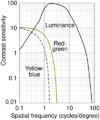
This graph shows how our eyes detect different types of contrast.
-
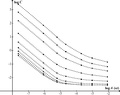
A graph showing how much contrast is needed to see objects at different light levels.

See also
- Acutance
- Color blindness
- Contrast ratio
- Display contrast
- Eye examination
- Optical resolution
- Psychophysics
- Radiocontrast
- Spatial frequency
- Visual acuity
