
Image: Anomalocaris eye
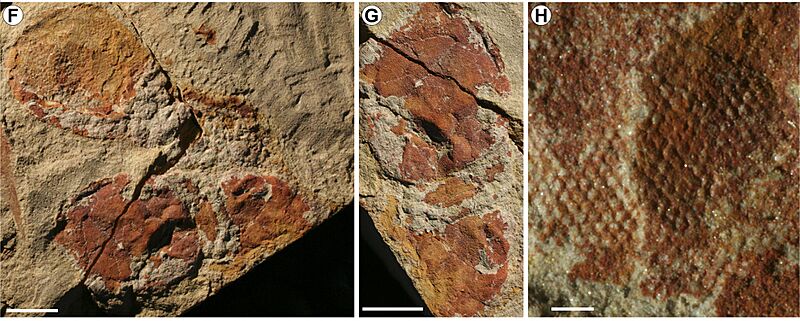


Description: FIGURE 6. Radiodont cephalic structures with importance for understanding the evolution of Euarthropoda. (A–B) Hurdia victoria from the Burgess Shale, showing the enlarged cephalic carapace with the eyes on stalks protruding from the ocular notches of the central and lateral carapace elements. USNM 274159. (A) Whole specimen in lateral view. (B) Closeup on the eyes and their relation to the cephalic carapace. (C) Central cephalic carapace element of Hurdia victoria from the Burgess Shale. USNM 57718, holotype. (D) Central cephalic carapace element of Hurdia triangulata from the Burgess Shale. USNM 57721, holotype. (E) Lateral cephalic carapace element of Hurdia from the Burgess Shale. USNM 274159, previous holotype of Proboscicaris (now synonymised with Hurdia). (F–H) Compound stalked eye of Anomalocaris aff. canadensis from the Emu Bay Shale, Australia. SAM P45920. (F) View showing both eyes. (G) Closeup on the lower of the two eyes. (H) Closeup showing the ommatidia. (I–K) Sessile acute zone-type eye of “Anomalocaris” briggsi from the Emu Bay Shale, Australia. (I) SAM P48377. (J) Eye of P54853. (K) Closeup of the ommatidia in P54853. Image credits: (A–E) A. Daley. (F–K) J. Paterson. Scale bars are 10 mm in (A and C–E), 5 mm in (B,F,G,I and J), 1 mm in (K) and 0.3 mm in (H).
Author: Gaëtan J.-M. Potin and Allison C. Daley
Usage Terms: Creative Commons Attribution-Share Alike 3.0
License: CC-BY-SA-3.0
License Link: http://creativecommons.org/licenses/by-sa/3.0/
Attribution Required?: Yes
Image usage
The following page links to this image:

