
Image: Calculated saros and inex numbers
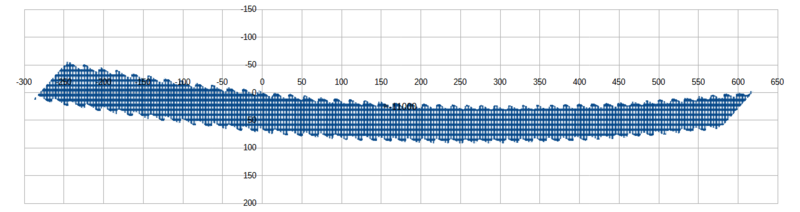


Description: The graph is like the solar eclipse panorama by Luca Quaglia and John Tilley (compare with w:File:Saros-Inex_panorama.png). The saros and inex numbers of an eclipse in every eclipse season from 11,000 BC to AD 15,000 are calculated from a given approximate date. First an index of the eclipse season is calculated as Index = FLOOR((date+2882.55)*2.1074515+0.5), where "date" is the number of Gregorian years since January 1, 1 BC in the proleptic Gregorian calendar. Then for how many times a five-month period separates two targeted eclipses we use the formula N5 = FLOOR(Index/7.62269+1.071-((Index/2.1074515)/16650)^2 - ((Index/2.1074515)/25000)^3 + 0.064 sin((Index-0.78)/0.335427)). (The sine term attempts to account for the deviation of the sun's longitude from its mean longitude.) The saros number for the eclipse is then 5 Index - 38 N5, and the inex number is 8 Index - 61 N5.
The formulae give the saros and inex number for an eclipse near the input date, checked against the spreadsheet of Quaglia and Tilley. Predicted eclipses will be within three months of "date". Sometimes there will be another eclipse one month before or after an eclipse given by these formulas. These appear in the original panorama of Quaglia and Tilley. If a slightly different formula is used for N5 it may give some of those eclipses instead of the ones given by the above N5 formula.
Author: Eric Kvaalen
Usage Terms: Creative Commons Attribution-Share Alike 3.0
License: CC-BY-SA-3.0
License Link: http://creativecommons.org/licenses/by-sa/3.0/
Attribution Required?: Yes
Image usage
The following page links to this image:

