
Eclipse cycle facts for kids

Eclipses do not happen randomly. They occur in specific patterns called eclipse cycles. An eclipse series is a collection of eclipses that happen separated by a specific amount of time.
These cycles help astronomers predict exactly when and where an eclipse will happen, even hundreds of years into the future.
Contents
How Eclipses Work

An eclipse happens when the Earth, the Moon, and the Sun line up in a straight row. When this happens, the shadow of one body falls on another.
- A solar eclipse happens at new moon. The Moon passes between the Earth and the Sun, blocking the Sun's light.
- A lunar eclipse happens at full moon. The Earth passes between the Sun and the Moon, casting a shadow on the Moon.
When the Sun, Earth, and Moon align perfectly, it is called syzygy.
Why Eclipses Are Rare

You might wonder why we don't have an eclipse every single month. After all, there is a new moon and a full moon every month.
The reason is that the Moon's orbit is tilted. It is tipped about 5 degrees compared to the path the Earth takes around the Sun. Because of this tilt, the Moon usually passes a little bit above or a little bit below the Sun from our point of view.
For an eclipse to happen, the Moon must be crossing the Earth's orbital plane. The two points where the Moon's path crosses the Earth's path are called nodes. An eclipse can only occur when the Moon is at a node and it is a full or new moon at the same time.
Repeating Patterns

Because the Moon and Earth move in regular paths, they eventually return to the same positions relative to each other. When the Moon, Earth, and Sun line up in the same way again, an eclipse repeats.
This repetition depends on three different ways of measuring a month:
- Synodic month: The time from one new moon to the next (29.53 days).
- Draconic month: The time it takes for the Moon to return to a node (27.21 days).
- Anomalistic month: The time it takes for the Moon to go from its closest point to Earth (perigee) and back (27.55 days).
When these three cycles sync up, a similar eclipse happens. It is like three runners on a track running at different speeds; eventually, they will all cross the starting line at the same time again.
The Saros Cycle
The most famous and useful eclipse cycle is called the Saros.
A Saros cycle lasts approximately:
- 18 years, 11 days, and 8 hours
After this amount of time, the Moon and Earth return to almost the exact same position in their orbits. This means a very similar eclipse will happen.
However, because of the extra 8 hours, the Earth has rotated an extra one-third of the way around. This means the next eclipse in the series will happen at a different location on Earth, shifted about 120 degrees to the west. It takes three Saros cycles (about 54 years) for an eclipse to return to the same geographic region.
Families of Eclipses


Astronomers group eclipses into "families" or series. Any specific eclipse belongs to a Saros series and an Inex series.
- A Saros series lasts for over 1,000 years. It starts with small partial eclipses near one of the Earth's poles, slowly moves toward the equator producing total or annular eclipses, and then ends with partial eclipses at the opposite pole.
- The Inex is another cycle that helps classify eclipses over very long periods, roughly every 29 years.
By using these numbers, scientists can make maps of all past and future eclipses. The "panorama" image shows thousands of eclipses arranged by their series.
Predicting Future Events

Using these cycles, we can predict eclipses far into the future. For example, the total solar eclipse that happened on April 8, 2024, is part of Saros series 139. The next eclipse in this exact series will happen 18 years, 11 days, and 8 hours later, in the year 2042.
Because of the "8 hours" part of the cycle, the 2042 eclipse will be visible mainly over the Pacific Ocean, rather than North America.
Changes Over Time

Eclipse cycles are very stable, but they do change slowly over thousands of years. This is because the Moon is slowly moving away from Earth, and the Earth's rotation is slowing down very slightly.
- Orbit Changes: The shape of the Earth's orbit and the Moon's orbit changes over millennia.
- Day Length: As the Earth's rotation slows, the length of a day increases by a tiny fraction of a second every century. Over thousands of years, this adds up and changes where an eclipse shadow falls on Earth.
These long-term changes mean that millions of years from now, total solar eclipses will no longer be possible because the Moon will appear too small in the sky to completely cover the Sun.
Images for kids
-
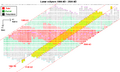
A diagram showing lunar eclipse patterns from the year 1000 to 2500.
-
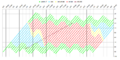
A graph showing the timing of specific solar eclipse series.
-
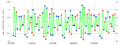
A chart showing the length of the "semester" eclipse interval.
-
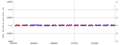
A chart showing the length of the Hipparchic cycle.
-
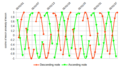
A graph showing the Moon's position during solar eclipses from 2001 to 2040.


See also
