
Image: Comparison angular diameter
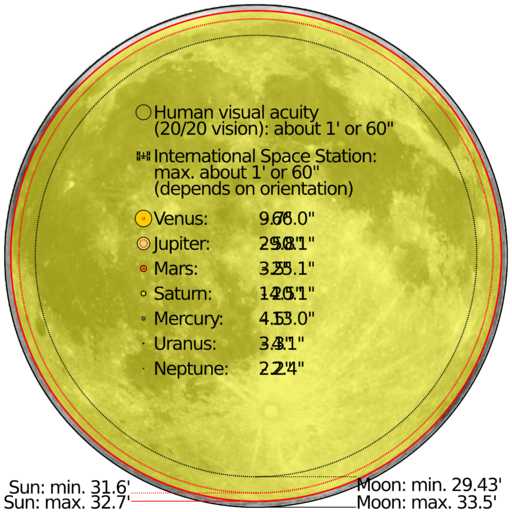


Description: Comparison of angular diameter of the Sun, Moon and planets with the International Space Station and human visual acuity. To get a true representation of the sizes, view the image at a distance of 102.6
[
=
1
tan
(
33.5 60
×
π 180
)
]
{\displaystyle {\begin{bmatrix}={\tfrac {1}{\tan {\big (}{\tfrac {33.5}{60}}\times {\tfrac {\pi }{180}}{\big )}}}\end{bmatrix}}}
times the width of the largest (Moon: max.) circle. For example, if this circle is 10 cm wide on your monitor, view it from 10.26 m away. Planetary angular diameters are from factsheets at http://nssdc.gsfc.nasa.gov/planetary/factsheet/ and Sun/Moon ones are from http://education.gsfc.nasa.gov/eclipse/pages/faq.html
Author: Full Moon as Seen From Denmark.jpg: Peter Freiman derivative work: Cmglee (talk)
Usage Terms: Creative Commons Attribution-Share Alike 3.0
License: CC-BY-SA-3.0
License Link: http://creativecommons.org/licenses/by-sa/3.0/
Attribution Required?: Yes
Image usage
The following page links to this image:

