
Image: Dunkleosteus terrelli size
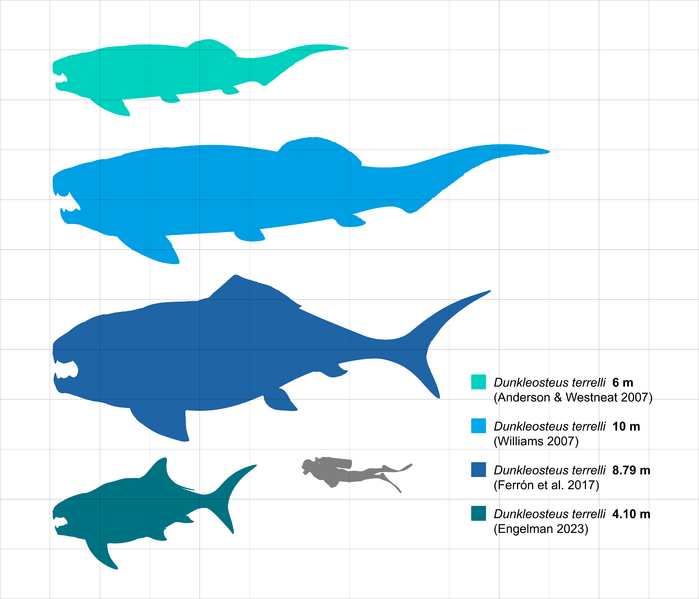


Description: Diagram featuring the multiple size estimations of the large arthrodire placoderm Dunkleosteus terrelli, in comparison with a ~1.8 m (5.9 ft) tall human. Different silhouettes and morphology are explained by: Both Anderson & Westneat 2007 and Williams 2007 provided length estimates for Dunkleosteus without a reliable depiction/reconstruction of the taxon, therefore, the present silhouette is based on outdated depictions of Dunkleosteus based on Coccosteus which were quite common at the time of these publications.[1][2] More recently, both Ferrón et al. 2017 and Engelman 2023 presented different reconstructions for Dunkleosteus, as well as different fin morphologies. As such, their respective reconstructions are reflected here.[3][4] The two first silhouettes are based on the old Dunkleosteus skeletal by Scott Hartman. This skeletal has been updated in his website, featuring a different tail and dorsal fin anatomy. A freely licensed silhouette version of the skeletal is available at PhyloPic under CC BY 3.0.
Color Key Estimate by Anderson & Westneat 2007, at 6 m (20 ft). In their 2007 skull mechanics analysis, the coauthors proposed this estimate for the largest specimen used for bite force testing, but the identity of this specimen is not stated. Could be CMNH 5768 or CMNH 6090.[1] Estimate by Williams 2007, at 10 m (33 ft). This body size is stated without any methodical background.[2] Estimate by Ferrón et al. 2017, at 8.79 m (28.8 ft). As stated by the team, this length (as well as other, smaller lengths) for Dunkleosteus was obtained in a regression analysis between the total body length and upper jaw perimeter of extant sharks, using morphometric data.[3] Later studies show the dimensions of this reconstruction do not match known dimensions of Dunkleosteus fossils.[5] Estimate by Engelman 2023, at 4.10 m (13.5 ft). The author used multiple lines of comparative anatomy, a large dataset of arthrodires and extant fish, as well as a new length estimation method, called orbit-opercular length. This method is shown to strongly predict length across fish from different clades.[4] References
↑ a b (2007). "Feeding mechanics and bite force modelling of the skull of Dunkleosteus terrelli, an ancient apex predator". Biology Letters 3 (1): 76–79. DOI:10.1098/rsbl.2006.0569. PMID 17443970. PMC: 2373817.
↑ a b (2007). "Force feeding". Current Biology 17. DOI:10.1016/j.cub.2006.11.057.
↑ a b (in English) (2017). "Ecomorphological inferences in early vertebrates: reconstructing Dunkleosteus terrelli (Arthrodira, Placodermi) caudal fin from palaeoecological data". PeerJ 5: e4081. DOI:10.7717/peerj.4081. PMID 29230354. PMC: 5723140. ISSN 2167-8359.
↑ a b (2023). "A Devonian Fish Tale: A New Method of Body Length Estimation Suggests Much Smaller Sizes for Dunkleosteus terrelli (Placodermi: Arthrodira)". Diversity 15 (3): 1–54. DOI:10.3390/d15030318.
↑ (in English) (2023). "Giant, swimming mouths: oral dimensions of extant sharks do not accurately predict body size in Dunkleosteus terrelli (Placodermi: Arthrodira)". PeerJ 11: e15131. DOI:10.7717/peerj.15131. PMID 37065696. PMC: 10100833.
Usage Terms: Public domain
Image usage
The following page links to this image:

