
Dunkleosteus facts for kids
Quick facts for kids Dunkleosteus |
|
|---|---|
_(Cleveland_Shale_Member,_Ohio_Shale,_Upper_Devonian;_Rocky_River_Valley,_Cleveland,_Ohio,_USA)_21_(34001200911).jpg) |
|
| Partially reconstructed D. terrelli skull and trunk armor (specimen CMNH 5768), Cleveland Museum of Natural History | |
Scientific classification  |
|
| Unrecognized taxon (fix): | Dunkleosteus |
| Type species | |
| †Dinichthys terrelli Newberry, 1873
|
|
| Species | |
|
List
†D. amblyodoratus Carr & Hlavin, 2010
†D. belgicus (?) (Newberry, 1873) |
|
Dunkleosteus was an ancient, giant armored fish that lived a very long time ago. It existed during the Late Devonian period, about 382 to 358 million years ago. This amazing creature was one of the first super-predators with a backbone. It swam in the open ocean, hunting other large animals.
Scientists have found Dunkleosteus fossils in many places. These include the United States, Canada, Poland, Belgium, and Morocco. There are ten known species of Dunkleosteus. Some of these were among the largest armored fish ever. The most famous and largest species is D. terrelli.
Scientists believe that a typical adult D. terrelli was about 3.4 metres (11 ft) long. Very large ones could reach about 4.1 metres (13 ft). This fish had an incredibly strong bite. It could open and close its jaws very quickly.
Contents
Discovering Dunkleosteus
The first Dunkleosteus fossils were found in 1867. A hotel owner and amateur paleontologist named Jay Terrell discovered them. He found the fossils in cliffs along Lake Erie in Ohio, United States. Terrell gave his finds to John Strong Newberry and the Ohio Geological Survey.
In 1873, Newberry described these fossils. He thought they belonged to a new type of fish. Later, more fossils were found. By 1875, it was clear there were several large fish species. Newberry named the most common species "Dinichthys" terrelli, honoring Jay Terrell. Sadly, most of Terrell's original collection was lost in a fire in 1873.
Today, the largest collection of Dunkleosteus fossils is at the Cleveland Museum of Natural History. Other museums around the world also have specimens. Many of these are casts of a famous fossil, CMNH 5768. This is the largest well-preserved D. terrelli individual. You can see the original CMNH 5768 at the Cleveland Museum of Natural History.
Naming and Family Tree
The name Dunkleosteus was given in 1956 by Jean-Pierre Lehman. It honors David Dunkle, who was a curator at the Cleveland Museum of Natural History. The name combines "Dunkle" with the Greek word for "bone" (ostéon). So, it means "Dunkle's bone."
At first, scientists thought Dunkleosteus was part of the Dinichthys group. But in 1956, they realized it was different enough to have its own group. Later studies showed that Dunkleosteus and Dinichthys were not as closely related as once thought. They belonged to different branches of the armored fish family tree. Dunkleosteus is now in a family called Dunkleosteidae.
_(Cleveland_Shale_Member,_Ohio_Shale,_Upper_Devonian;_Rocky_River_Valley,_Cleveland,_Ohio,_USA)_25_(34091142396).jpg)
Species of Dunkleosteus
Scientists have described at least ten different species of Dunkleosteus. However, many of these are not well-known. Some might even be the same as other species or not truly belong to Dunkleosteus.
- D. terrelli: This is the largest and most famous species. Its skull could be up to 60–70 cm (24–28 in) long. Fossils of D. terrelli have been found in the United States and Europe.
- D. belgicus: This species is known from fossil fragments found in Belgium. Some scientists think it might be a "doubtful name" because the fossils are hard to identify.
- D. denisoni: Known from a small plate, this species had a skull similar to D. marsaisi.
- D. marsaisi: Fossils from Morocco belong to this species. Its skulls were smaller, averaging 35 centimetres (1.15 ft) long. Many researchers believe it might be the same as D. terrelli.
- D. magnificus: This large armored fish was found in New York. Its skull was about 55 cm (22 in) long. The total length was estimated to be around 3 m (9.8 ft).
- D. missouriensis: Known from fragments found in Missouri. It is thought to be very similar to D. terrelli.
- D. newberryi: This species is known from a jawbone found in New York. Some features suggest it might not belong to Dunkleosteus.
- D. amblyodoratus: This species is known from fragments found in Ontario, Canada. Its name means 'blunt spear' because of the shape of its head plates.
- D. raveri: This was a smaller species, possibly about 1 meter long. It had relatively large eyes. Scientists think D. raveri might have been an ancestor to D. terrelli.
- D. tuderensis: This species is known from a jawbone found in Russia.
Out of all these, only D. terrelli, D. raveri, D. tuderensis, and possibly D. amblyodoratus are widely agreed upon as distinct species.

What Dunkleosteus Looked Like
Size and Body Structure
Dunkleosteus had strong armor plates covering its head and the front half of its body. This armor was thickest at the back of its skull, sometimes over 2–3 inches (5.1–7.6 cm) thick. However, most of the armor on its body was thinner, about 0.33–1 inch (0.84–2.54 cm) thick. These plates were made of bone, similar to the bones of land animals.

Most Dunkleosteus fossils only preserve the armored front parts. This means scientists don't know exactly what the back half of the fish looked like. Because of this, many early drawings of Dunkleosteus were based on smaller, more complete armored fish. This led to many different ideas about its size.
Today, the most careful studies suggest that a typical adult D. terrelli was about 3.4 metres (11 ft) long. Very large individuals might have reached 4.1 metres (13 ft). These estimates are based on comparing the known armored parts to other armored fish.
Scientists have also studied the fins and backbone of Dunkleosteus. Its backbone was very stiff in the front part of its body. This, along with its strong muscles, suggests that Dunkleosteus might have been a fast swimmer, similar to modern tuna or sharks.


Scientists have also estimated the weight of Dunkleosteus. A typical adult, about 3.41 metres (11.2 ft) long, might have weighed between 950–1,200 kilograms (2,090–2,650 lb). The largest individuals, around 4.1 metres (13 ft) long, could have weighed 1,494–1,764 kilograms (3,294–3,889 lb). These weights are higher than earlier estimates because armored fish often had deeper and wider bodies than sharks.
Life of Dunkleosteus
Diet

Dunkleosteus terrelli had a special jaw system. It allowed the fish to open its mouth very quickly. Early studies suggested it might have used "suction feeding," like some modern fish that suck in their prey. However, more recent research from 2025 questioned this idea.
Scientists now think Dunkleosteus likely bit and tore its prey into pieces. Its jaws had blade-like edges instead of teeth. These were perfect for cutting through tough armor. This suggests it hunted other armored fish and creatures like ammonites. Dunkleosteus lived in open water, where suction feeding on large prey is difficult.
Fossils show that Dunkleosteus often ate other fast-swimming fish. It would frequently spit out bones it couldn't digest. This means it was a powerful and active hunter.
Reproduction
Dunkleosteus, like many other armored fish, might have been one of the first vertebrates to fertilize eggs internally. This means the eggs were fertilized inside the female's body. Some other armored fish fossils show signs of giving birth to live young, similar to some modern sharks. This is called viviparity.
Growth
.jpg)
.jpg)

Studies of young D. terrelli jaws show they were just as strong as adult jaws. This means that even young Dunkleosteus could bite with great force. They were likely able to hunt and tear apart tough prey from a young age, just like the adults, but on a smaller scale. This is different from many land animals, where young animals often have weaker jaws than adults.
Images for kids
-
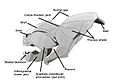
Labelled skull diagram of D. terrelli
-
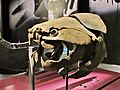
D. marsaisi skull


See also
 In Spanish: Dunkleosteus para niños
- List of placoderms
