
Image: X-rays blast from a solar flare ESA517028
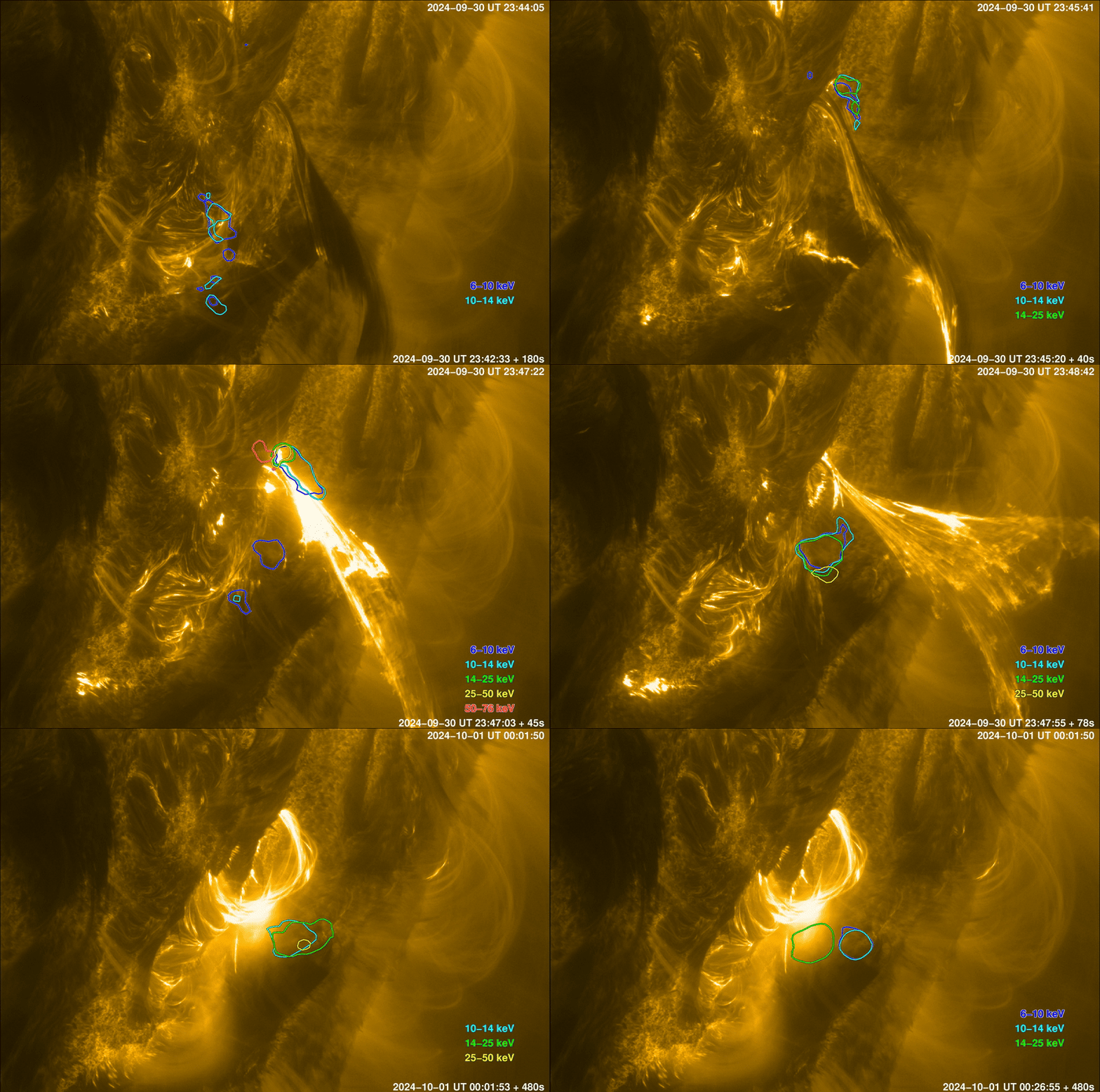

Description: This video shows the evolution of X-ray emission during the M7.7 class solar flare recorded by the ESA-led Solar Orbiter spacecraft in high resolution on 30 September 2024.The coloured contours outline the X-ray source regions detected by Solar Orbiter’s X-ray Spectrometer/Telescope (STIX) at the measured levels indicated in the key, superposed on top of the images recorded by the mission’s Extreme Ultraviolet Imager (EUI).EUI images plasma at ~1 million degrees, but STIX samples much hotter regions, which is why some of the contours appear not to correlate directly with features visible in the EUI imagery.High energy X-ray emission forms at locations where particles deposit their energy, providing a signature of accelerated particles during the magnetic reconnection events that lead up to a flare.The emission in ultraviolet to X-rays was already slowly rising when STIX first started observing the region. The X-ray emission rose so dramatically during the flare itself – as reconnection events increased – that particles were accelerated to speeds of 40–50% the speed of light, equivalent to about 431–540 million km/h. Furthermore, the instruments showed an increase in energy transfer from the magnetic field to the surrounding plasma, through these reconnection events. After the main phase of the flare, the original cross-shape of magnetic field lines is seen to relax in the EUI images, while STIX shows the energy decrease towards ‘normal’ levels.Read moreSolar Orbiter is a space mission of international collaboration between ESA and NASA, operated by ESA. The Extreme Ultraviolet Imager (EUI) instrument is led by the Royal Observatory of Belgium (ROB). The STIX X-ray Spectrometer/Telescope is led by FHNW, Windisch, Switzerland.[Image description: A GIF showing a close-up image of the Sun's surface, with mottled dark black and bright yellow patches. Yellow arches and streaks of light give an impression of the Sun being very active. Dark blue, light blue, green, yellow and red contour lines indicate X-ray emission of increasing energy.]
Author: European Space Agency
Usage Terms: Creative Commons Attribution-Share Alike 3.0
License: CC-BY-SA-3.0
License Link: http://creativecommons.org/licenses/by-sa/3.0/
Attribution Required?: Yes
Image usage
The following page links to this image:

