
Solar Orbiter facts for kids

Artist's impression of the Solar Orbiter orbiting the Sun
|
|
| Mission type | Heliophysics |
|---|---|
| Operator | ESA / NASA |
| Mission duration | 7 years (nominal) + 3 years (extended) Elapsed: 6 years, 8 months and 11 days |
| Spacecraft properties | |
| Manufacturer | Airbus Defence and Space |
| Launch mass | 1,800 kg (4,000 lb) |
| Payload mass | 209 kg (461 lb) |
| Dimensions | 2.5 × 3.1 × 2.7 m (8 × 10 × 9 ft) |
| Power | 180 watts |
| Start of mission | |
| Launch date | 10 February 2020, 04:03 UTC |
| Rocket | Atlas V 411 (AV-087) |
| Launch site | Cape Canaveral, SLC‑41 |
| Contractor | United Launch Alliance |
| Entered service | November 2021 (start of main mission) |
| Orbital parameters | |
| Reference system | Heliocentric |
| Regime | Elliptic orbit |
| Perihelion | 0.28 AU (42 million km; 26 million mi) |
| Aphelion | 0.91 AU (136 million km; 85 million mi) |
| Inclination | 24° (nominal mission) 33° (extended mission) |
| Period | 168 days |
| Main | |
| Type | Ritchey–Chrétien reflector |
| Diameter | 160 mm |
| Focal length | 2.5 m |
| Wavelengths | Visible light, ultraviolet, X-rays |
 ESA insignia (2020s) Cosmic Vision (Science Programme)
|
|
The Solar Orbiter (often called SolO) is a special spacecraft. It was built by the ESA with help from NASA. Its main job is to study our Sun up close. It helps scientists understand the Sun's outer atmosphere, called the heliosphere, and the constant stream of particles it sends out, known as the solar wind.
This amazing probe flies closer to the Sun than any other spacecraft before it, getting as close as 0.284 AU. That's even closer than the planet Mercury! From this unique position, Solar Orbiter can take detailed pictures and measurements, especially of the Sun's north and south poles. These areas are very hard to see from Earth. The mission launched on 10 February 2020 from Cape Canaveral, Florida, USA. Its main mission is set to run until the end of 2026, with a possible extension until 2030.


Contents
Exploring the Sun's Secrets
The Solar Orbiter's journey began with a "cruise phase" that lasted until November 2021. During this time, the spacecraft used a clever trick called "gravity assist." It flew close to Venus twice and Earth once. This helped it change its path and speed, guiding it closer to the Sun. While traveling, it also tested its instruments. The first time it flew very close to the Sun was on 26 March 2022.
The spacecraft's orbit is special. It's designed to meet Venus regularly. Each time it passes Venus, it uses the planet's gravity to tilt its orbit. This allows Solar Orbiter to get a better view of the Sun's poles. For example, after its Venus flyby in 2025, its orbit tilted to 17 degrees. If the mission continues, it could tilt even more, up to 33 degrees!
Solar Orbiter gets very close to the Sun about every six months. These close approaches let scientists study the same parts of the Sun's atmosphere again and again. This helps them watch how magnetic activity builds up. This activity can cause huge explosions like solar flares or eruptions.
Scientists also work with NASA's Parker Solar Probe mission. Both spacecraft gather data at the same time. This gives researchers a more complete picture of the Sun. They also combine their findings with powerful telescopes on Earth, like the Daniel K. Inouye Solar Telescope.
Why Do We Study the Sun?
The main goal of Solar Orbiter is to take very detailed pictures and measurements of the Sun. It also studies the space around the Sun, called the inner heliosphere. This mission helps us answer big questions like:
- Where do the Sun's magnetic fields and the solar wind come from in its outer atmosphere, the corona?
- How do sudden events on the Sun affect the space around it?
- How do solar eruptions create powerful particles that spread throughout the Solar System?
- How does the Sun's internal "dynamo" work? How does it connect the Sun's inside to the space around it?
Meet the Solar Orbiter Spacecraft
The Solar Orbiter spacecraft is built to face the Sun directly. It has a special heat shield to protect it from the Sun's intense heat and radiation. This shield is super important when the probe gets very close to the Sun. The spacecraft carries 21 different sensors. These sensors are carefully placed to either study the Sun from a distance or measure the space around it.
Solar Orbiter uses some clever technology from other missions. For example, its solar arrays (the "wings" that collect sunlight for power) are similar to those on ESA's BepiColombo mission. These solar arrays can even turn to avoid getting too hot when the spacecraft is near the Sun. A battery pack also helps power the spacecraft, especially when it passes behind a planet and can't get sunlight.
How Solar Orbiter Talks to Earth
Solar Orbiter sends its findings back to Earth using a special communication system. It uses antennas to send and receive signals. There are small antennas for emergencies and bigger ones for sending lots of data.
The main antenna is designed to work even when it's very hot near the Sun. It can point in different directions to connect with ground stations on Earth. Sometimes, it even folds behind the heat shield for protection. Because it can't always send data, Solar Orbiter stores information on board. Then, it sends everything back to Earth when it has a good connection.
Scientists on Earth receive this data at special centers. These include the Mission Operations Centre in Germany and the Science Operations Centre in Spain. They use a network of ground stations, like the ones in Argentina, Australia, and Spain, to stay in touch with Solar Orbiter.
Solar Orbiter's Scientific Tools
Solar Orbiter carries 10 special instruments. These tools help it gather all the information about the Sun and its surroundings. They are divided into two main groups:
Instruments for Measuring Space Around the Sun
These four instruments measure the space environment directly around the spacecraft.
- SWA (Solar Wind Plasma Analyser): This tool measures the plasma (super-hot gas) that makes up the solar wind. It checks its speed, temperature, and what it's made of.
- EPD (Energetic Particle Detector): This detector counts and studies fast-moving particles. These particles are shot out by the Sun. It helps us understand where they come from.
- MAG (Magnetometer): This instrument measures the magnetic field in space. It helps scientists see how the Sun's magnetic field spreads out into the Solar System.
- RPW (Radio and Plasma Waves): This unique tool measures electric and magnetic waves in the solar wind. It helps understand how the Sun's atmosphere gets so hot.
Instruments for Looking at the Sun
These six instruments take pictures and study the Sun from a distance.
- PHI (Polarimetric and Helioseismic Imager): This imager takes high-resolution pictures of the Sun's surface. It measures magnetic fields and how the surface moves. This helps us study the Sun's inside.
- EUI (Extreme Ultraviolet Imager): This camera takes pictures of the Sun's atmosphere using ultraviolet light. It shows us the layers above the surface. It's the first to image the Sun's poles in UV!
- SPICE (Spectral Imaging of the Coronal Environment): This tool uses extreme ultraviolet light to study the Sun's corona. It helps match what we see on the Sun to the solar wind particles.
- STIX (Spectrometer Telescope for Imaging X-rays): This instrument takes X-ray images of the Sun. It helps scientists study solar flares and other hot events on the Sun.
- Metis (Coronagraph): This tool takes pictures of the Sun's outer atmosphere, the corona. It blocks out the bright Sun to see the fainter corona. This helps link events on the Sun to what happens in space.
- SoloHI (Solar Orbiter Heliospheric Imager): This imager takes wide-angle pictures of the solar wind. It helps spot huge clouds of material, called coronal mass ejections, as they leave the Sun.
_(24967051097).jpg)

Solar Orbiter's Journey and Discoveries


Before Launch
The contract to build Solar Orbiter was given to Astrium UK in April 2012. The spacecraft's solar shield passed a two-week heat test in June 2014. After some delays, the spacecraft was ready for launch in February 2019. It was shipped to Germany for final tests in September 2018.
Launch
The Atlas V rocket carrying Solar Orbiter lifted off from Cape Canaveral, Florida, on 10 February 2020. This happened at 04:03 UTC. The spacecraft separated from the rocket almost an hour later. ESA received the first signals from Solar Orbiter shortly after.
Cruise Phase
After launch, Solar Orbiter entered its cruise phase, which lasted until late 2021. It used repeated gravity assists from Earth and Venus to reach its working orbit. This orbit is elliptical, meaning it's not a perfect circle.
In June 2020, Solar Orbiter flew within 77 million kilometers of the Sun. It captured the closest pictures of the Sun ever taken at that time. During its journey, it even flew through the tails of two comets: C/2019 Y4 (ATLAS) in June 2020 and C/2021 A1 Leonard in December 2021.
In August 2021, Solar Orbiter had its second Venus flyby. This happened just 33 hours before another ESA spacecraft, BepiColombo, also flew past Venus. Both spacecraft studied Venus's magnetic environment. This gave scientists unique data from two different locations at the same time.
Nominal Mission Phase
The main mission is planned for seven years. During this time, Solar Orbiter will use more gravity assists from Venus. These flybys will tilt its orbit from 0° to 24°. This gives it a much better view of the Sun's poles. If the mission is extended, the tilt could increase even further to 33°.
Discoveries in 2022
On 7 March 2022, Solar Orbiter took the highest resolution image of the Sun's full disk and outer atmosphere (the corona) to date. In September 2022, scientists used Solar Orbiter data to suggest a solution to the mystery of "magnetic switchbacks." These are sudden flips in the Sun's magnetic field.
Later in October 2022, Solar Orbiter worked with the Daniel K. Inouye Solar Telescope on Earth. They made coordinated observations of the Sun. This showed how combining data from space and Earth can help answer big scientific questions. In 2022, Solar Orbiter also teamed up with the Parker Solar Probe to study why the Sun's atmosphere is so much hotter than its surface.
Discoveries in 2024
In March 2024, both Solar Orbiter and Parker Solar Probe made their closest approaches to the Sun. Parker Solar Probe was at 7.3 million km, and Solar Orbiter was at 45 million km. Solar Orbiter observed the Sun, while Parker Solar Probe measured the solar wind directly. This allowed scientists to compare data from both probes.
In mid-May 2024, a very active sunspot region, AR3664, caused the biggest solar storm to hit Earth in over 20 years. Solar Orbiter observed this region in late May when it was facing away from Earth. It recorded the strongest solar flare of solar cycle 25 on 20 May. After this, its instruments detected a surge of fast ions and electrons. The spacecraft's Metis instrument also saw a coronal mass ejection. By combining observations from Solar Orbiter and NASA's Solar Dynamics Observatory, scientists tracked this active region for 94 days. This was the longest such series of observations ever.
On 30 September 2024, during its ninth close pass to the Sun, Solar Orbiter observed a powerful M7.7-class solar flare. It used several instruments to capture this event. This provided the most detailed recording of a large solar flare so far. It allowed scientists to see a "magnetic avalanche" building up just minutes before the flare.
Discoveries in 2025
In February 2025, Solar Orbiter successfully completed its fourth Venus flyby. This tilted its orbit to 17 degrees, moving it out of the main orbital plane of the Solar System. On 11 June 2025, the mission released its first images and videos of the Sun's south pole. These were taken in March 2025 and are the first images of the Sun's poles from outside the ecliptic plane.
In September 2025, scientists published a catalogue of solar energetic electrons. They used data from Solar Orbiter to identify two types of these electrons. One type is linked to intense solar flares, and the other to coronal mass ejections.
In November 2025, scientists shared early results from the March 2025 observations of the Sun's south pole. Data showed that the Sun's magnetic field drifts towards the poles at about 10 to 20 meters per second. This speed is similar to what is seen at lower latitudes, which was a surprise to researchers.
Events in 2026
Between 19 and 23 January 2026, ISRO and ESA held a workshop in Thiruvananthapuram. They presented data from Aditya-L1, Proba-3, and Solar Orbiter. These missions provided different views of the Sun.
Solar Orbiter's Path Around the Sun


| Date | Event | Distance from the Sun (AU) / a planet (km) | Orbital inclination |
|---|---|---|---|
| Cruise Phase | |||
| 15 Jun 2020 | Perihelion #1 | 0.52 | 7.7° |
| 27 Dec 2020
12:39 UTC |
Venus flyby #1 | 7,500 | |
| 10 Feb 2021 | Perihelion #2 | 0.49 | |
| 09 Aug 2021
04:42 UTC |
Venus flyby #2 | 7,995 | |
| 12 Sep 2021 | Perihelion #3 | 0.59 | |
| 27 Nov 2021 | Earth flyby | 460 | |
| Nominal Mission Phase | |||
| 26 Mar 2022 | Perihelion #4 | 0.32 | |
| 04 Sep 2022
01:26 UTC |
Venus flyby #3 | 6,000 | |
| 12 Oct 2022 | Perihelion #5 | 0.29 | |
| 10 Apr 2023 | Perihelion #6 | 0.29 | |
| 07 Oct 2023 | Perihelion #7 | 0.29 | |
| 04 Apr 2024 | Perihelion #8 | 0.29 | |
| 30 Sep 2024 | Perihelion #9 | 0.29 | |
| 18 Feb 2025
20:48 UTC |
Venus flyby #4 | 379 | 17° |
| 31 Mar 2025 | Perihelion #10 | 0.29 | |
| 16 Sep 2025 | Perihelion #11 | 0.29 | |
| 03 Mar 2026 | Perihelion #12 | 0.29 | |
| 18 Aug 2026 | Perihelion #13 | 0.29 | |
| 24 Dec 2026
23:04 UTC |
Venus flyby #5 | 950 | 24° |
| Extended Mission Phase | |||
| 06 Feb 2027 | Perihelion #14 | 0.28 | |
| 06 Jul 2027 | Perihelion #15 | 0.28 | |
| 03 Dec 2027 | Perihelion #16 | 0.28 | |
| 18 Mar 2028
08:22 UTC |
Venus flyby #6 | 350 | 33° |
| 7 May 2028 | Perihelion #17 | 0.33 | |
| 04 Oct 2028 | Perihelion #18 | 0.33 | |
| 03 Mar 2029 | Perihelion #19 | 0.33 | |
| 10 Jun 2029
17:47 UTC |
Venus flyby #7 | 350 | |
| 11 Aug 2029 | Perihelion #20 | 0.37 | |
| 08 Jan 2030 | Perihelion #21 | 0.37 | |
| 03 Sep 2030
03:03 UTC |
Venus flyby #8 | 2650 | |
| 06 Jun 2030 | Perihelion #22 | 0.37 | |
Source:

Latest Findings and News
Since its launch, Solar Orbiter's discoveries have been shared in scientific journals. Scientists also regularly post "science nuggets" on the Solar Orbiter community website.
You can find the latest news and updates about Solar Orbiter on the official ESA public pages. There are also updates on social media accounts like Bluesky and Twitter/X. Many amazing images taken by the spacecraft are available on its official Flickr account.
Images for kids
-
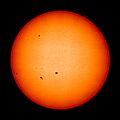
PHI's view of the Sun in visible light
-
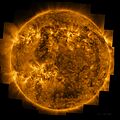
EUI's view of the Sun in UV light
-
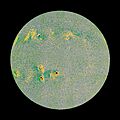
PHI's map of the Sun's magnetic field
-
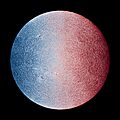
PHI's velocity map of the Sun's surface
-
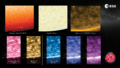
The collage of SoLO's view of the Sun's south pole on 16–17 March 2025, from a viewing angle of around 15° below the solar equator.
-
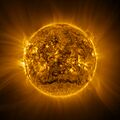
Solar Orbiter's image of the sun's corona, as it looks in ultraviolet light.


See also
- List of heliophysics missions
- List of European Space Agency programmes and missions
