
Solar Dynamics Observatory facts for kids

Solar Dynamics Observatory satellite
|
|
| Names | SDO |
|---|---|
| Mission type | Solar research |
| Operator | NASA GSFC |
| Website | http://sdo.gsfc.nasa.gov |
| Mission duration | 5 years (planned) 16 years, 8 months, 9 days (elapsed) |
| Spacecraft properties | |
| Spacecraft type | Solar Dynamics Observatory |
| Manufacturer | Goddard Space Flight Center |
| Launch mass | 3,100 kg (6,800 lb) |
| Dry mass | 1,700 kg (3,700 lb) |
| Payload mass | 290 kg (640 lb) |
| Start of mission | |
| Launch date | 11 February 2010, 15:23:00 UTC |
| Rocket | Atlas V 401 |
| Launch site | Cape Canaveral, SLC-41 |
| Contractor | United Launch Alliance |
| Orbital parameters | |
| Reference system | Geocentric orbit |
| Regime | Geosynchronous orbit |
| Longitude | 102° West |
 Solar Dynamics Observatory patch Large Strategic Science Missions
Heliophysics Division |
|
The Solar Dynamics Observatory (SDO) is a special NASA spacecraft. It has been watching the Sun closely since 2010. SDO launched on February 11, 2010. It is part of a bigger program called "Living With a Star" (LWS).
The LWS program helps scientists understand how the Sun and Earth are connected. This connection affects life on our planet. SDO's main job is to learn how the Sun influences Earth and the space around it. It does this by studying the Sun's atmosphere in great detail. SDO looks at the Sun using many different types of light at the same time.
Scientists use SDO to figure out how the Sun's powerful magnetic field is made. They also want to know how this magnetic energy is released. This energy travels into space as solar wind, fast-moving particles, and changes in the Sun's brightness.
Contents
About the SDO Spacecraft
The SDO spacecraft was built at NASA's Goddard Space Flight Center in Maryland. It launched from Cape Canaveral Space Force Station in Florida on February 11, 2010. The mission was planned to last for five years and three months. However, SDO has enough supplies to keep working for at least ten years. Many scientists see SDO as a successor to another solar observatory called SOHO.
SDO is a very stable spacecraft. It uses two solar panels to get power from the Sun. It also has two special antennas to send data back to Earth. SDO orbits Earth in a special path called a geosynchronous orbit. This orbit keeps it above the same spot on Earth.
The spacecraft carries three main science tools, called instruments:
- The Extreme Ultraviolet Variability Experiment (EVE)
- The Helioseismic and Magnetic Imager (HMI)
- The Atmospheric Imaging Assembly (AIA)
These instruments work together to study the Sun. All the information SDO collects is sent to Earth quickly.
SDO's Extended Mission
As of February 2020, SDO was projected to continue working until 2030. This means it will keep sending us amazing data for a long time! In August 2025, NASA and IBM introduced a new artificial intelligence model. It's called Surya Heliophysics Foundational Model. This model learned from nine years of SDO's observations. It helps scientists predict how the Sun's ultraviolet light affects Earth’s upper atmosphere. This can even give early warnings to satellite operators.
SDO's Science Tools
SDO uses three main instruments to study the Sun. Each one helps us learn something different.
Helioseismic and Magnetic Imager (HMI)

The HMI instrument is like an X-ray machine for the Sun. It helps scientists at Stanford University study how the Sun changes. HMI looks deep inside the Sun and at its powerful magnetic fields. It takes very detailed pictures of the Sun's entire surface. HMI measures the Sun's magnetic field and how it moves. This helps us understand what causes solar activity.
HMI creates special images called Doppler images and magnetograms. These images show how gases move on the Sun and where its magnetic fields are strongest. This instrument is even better than older ones. It gives us a full view of the Sun's magnetic activity. The data from HMI helps us understand how the Sun's inside works. It also shows how these internal processes create the magnetic fields we see on the surface.
Extreme Ultraviolet Variability Experiment (EVE)
The EVE instrument measures the Sun's extreme ultraviolet (EUV) light. It does this with much better detail and speed than previous missions. EVE can measure the full range of EUV light every 10 seconds. This is important because the Sun's EUV light heats Earth's upper atmosphere. It also creates the ionosphere, which is vital for radio communications.
The Sun's EUV output changes all the time. These changes happen quickly and over the Sun's 11-year solar cycle. Understanding these changes is very important. They affect how hot Earth's atmosphere gets. They can also cause problems for satellites and GPS signals. The University of Colorado Boulder built the EVE instrument. It provides much clearer measurements of EUV light.
Atmospheric Imaging Assembly (AIA)
The AIA instrument takes continuous pictures of the Sun's outer layers. These layers are called the chromosphere and the corona. AIA uses seven different types of extreme ultraviolet light. This allows it to see temperatures from about 20,000 Kelvin to over 20 million Kelvin. It takes very high-resolution images every 12 seconds. This gives scientists amazing views of how the Sun's atmosphere changes.
The Lockheed Martin Solar and Astrophysics Laboratory leads the AIA science team. They also operate the instrument. They share all the data with scientists and the public around the world. The AIA instrument has been working perfectly since May 1, 2010. It sends back incredibly clear images of the Sun.
| AIA wavelength channel | What it sees | Part of the Sun's atmosphere | Typical temperature |
|---|---|---|---|
| White light (450 nm) | Continuum | Photosphere | 5000 K |
| 170 nm | Continuum | Temperature minimum, photosphere | 5000 K |
| 160 nm | C IV + continuum | Transition region and upper photosphere | 100,000 and 5,000 K |
| 33.5 nm | Fe XVI | Active region corona | 2.5 million K |
| 30.4 nm | He II | Chromosphere and transition region | 50,000 K |
| 21.1 nm | Fe XIV | Active region corona | 2 million K |
| 19.3 nm | Fe XII, XXIV | Corona and hot flare plasma | 1.2 million and 20 million K |
| 17.1 nm | Fe IX | Quiet corona, upper transition region | 630,000 K |
| 13.1 nm | Fe VIII, XX, XXIII | Flaring regions | 400,000, 10 million, and 16 million K |
| 9.4 nm | Fe XVIII | Flaring regions | 6.3 million K |
You can see amazing pictures and videos of the Sun from SDO. Visit NASA's SDO Data website or The Sun Today to explore them.
How SDO Talks to Earth
SDO sends all its science data back to Earth using two powerful high-gain antennas. It also sends basic information about itself, called telemetry, using two smaller antennas. The data comes down to two special 18-meter radio antennas. These antennas are located in White Sands Missile Range, New Mexico. They were built just for SDO.
Scientists and engineers at NASA's Goddard Space Flight Center control SDO. They work from a special room called the Mission Operations Center. SDO sends a huge amount of data every day. It sends about 1.5 Terabytes of data daily. That's like downloading about 500,000 songs every single day!
SDO's Journey to Space
SDO was launched by NASA from Cape Canaveral Space Launch Complex 41 in Florida. It rode into space on an Atlas V-401 rocket. The first launch attempt on February 10, 2010, was delayed due to strong winds. But the next day, February 11, 2010, the launch was a success!
Right after launch, something cool happened. The rocket flew through a cirrus cloud. This created amazing shock waves in the sky. It also messed up a natural light show called a sun dog. A sun dog is a bright spot of light in the sky, often seen next to the Sun.
After the rocket boosted it into space, SDO began orbiting Earth. Its first orbit was about 2,500 kilometers above our planet.
Moving to its Final Orbit

Solar Dynamics Observatory · Earth
Over a few weeks, SDO slowly moved into its final orbit. This is a special circular, geosynchronous orbit about 35,789 kilometers high. It stays above 102° West longitude. This orbit was chosen for a good reason. It allows SDO to communicate with its ground station 24 hours a day, 7 days a week. It also helps SDO avoid being in Earth's shadow for too long. This means it can keep watching the Sun almost all the time.
Mission Mascot: Camilla Corona
Camilla Corona is a rubber chicken and the fun mascot for the SDO mission! She is part of the team that helps educate the public, especially kids. Camilla teaches everyone about the SDO mission, facts about the Sun, and Space weather. She also helps share information about other NASA missions and space projects. You can even find Camilla Corona SDO interacting with fans on social media.
Images for kids
-

Camilla Corona SDO
-

SDO 3-D schematic
-
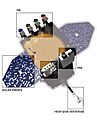
SDO Instruments
-
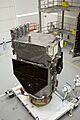
SDO ready to be placed on Atlas rocket for launch.
-

First light image from the SDO showing a prominence eruption.
-
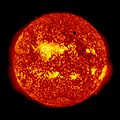
An image of the 2012 transit of Venus taken by SDO.


.jpg)
SDO on Stamps

In 2021, the United States Postal Service released a series of stamps. These special "forever stamps" featured beautiful images of the Sun. All these images were taken by the Solar Dynamics Observatory!
See also
- Heliophysics
- Advanced Composition Explorer
- Parker Solar Probe
- Radiation Belt Storm Probes (Van Allen Probes)
- Richard R. Fisher
- Solar and Heliospheric Observatory (SOHO)
- STEREO (Solar TErrestrial RElations Observatory), launched 2006, 1 of 2 spacecraft still operational.
- Wind (spacecraft), launched 1994, still operational.
- List of heliophysics missions
