
Rationalization (mathematics) facts for kids
Rationalization of denominators is a math trick to make fractions look neater and easier to work with. It means getting rid of square roots (or other roots) from the bottom part of a fraction. The bottom part of a fraction is called the denominator.
We do this by multiplying the fraction by a special form of the number one. This special "one" is made from the root we want to remove.
For example, if you have  , you can multiply it by
  . Since is equal to 1, you are not changing the value of the original fraction.
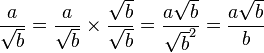
This makes the denominator a whole number, which is often easier to use in calculations.
Contents
What is Rationalizing a Denominator?
Rationalizing a denominator means changing a fraction so that its bottom part (the denominator) does not have a radical in it. A radical is a symbol like a square root ( ) or a cube root (
![\sqrt[3]{}](/images/math/9/b/b/9bbd095bafd3ae229d6baa25f34ebe84.png) ).
).
Think of it like tidying up a room. You want everything in its proper place. In math, having a radical in the denominator is sometimes seen as untidy.
Historically, it was harder to calculate with radicals in the denominator. Today, we rationalize to make expressions simpler. It also helps when you need to add or subtract fractions.
Why Do We Rationalize?
- Simpler Form: It puts the fraction into a standard, simpler form. This makes it easier to compare fractions.
- Easier Calculations: It can make adding, subtracting, or multiplying fractions simpler.
- Avoiding Decimals: Sometimes, a radical in the denominator would lead to a long, messy decimal if you tried to divide. Rationalizing helps avoid this.
How to Rationalize a Denominator
The main idea is to multiply the fraction by a special fraction that equals 1. This special fraction will have the radical from the denominator on both its top and bottom.
Step-by-Step Example
Let's look at an example: 
1. Identify the radical: The radical in the denominator is  . 2. Create the "one": Make a fraction using this radical on both the top and bottom. This gives us
  . Remember, this fraction equals 1. 3. Multiply the fractions: Multiply your original fraction by this new "one." *
  4. Multiply the numerators (tops): *
  5. Multiply the denominators (bottoms): *
  6. Put it all together: * The new fraction is
  .
.
Now, the denominator is the whole number 2, and there are no radicals at the bottom!
Why Does Multiplying by Itself Work?
When you multiply a square root by itself, you get the number inside the root.


This is because the square root operation is the opposite of squaring a number. So,  simply equals
  . This is the key to getting rid of the radical in the denominator.
See also
In Spanish: Racionalización de radicales para niños
