
School feeding in low-income countries facts for kids
School feeding programs are special projects that give food to children at school. These programs help kids in many ways. They make sure children get enough to eat, which helps them learn better and stay healthy. They also encourage more children to come to school and stay in school, especially in places where food is scarce.
Many rich and middle-income countries already provide school meals. But the children who need these programs the most live in poorer countries. In these places, international groups like the United Nations World Food Programme (WFP) or the World Bank often start the programs. Sometimes, countries start their own programs and then ask for help. Over time, many countries learn to run their school feeding programs by themselves, without needing outside help.
Every school feeding program is a bit different. They are designed and run in ways that fit each country's needs. This means it's hard to compare them all directly, as they are unique to their local situations.
Contents
Why Are School Meals Important?
Helping Kids Learn and Grow
Millions of children around the world go hungry every day, especially in Africa. Also, many school-aged children, especially girls, don't go to school at all. School feeding programs try to solve both these problems at once.
Schools are great places to help kids with their health and education. School meals are just one part of this. Other programs might include giving medicine to prevent worms or teaching about health. Overall, school meals directly help children's health and education. They also indirectly help their families' lives. These programs support big goals like reducing hunger and making sure all children get a primary education.
School meals help children get more nutrients. For example, they can reduce malnutrition and help kids get more vitamins and minerals. When children get enough food at school, their families might also have more food at home because the children are eating less there. Some programs even send food home with children, which helps the whole family. However, some people say that school meals are only a temporary fix and don't solve the main reasons for hunger, like high food prices.
Education is super important for a child's future. It helps people get more opportunities, earn more money, and have a better life. School meals greatly help kids' education. They make more children sign up for school and attend regularly. They also help fewer kids drop out and improve how well students think and learn. When schools offer meals, it makes it easier for families to send their children to school because it reduces the cost. Also, getting food at school can be a big reason for students to show up instead of staying home. When kids are well-fed, they can focus better and do better in their studies.
Making School Fair for Everyone
School feeding programs can help make education fair for both boys and girls. Sometimes, girls face more challenges getting to school. These can include old-fashioned ideas about what girls should do, dangers outside the home, or schools that aren't set up well for girls. Because of these challenges, it can cost more for very poor families to send their daughters to school. This includes the money they might lose if their daughter isn't home to help with chores.
School feeding programs lower these costs, making it easier for families to send their girls to school. When more girls get an education, it can lead to many good things. For example, educated women often have smaller families, get better jobs, and have more power in their lives.
How Do School Feeding Programs Work?
Different Ways to Get Food
There are two main ways to give food through school feeding programs:
- Meals at school: Food is given to children while they are at school, like a bowl of porridge or special crackers.
- Take-home food: Basic food items, like a bag of rice or cooking oil, are given to families of children who come to school regularly.
Sometimes, the food for these programs comes from other countries. But more and more, countries and organizations want to use "home-grown school feeding." This means the food is grown and bought within the country as much as possible. These programs help children get good food and education. They also help local farmers by giving them a steady market for their crops. Many countries in Africa, like Ghana and Kenya, are using home-grown school feeding programs.
Who Helps Run These Programs?
School feeding programs can be at different stages of development. Some programs rely mostly on money and help from outside groups. Other programs are run mostly by the country's own government. For example, countries like Afghanistan still need a lot of outside help. But countries like Chile and India have their own strong school feeding programs. Chile has had a government-run program for over 40 years, working with private companies. India has supported school feeding since 2001, seeing it as a right for its citizens. Countries in the middle, like Kenya, might have some government support but still need outside help.

The United Nations World Food Programme (WFP) is the biggest helper for school feeding programs around the world. They give money and help develop programs for about 22 million children in 70 countries each year. This costs almost $500 million every year. WFP often works with governments. But if a government can't or won't help, WFP might work with other groups. WFP thinks it would cost about $3.2 billion each year to feed all 66 million hungry school-aged children worldwide, which is about $50 per child.
WFP has been helping for over 45 years. They are now trying to help countries take more ownership of their school meal programs. They have eight standards to guide how to make these programs last, including having a clear plan, steady money, and local support.
Challenges and What We've Learned
What Makes School Meals Tricky?
Even though school feeding programs have many good effects, they can also have some challenges. For example, they might increase costs for local communities. Communities might need to provide firewood for cooking, fresh fruits, or vegetables. They also need people to cook the meals and places to store the food. These extra needs can sometimes reduce the overall benefit for a community.
School feeding programs need to be designed carefully for each community. This is because every place has different people, geography, and needs. A successful program needs to:
- Figure out if school feeding is the best way to help children.
- Set clear goals for what the program should achieve.
- Choose what kind of food to serve.
- Decide how to get the food.
- Plan how to manage, run, and check the program in schools.
Because these programs need so much planning and are unique to each place, keeping them going for a long time is a big concern. Countries often don't have enough staff, money, or buildings to run the programs by themselves for very long. They often need outside help to keep them going.
What Have Studies Shown?
Many studies are done to see how well school feeding programs work, especially in poorer countries. The results often depend on the specific place. But what we learn from one community can help other programs.
Researchers have found some interesting things:
- The time of day meals are given might not be the most important thing for learning. Sometimes, sending food home (take-home rations) can work just as well as meals at school, and might even be cheaper.
- In some places, going to school more often helped learning more than just getting better nutrition. But school feeding programs still encourage kids to attend school, which is a good thing for their education.
- One study in Chile found that giving more calories in meals didn't necessarily lead to better school attendance or test scores. This suggests that focusing on the types of nutrients in the food, not just the calories, might be more important.
Images for kids
-
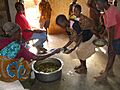
School feeding program in Malawi

