
SemEval facts for kids
| Academics | |
|---|---|
| Disciplines: | Natural Language Processing Computational Linguistics Semantics |
| Umbrella Organization: |
ACL-SIGLEX |
| Workshop Overview | |
| Founded: (Origin) |
1998 (Senseval) |
| Latest: | Semseval 2 Summer 2010 (Ended) ACL @ Uppsala, Sweden |
| Upcoming: | Semseval 3 Summer 2012(tentative) ACL @ Jeju Island, Korea |
| History | |
| Senseval-1 | 1998 @ Sussex |
| Senseval-2 | 2001 @ Toulouse |
| Senseval-3 | 2004 @ Barcelona |
| SemEval-1 (Senseval-4) |
2007 @ Prague |
| SemEval-2 | 2010 @ Uppsala |
SemEval (which stands for Semantic Evaluation) is like a big competition for computer programs. Its main goal is to see how well these programs can understand the meaning of human language. Imagine teaching a computer to not just read words, but to truly get what they mean, just like you do! This is super important for things like search engines, language translation, and even talking to smart assistants.
Contents
What is SemEval?
Computers are great at following instructions, but understanding the subtle meanings in our words is tricky for them. SemEval helps scientists and engineers test and improve computer systems that work with language. These systems are part of a field called Natural Language Processing (NLP) and Computational Linguistics.
Why Understanding Language Matters
Think about how you use words. The same word can mean different things depending on how it's used. For example, "bank" can mean the side of a river or a place where you keep money. Humans understand this easily from the rest of the sentence. Computers need help to figure this out.
Computers that can truly understand language are very useful. They can:
- Help search engines find exactly what you're looking for.
- Translate languages more accurately.
- Make smart assistants like Siri or Alexa better at understanding your commands.
- Analyze huge amounts of text to find important information.
How SemEval Works
SemEval is organized as a series of workshops. In these workshops, different research teams create computer programs to solve specific language understanding challenges. These challenges are called "tasks."
The Tasks
Each SemEval workshop has several tasks. These tasks focus on different parts of language meaning. For example, one task might be about figuring out the meaning of a word in a sentence. Another might be about understanding the relationship between different words.
The Competition
Teams from all over the world submit their computer systems to compete in these tasks. All systems are tested on the same set of data. This makes the competition fair. The results show which systems are best at understanding language. This helps everyone learn new ways to make computers smarter.
A Look at SemEval's History
SemEval started a long time ago, in 1998. Back then, it was called Senseval. The first Senseval workshop was held in Sussex. Its main focus was on "word sense disambiguation." This means figuring out the correct meaning of a word when it has several possible meanings.
From Senseval to SemEval
Senseval workshops continued in 2001 (Toulouse) and 2004 (Barcelona). In 2007, the workshop changed its name to SemEval. This new name showed that it was covering a wider range of language meaning tasks, not just word sense. The first SemEval (also known as Senseval-4) was in Prague.
Recent Workshops
Since then, SemEval has continued to grow. SemEval-2 took place in Uppsala in 2010. SemEval-3 was planned for 2012 in Korea. Each workshop helps researchers push the boundaries of what computers can do with human language.
Images for kids
-
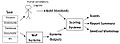
SemEval Framework, showing how different parts of language understanding work together.

