
Southeast Asian long-fingered bat facts for kids
Quick facts for kids Southeast Asian long-fingered bat |
|
|---|---|
| Conservation status | |
Scientific classification  |
|
| Kingdom: | Animalia |
| Phylum: | Chordata |
| Class: | Mammalia |
| Order: | Chiroptera |
| Family: | Miniopteridae |
| Genus: | Miniopterus |
| Species: |
M. fuscus
|
| Binomial name | |
| Miniopterus fuscus Bonhote, 1902
|
|
| Script error: The function "autoWithCaption" does not exist. | |
Script error: No such module "Check for conflicting parameters".
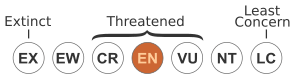
The Southeast Asian long-fingered bat (Miniopterus fuscus) is a type of bat that lives in Japan. It's a special kind of bat called a vesper bat, and it belongs to the family Miniopteridae. Sadly, this bat is currently listed as endangered by a group called the IUCN. This means it's at high risk of disappearing forever if we don't protect it.
Contents
What Does This Bat Look Like?
This bat is quite small! It usually weighs about 10.8 grams (0.38 oz), which is like a few paperclips. Its forearm, which is part of its wing, is about 41.5 millimetres (1.63 in) long.
Bat Life Cycle
Female bats of this species have one baby at a time. This usually happens in early June each year. These bats fly over forests to find their food. They mostly eat insects like butterflies, moths, and flies. They also enjoy eating Hymenoptera, which are insects like bees, wasps, and ants.
Where Does This Bat Live?
This bat is only found in Japan. It lives on several islands there. These islands include Amami-Oshima, Tokuno-shima, Okinoerabu Island, Okinawa Island, Kume Island, Ishigaki, and Iriomote Island.
A long time ago, in 1933, some of these bats were found on the Kii peninsula in Honshu. But now, they are no longer found there. This means they are considered extinct in that area.
These bats like to live in forests. They make their homes, called roosts, inside old mines and caves. They live together in large groups, sometimes with hundreds of bats in one colony. In the past, there were very big groups of mother bats and their babies. But now, these large maternity colonies are not as common. On Okinawa Island, there is one colony with about 10,000 female bats.
Protecting This Special Bat
The IUCN Red List has listed the Southeast Asian long-fingered bat as endangered. This is because it lives in a very small area. Also, the places where it lives are getting damaged. The caves where these bats sleep are often disturbed by people.
Some caves that these bats use have electricity added for tourists. This can bother the bats. There is also new building work happening near some caves. On Ishigaki Island, a new airport was built right above several caves where these bats often go. Sadly, this bat does not live in any special protected areas. This makes it even harder to keep them safe.
