
Virginia bluebells facts for kids
Quick facts for kids Virginia bluebells |
|
|---|---|
 |
|
Scientific classification  |
|
| Kingdom: | Plantae |
| Clade: | Tracheophytes |
| Clade: | Angiosperms |
| Clade: | Eudicots |
| Clade: | Asterids |
| Order: | Boraginales |
| Family: | Boraginaceae |
| Genus: | Mertensia |
| Species: |
M. virginica
|
| Binomial name | |
| Mertensia virginica |
|
| Script error: The function "autoWithCaption" does not exist. | |
Script error: No such module "Check for conflicting parameters".
Virginia bluebells are pretty wild flowers found in eastern North America. They are also known as Virginia cowslip or Roanoke bells. These plants are special because they are "spring ephemerals." This means they grow, bloom, and make seeds in the spring. Then, they disappear by early summer until the next year. Their bell-shaped flowers are usually a lovely sky-blue color.
Contents
What Do Virginia Bluebells Look Like?
Virginia bluebells have rounded leaves that are a gray-green color. Their stems can grow up to 60 centimeters (about 2 feet) tall. The leaves at the bottom of the stem have small stalks. The leaves higher up on the stem are attached directly without stalks.
Flowers and How They Grow
When the flowers are still buds, they are pink. Each flower has five petals joined together like a tube. It also has five stamens (the parts that make pollen) and a central pistil (the part that receives pollen).
These flowers appear in mid-spring. They grow in nodding, spiral-shaped clusters at the end of arched stems. Most flowers are blue, but sometimes you can find white or pink ones.
How Bluebells Make Seeds
The stamens and the stigma (the top part of the pistil) are too far apart for the flower to fertilize itself. This means they need help from insects!
Bumblebees can pollinate these flowers. But because the flower is shaped like a funnel, bumblebees have to hover, which they don't do very often. Butterflies are the most common helpers. They can easily land on the edges of the flower and still reach the sweet nectar inside.
In early summer, each flower that has been pollinated makes four seeds. These seeds are inside wrinkled, nut-like casings. After making seeds, the plant goes dormant. This means it rests underground until the next spring.
These plants are very tough and can survive very cold temperatures, down to -40 degrees Celsius (-40 degrees Fahrenheit).
People also love to grow Virginia bluebells in their gardens. They have even won an award called the Royal Horticultural Society's Award of Garden Merit.
Images for kids
- Photos
-
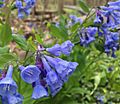
Virginia Bluebells in Ohio
-
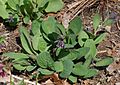
Leaves before blooming
-
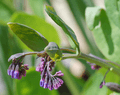
Flower buds
-
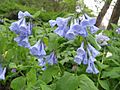
A typical blue flower in Berlin, Germany
-
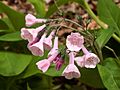
A pink flower
-
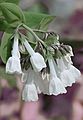
A white flower
-
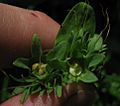
The fruits (seed casings)
-
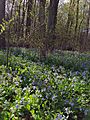
Woods covered in bluebells
-
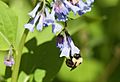
A bumblebee visiting a bluebell


.jpg)


