
Abensberg 1809 order of battle facts for kids
The Battle of Abensberg was a big fight that happened on April 20, 1809. It was part of the Napoleonic Wars, a time when Emperor Napoleon I of France was leading his armies across Europe. In this battle, Napoleon's forces, which included soldiers from France, Bavaria, and Württemberg, fought against Austrian troops.
The battle took place near Abensberg, a town in what is now Germany. The Austrian side was led by generals like Johann von Hiller, Archduke Louis of Austria, and Michael von Kienmayer. They were part of a larger Austrian army. Napoleon's troops were very strong and managed to defeat the Austrians. They caused many losses and forced the Austrians to retreat.
About 55,000 French and German soldiers faced off against 42,000 Austrians. However, only about 25,000 soldiers from each side actually fought. The Austrians lost around 2,710 soldiers who were killed or wounded, and about 4,000 were captured. Napoleon's side had fewer losses, with 215 French, 146 Württembergers, and 746 Bavarians, totaling 1,107 soldiers.
Contents
Who Fought at Abensberg?
This section tells you about the main groups of soldiers and their leaders during the battle.
The Austrian Army

The Austrian forces were led by Feldmarschall-Leutnant Johann von Hiller. He was in charge of the left side of the main Austrian army. His forces were made up of several large groups called "Armeekorps."
- VI Armeekorps: This large group was led by Johann von Hiller himself. It had many infantry (foot soldiers) regiments and artillery (cannons). Some parts of this corps were fighting in other places, like Munich or Moosburg.
- V Armeekorps: This group was commanded by Feldmarschall-Leutnant Archduke Louis of Austria. It also had many infantry and cavalry (soldiers on horseback) units. Like Hiller's corps, some of its parts were sent to other battles.
- II Reserve Armeekorps: This smaller reserve group was led by Feldmarschall-Leutnant Michael von Kienmayer. It mainly consisted of elite Grenadier battalions (special infantry) and cavalry regiments like Cuirassiers and Dragoons.
Austrian Generals
These were some of the important Austrian generals who led troops in the battle:
 |
 |
 |
 |
 |
| Prince Reuss | Franz Jellacic | Josef Radetzky | Frederick Bianchi | Konstantin d'Aspré |
Napoleon's French-Allied Army
Emperor Napoleon I of France himself was in command of the French and allied forces. His army was called the "Grande Armée."
- Provisional Corps: A special group of soldiers was put together for this battle, led by Marshal Jean Lannes. This corps included different types of soldiers:
* Cavalry (Chasseurs à cheval) * Two infantry divisions (1st and 3rd Divisions) with many Line Infantry Regiments. * Two Heavy Cavalry Divisions (1st and 2nd) with powerful Carabinier and Cuirassier regiments. * All these groups had their own artillery.
- VII (Bavarian) Corps: This corps was made up of soldiers from Bavaria, an ally of France. It was led by Marshal François Joseph Lefebvre. It had three Bavarian divisions, each with infantry, cavalry, and artillery.
* 1st Bavarian Division: Led by Crown Prince Ludwig of Bavaria. * 2nd Bavarian Division: Led by Lieutenant-General Karl Philipp von Wrede. * 3rd Bavarian Division: Led by Lieutenant-General Bernhard Erasmus von Deroy.
- Württemberg (later VIII) Corps: Soldiers from Württemberg, another French ally, formed this corps. It was commanded by General of Division Dominique Vandamme. This corps included a Württemberg Infantry Division and a Württemberg Cavalry Division, along with artillery.
French-Allied Generals
These were some of the important generals on Napoleon's side:
 |
 |
 |
 |
 |
 |
| Charles Morand | Charles Gudin | Étienne Nansouty | Jean Doumerc | Jean Defrance | Karl von Wrede |
Images for kids
-
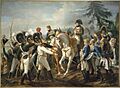
Napoleon speaks to Bavarian troops.
-
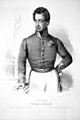
Archduke Louis led the V Armeekorps.
-
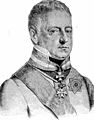
Michael von Kienmayer led the small II Reserve Armeekorps.
-
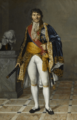
François Joseph Lefebvre commanded the Bavarian VII Corps.
-
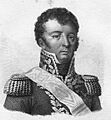
Dominique Vandamme led the Württemberg contingent.


.jpg)
