
Butter churning in Nepal facts for kids

Have you ever wondered how butter is made? In Nepal, making butter is a really important part of daily life and culture. It's not just about food; it's a tradition! This process involves separating yummy butter from curd. They use special traditional tools and a spinning motion, kind of like a centrifugation machine, to make it happen.
Tools for Making Butter
Theki
The Theki (Nepali: ठेकी) is the biggest and most important tool for churning butter. It's shaped like a cylinder in the middle, with a narrow neck and a wide, fan-like opening at the top.
Most Thekis are made from darigitho (Nepali: दारीगिठो) wood. That's why people in villages often call it Daar ko theki. Sometimes, Rhododendron (Nepali: गुराँस) wood is also used. The Theki holds the curd while the butter is being made, and it's where another tool, the Madaani, goes in.
Madaani
The Madaani (Nepali: मदानी), also known as Ghupa, is the main tool that does all the work in butter churning. It's made of a few different parts:
- Saro (Nepali: सरो): This is a long, solid stick. It's usually made from Falat (Nepali: फलाँट) or Katus (Nepali: कटुस) wood. The Saro connects to the Pora at one end, and a rope called Neti wraps around it.
- Pora (Nepali: पोरा): This part is at the bottom of the Madaani and looks like a fan. It's made from the same wood as the Saro. The Pora has four blunt, blade-like parts that spin the curd around. You can think of it as the spinning part of the butter-making machine!
- Neti (Nepali: नेती): This is a rope that wraps around the Saro. It has two free ends, each with a small wooden block called a Koila. People hold these Koila blocks to move the Madaani back and forth. The Neti can be made from nylon or even paddy straw.
Torso or Taro
The Torso or Taro (Nepali: तोर्सो/तरो) is a flat piece of wood. It has a hole at one end where the Saro of the Madaani fits through. This helps to hold the Madaani steady. The other end of the Torso is tied to a support structure. While it can be made from any wood, Falat (Nepali: फलाँट) and Katus (Nepali: कटुस) are considered the best choices.
Dhungro
The Dhungro (Nepali: ढुंग्रो) is a hollow tube, usually made from bamboo (Nepali: बाँस). It's used to collect the churned milk (the liquid left after the butter is made) once the process is finished.
How Butter is Churned
First, curd that has been collected over a few days is put into the Theki. Then, the Madaani is placed inside the Theki, held steady by the Torso.
Next, the Neti rope is moved back and forth. This makes the Madaani spin quickly inside the Theki. This spinning motion separates the butter from the curd.
Sometimes, adding a little hot water in the middle of the process can make the butter form faster. But you have to be careful! Adding too much water, especially later on, can mean you get less butter.
You know the butter is ready when you can move the Pora (the fan-like part of the Madaani) around the surface of the liquid. The butter will have separated and gathered into a lump. This whole process usually takes about 20 minutes.
Once the butter is ready, it's taken out and collected. The remaining liquid, called churned milk (Nepali: मोही), is then poured into the Dhungro.
Gallery
-
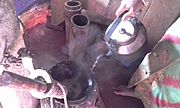
Adding hot water can speed up the process.
-
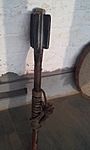
The Madaani: The top fan-like part is the Pora, and the lower part with the Neti rope is the Saro.
-
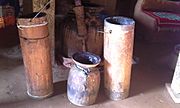
Two Dhungro tubes on the sides, with a small Theki in the middle.
-
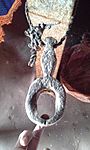
The Torso tool.
-
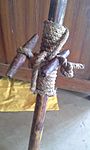
The Neti rope setup. The small wooden blocks at the ends are called Koila.
-
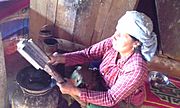
A woman taking out the butter after it's churned.

.jpg)
.jpg)
.jpg)
.jpg)

