
Devil's-tongue facts for kids
Quick facts for kids Devil's-tongue |
|
|---|---|
Scientific classification  |
|
| Kingdom: | Plantae |
| Clade: | Tracheophytes |
| Clade: | Angiosperms |
| Clade: | Eudicots |
| Order: | Caryophyllales |
| Family: | Cactaceae |
| Genus: | Opuntia |
| Species: |
O. ammophila
|
| Binomial name | |
| Opuntia ammophila Small
|
|
| Script error: The function "autoWithCaption" does not exist. | |
Script error: No such module "Check for conflicting parameters".
Opuntia ammophila, also known as the devil's-tongue, is a type of prickly pear cactus. You can find it growing in Florida. These cacti usually grow alone. They don't often form big, dense groups.
For a long time, people thought O. ammophila was just a different kind of O. humifusa. But scientists now know it's its own unique species. One way to tell them apart is by their pads, called cladodes. O. ammophila has gray-green pads, while O. humifusa has green ones.
What it Looks Like
Long ago, Opuntia ammophila could grow as tall as a person! Some plants even had thick trunks. But today, it's rare to find one that's even 1 meter (about 3 feet) tall. Even smaller plants will have a single main stem or trunk.
The flowers of this cactus are quite special. Their buds have petals that curve backward. When the flowers open, they are a light yellow color. The center part, called the stigma, is cream-colored. You won't see this plant very often in central Florida.
Images for kids
-
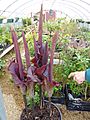
Amorphophallus konjac in bloom
-
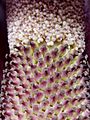
Amorphophallus konjac male (top) and female (bottom) flowers
-
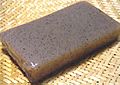
Japanese konjac gel, with hijiki seaweed mixed in
-
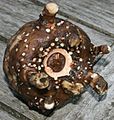
Konjac corm used for preparing food
.jpg)


See also
 In Spanish: Konnyaku para niños
