
Farnsworth Homestead facts for kids
Quick facts for kids |
|
|
Farnsworth Homestead
|
|
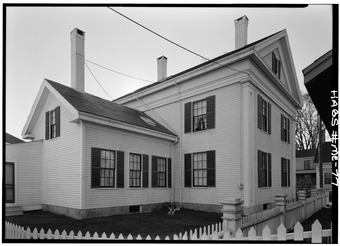
HABS photo, 1960
|
|

 Location in Maine

Location in the United States
|
|
| Location | 21 Elm St., Rockland, Maine |
|---|---|
| Area | 1 acre (0.40 ha) |
| Built | 1854 |
| Built by | W.H. Glover Lumber Co. |
| Architectural style | Greek Revival |
| NRHP reference No. | 73000241 |
| Added to NRHP | May 25, 1973 |
The Farnsworth Homestead is a special old house in Rockland, Maine. It was built in 1854 by William A. Farnsworth. This house is a great example of Greek Revival architecture, which was a popular style back then. It was also the home of Lucy Farnsworth. She was a very important person who helped create the Farnsworth Art Museum. Today, the museum owns the house and lets people visit it as a historic house museum. The house was added to the National Register of Historic Places in 1973 because of its history and architecture.
Contents
What is the Farnsworth Homestead?
The Farnsworth Homestead is located in downtown Rockland. It sits on the north side of Elm Street. The house is right behind the main building of the Farnsworth Art Museum. The homestead includes the main house and a carriage house. These two buildings are connected by smaller sections called ells.
How Does the House Look?
The main house is two-and-a-half stories tall. It is made of wood and has a pointed roof. The bottom part of the house is made of strong granite and brick. The front of the main house has smooth, flat wooden boards. The other parts, like the ells and the carriage house, have overlapping wooden boards called clapboards.
The corners of the main house have flat, column-like decorations. These go up to a decorative band that goes all around the building. The pointed parts of the roof, called gables, are shaped like triangles. The main front door is set back in the middle of the house. It has flat columns and a decorated frame around it.
Who Lived in the House?
The house was built in 1854 by William A. Farnsworth. He was a well-known businessman in the area. He worked in the lime rock processing industry. William Farnsworth had a large family. However, most of his properties were eventually passed down to his daughter, Lucy.
Lucy Farnsworth was a private person who never married. She passed away in 1935. In her will, she left her money and properties to create the Farnsworth Art Museum. She also wanted her family home to be kept as a museum. This way, people could see what a home looked like in the mid-1800s.
See also
