
Fergusonina facts for kids
Quick facts for kids Fergusonina |
|
|---|---|
 |
|
| Outline | |
Scientific classification  |
|
| Kingdom: | Animalia |
| Phylum: | Arthropoda |
| Class: | Insecta |
| Order: | Diptera |
| Family: | Fergusoninidae |
| Genus: | Fergusonina Malloch, 1924 |
Fergusonina are a special group of flies. They are the only type of fly in a family called Fergusoninidae. These flies are known for creating unique bumps, called galls, on plants.
Contents
What are Fergusonina Flies?
There are about 40 different kinds of Fergusonina flies. Each kind makes galls on specific trees. These trees include Eucalyptus, Melaleuca, Corymbia, and Metrosideros. All these trees belong to the Myrtaceae plant family. You can find these flies and their galls in Australia and New Zealand.
Tiny Architects: How Galls are Formed
Fergusonina flies are quite small. Their young, called larvae, grow inside the galls. These galls can form on a plant's leaves, new shoots, or flower buds.
The flies don't make the galls all by themselves. They get help from tiny worms called nematodes. These nematodes belong to the genus Fergusobia. The flies and these worms have a very special partnership. They absolutely need each other to survive.
A Special Partnership: Flies and Worms
Female Fergusonina flies carry these tiny Fergusobia worms inside their bodies. When a female fly lays her eggs on a plant, she also brings the worms to the plant. The worms then help to create the gall where the fly larvae will live and grow.
Most types of Fergusonina flies only use one specific kind of tree for their galls. However, a few types can use more than one kind of tree.
Where Do They Live?
These interesting flies are found in Australia and New Zealand. They are an important part of the ecosystems in these regions. They show us how different living things can work together in nature.
-
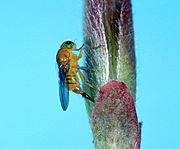
A Fergusonina species

