
Clawed armhook squid facts for kids
Quick facts for kids Clawed armhook squid |
|
|---|---|
 |
|
| Gonatus onyx on the Davidson Seamount at 1,328 m depth. | |
| Conservation status | |
| Scientific classification |

The Clawed armhook squid (scientific name: Gonatus onyx) is a fascinating sea creature. It belongs to the group of animals called Cephalopoda, which includes squids, octopuses, and cuttlefish. These are all part of the larger group known as Mollusca, like snails and clams.
This squid gets its common names, the clawed armhook squid and the black-eyed squid, from its unique features. It has striking black eyes and two special arms with sharp, claw-like hooks at the ends. These two arms are a bit longer than its other arms.
The clawed armhook squid is part of the Gonatidae family. You can find them mostly in the northern Pacific Ocean, stretching from Japan all the way to California. They are one of the most common squids found off the coast of California. These squids usually live in deep waters, but they often swim closer to the surface during the day, probably to find food.
Contents
Where They Live
The clawed armhook squid is very common in the Northern Pacific Ocean. They live in areas from the coast of California to the east coast of Japan. You can also find them as far north as the Bering Sea. They are especially abundant off the coast of California.
These squids are typically found over deep ocean basins, shelves, and where the shelf drops off. Their numbers don't change much across these wide areas.
Different Homes for Different Ages
Adult and young squids live in different parts of the ocean. Adult squids tend to live alone in deeper waters. Younger squids, called juveniles, prefer shallower coastal waters and often swim in groups.
The depth where they live changes throughout the day and night. During the day, they stay in deeper waters. Adults are usually found between 400 and 1000 meters deep. Younger squids are found from 0 to 800 meters deep during the day.
At night, both adults and juveniles swim up closer to the surface. Adults can be found from 100 to 800 meters deep, but most are around 400-500 meters. Juveniles are found from 0 to 500 meters, with many staying in the top 300 meters.
Female squids go even deeper when they are laying eggs. They have been seen holding their egg masses between 1500 and 2600 meters deep. One female was even spotted caring for her eggs in Monterey Canyon at 1590 meters deep.
What They Look Like
The clawed armhook squid is a medium-sized squid. Most adults have a mantle (body) length of about 12 centimeters (about 5 inches). Some squids found in warmer waters can grow up to 18 centimeters (about 7 inches).
Female squids tend to grow a couple of centimeters larger than males. Their mantle makes up most of their body length. Their arms add another 40 millimeters (about 1.5 inches) on average.
Special Features
They have distinctive black eyes on each side of their head. These eyes are very well-developed and help them hunt in the dark depths of the ocean.
Their arms have five pairs. One pair has a large primary hook at the end, along with many rows of suckers. The other four pairs of arms are usually shorter and don't have these large hooks, but they are still lined with rows of suckers. Scientists believe these clawed arms help them catch and hold their prey.
The clawed armhook squid moves by pushing water out of a special tube called a siphon. They also use their fins to help them swim. Young squids often use ink as a defense mechanism and to help them move quickly. Adult squids rarely use ink. Instead, they rely on fast swimming to escape danger.
Adult squids have special cells called chromatophores under their skin. These cells allow them to change colors to hide their reflective internal organs. They also have a beak, like all squids. Their beak is small but sharp, especially the upper part. This helps them attack prey that might be larger than themselves.
How They Reproduce
Like most squids, Gonatus onyx lays eggs outside of its body. Females lay their eggs between April and July. They then care for these eggs for about six to nine months until the baby squids are ready to hatch. This happens in very deep waters, sometimes more than 2,500 meters deep.
This long time spent developing and caring for the eggs helps the baby squids hatch already quite developed. This means they are ready to swim up to shallower waters where there is more food. During this long waiting period, the female squids survive by using stored fat from their bodies.
Most squids, including Gonatus onyx, are believed to reproduce only once in their lives. After they lay their eggs, they usually die.
Egg Care
Female Gonatus onyx have a unique way of caring for their eggs. They hold the egg mass with their hooked arms. They do this because they lose their feeding tentacles after laying eggs, so they can't eat while holding the eggs.
Once the eggs are laid, the females move to very deep waters. This helps keep the eggs safe from predators. The eggs are covered in a black, jelly-like substance. Each egg is oval-shaped and measures about 2.0 to 3.0 millimeters long. A single egg mass can contain anywhere from 2,000 to 5,000 baby squids!
Young Squids
When they first hatch, baby Gonatus onyx squids look quite different from adults. They are moderately large, about 5.0 millimeters long in total. Their mantle is about 3.2-3.5 millimeters long.
Young squids have four pairs of arms. The first two pairs have suckers, but the third and fourth pairs do not. They also have one pair of tentacles that are longer than their arms. These tentacles have many sucker buds, but the central hook isn't visible yet.
You can identify young squids by their unique color pattern. They have specific spots of color (chromatophores) on their tentacles, fins, and mantle. Young squids move with a "hop-and-sink" swimming style.
They grow into juveniles in about three months. During this time, they are very active predators and often swim in schools (groups). They also start to develop the hooks on their arms and tentacles. Young squids tend to stay in groups because they are less likely to hunt each other when they are still developing. They are still relatively small, with a mantle length of about 30 millimeters.
Adult Life
After about three months, squids move to deeper waters and their lifestyle changes completely. Adult Gonatus onyx squids become solitary hunters. They make long vertical journeys during the night, swimming closer to the surface to feed on other animals that also migrate.
Adults of this species have been known to eat other squids of the same species. This might happen because there isn't much food in the deep waters. It could also be a way to reduce competition for food or mates. This behavior is more common where many squids live close together.
Adult squids also eat fish that are about the same size as them, especially a type of fish called Stenobrachius leucopsarus. We don't know much about what young squids eat, but some studies suggest they mostly eat small crustaceans before switching to larger prey as they mature.
Color and Defense
Adult and young squids behave differently because they live at different depths, where the amount of light changes. Adults are opaque (not see-through) and can be orange and white. Young squids are clear.
Adults can change between these two colors as a way to defend themselves from predators. They have also been seen using ink in a clever way. They release ink in long, rope-like shapes. This makes the squid look like a different animal to predators, giving the squid time to escape. Adults don't use the same fast defense moves as juveniles. This is because there are fewer predators in the deeper waters, and these quick escapes use a lot of energy, which is a limited resource in the deep sea.
Images for kids
-
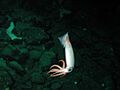
Gonatus onyx on the Davidson Seamount at 1,328 m depth.
