
Grand Forks Woolen Mills facts for kids
Quick facts for kids |
|
|
Grand Forks Woolen Mills
|
|
 |
|

 Location in North Dakota

Location in the United States
|
|
| Location | 301 N. 3rd St., Grand Forks, North Dakota |
|---|---|
| Area | less than 1 acre (0.40 ha) |
| Built | 1895 |
| Architect | Ross, John W. |
| Architectural style | Commercial vernacular |
| MPS | Downtown Grand Forks MRA |
| NRHP reference No. | 83001936 |
| Added to NRHP | October 26, 1983 |
The Grand Forks Woolen Mills building is located in Grand Forks, North Dakota. It stands at the corner of Third Avenue North and North Third Street. The building was designed by architect John W. Ross.
This three-story brick building is about 50 feet (15 meters) wide and 100 feet (30 meters) long. It was built in 1895. Its design style is called Commercial vernacular. This means it was built for business use with a common, local style. The building is at the very north end of the old business area. It was added to the National Register of Historic Places in 1983 because of its historical importance.
Contents
History of the Grand Forks Woolen Mill
Building the Mill
The Grand Forks Woolen Mills building cost about US$17,000 to build. It was made for a woolen mill business that had started in 1892. The building was placed on a plot of land that was 100 feet (30 meters) by 140 feet (43 meters). This was a common size for new buildings in Grand Forks back then.
How Wool Was Made into Cloth
The mill was used for many steps to turn raw wool into cloth. These steps included:
- Carding: Untangling and cleaning the wool fibers.
- Spinning: Twisting the fibers into yarn.
- Weaving: Making the yarn into fabric on a loom.
- Dyeing: Adding color to the wool or fabric.
- Sewing: Making finished products from the cloth.
The building also had offices and a store where people could buy the finished products.
A Symbol of Local Pride
People in Grand Forks were very proud of the woolen mill. It showed that their city could be economically independent from Minnesota. The mill was a big part of Grand Forks' dream to become a major manufacturing center. Before the mill, wool had to be sent to cities like Minneapolis to be processed. Having a local mill meant that local farmers could get more money for their raw wool. It also meant that customers in Grand Forks could buy wool products at lower prices.
The Mill's Decline
The woolen mill business did not last very long. It employed about 75 people at its busiest time. However, it stopped operating sometime between 1901 and 1906. The mill found it too hard to compete with much larger companies, like the North Star Woolen Mill in Minneapolis. The Grand Forks location was also too far from both large supplies of raw wool and big groups of customers.
Later Uses of the Building
A small, one-story addition was built on the north side of the main building. In 1916, a fire badly damaged the building. The one-story addition was completely destroyed by the fire. However, the main building's strong walls were still standing.
The building was rebuilt in 1918 using fire-proof materials. It even had a new concrete floor. After being rebuilt, the building was used for many years as a garage for Hanson Ford, a car dealership.
Images for kids
-
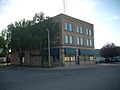
The Grand Forks Woolen Mills building.
