
Hyaloclastite facts for kids
Hyaloclastite is a special type of rock. It is made of many small, sharp pieces of volcanic glass. This glass forms when hot lava cools down very, very quickly. This usually happens when lava erupts underwater or under thick ice. It can also form when lava flows on land reach a large body of water, like the ocean.
Contents
What is Hyaloclastite?
Imagine super hot lava flowing out of a volcano. When this lava meets cold water or ice, something amazing happens! The lava cools so fast that it doesn't have time to form regular crystals. Instead, it shatters into tiny, sharp pieces of volcanic glass. These pieces are called hyaloclastite. The word "hyaloclastite" comes from Greek words meaning "glass" (hyalus) and "broken pieces" (clasts).
How Does Hyaloclastite Form?
Hyaloclastite forms in a process called "quench fragmentation." Think of dropping a very hot glass into cold water – it might crack or shatter. Lava does something similar.
- Underwater Eruptions: When a volcano erupts deep in the ocean, the lava immediately hits cold seawater. This causes the outer parts of the lava to cool and break apart rapidly.
- Under Ice Eruptions: Some volcanoes erupt under glaciers or ice sheets. The intense heat of the lava melts the ice, creating water. This water then quickly cools the lava, making it shatter.
- Lava Meeting the Sea: Even lava flowing on land can create hyaloclastite. If a lava flow reaches the ocean, the edges that touch the water will cool and break into these glass fragments.
The pieces of hyaloclastite are often flat and angular. They can be as small as a millimeter or a few centimeters in size. This breaking can be caused by the force of the volcanic explosion itself or by the sudden temperature change.
Unique Minerals in Volcanic Glass
Inside hyaloclastite, you can find interesting materials. One is called sideromelane. This is a clear type of basalt glass that cooled very fast in water. It looks pure because it doesn't have tiny iron oxide crystals that are common in another type of volcanic glass called tachylite. Often, these glass fragments are covered by a yellowish, waxy layer. This layer is called palagonite. It forms when sideromelane reacts with water over time. It's like a natural coating that protects the volcanic glass.
Hyaloclastite Landscapes Around the World
Hyaloclastite plays a big role in shaping certain landscapes.
- Iceland and British Columbia: In places like Iceland and the Canadian province of British Columbia, you can see long ridges made of hyaloclastite. These ridges formed during the last Ice Age. Back then, volcanoes erupted under thick glaciers, creating these unique landforms.
- Tuyas: Hyaloclastite is often found around special volcanoes called tuyas. Tuyas are volcanoes with flat tops and steep sides. They form when lava erupts through a thick sheet of ice or a glacier. The hyaloclastite helps build up these distinctive shapes.
Building New Land with Lava Deltas
When lava flows into the sea, it can create new land called a lava delta. Hyaloclastite is a main ingredient in building these deltas. As the lava enters the water, it breaks into fragments. These fragments pile up on the seabed, forming sloping layers called "foresets." These foresets gradually fill in the underwater space. Eventually, they build up enough material to reach sea level. This allows the lava flow to continue moving forward on top of the new land until it reaches the sea again, starting the process all over.
See also
- Hyalotuff
Images for kids
-
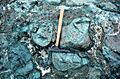
Hyaloclastite forms when lava cools quickly near water or ice.
-
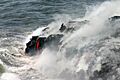
Hot lava meeting the ocean creates hyaloclastite.


