
Kihanga reed frog facts for kids
Quick facts for kids Kihanga reed frog |
|
|---|---|
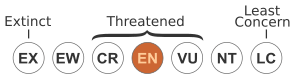
| Conservation status | |
| Scientific classification | |
| Genus: |
Hyperolius
|
| Species: |
kihangensis
|

 |
|
| Hyperolius kihangensis is only known from the Udzungwa Mountains in Tanzania | |
The Hyperolius kihangensis, also known as the Kihanga reed frog or volcano reed frog, is a special kind of frog. It belongs to a group of frogs called Hyperoliidae. This frog is found only in the Udzungwa Mountains in south-central Tanzania. This means it is an endemic species, found nowhere else in the world!
What Does the Kihanga Reed Frog Look Like?
These frogs are quite small. Adult male frogs are about 16 to 19 millimeters (0.6 to 0.7 inches) long. Female frogs are a bit bigger, measuring 23 to 26 millimeters (0.9 to 1 inch) long.
Their bodies and heads are wide and flat. They have large eyes that stick out a little. Their snouts, or noses, are short. The skin on their backs is a mix of brown and gray colors. It often has small dark spots. A wide, light-colored band runs across their lower back. Each heel has a tiny white dot. Some frogs even have a cool hourglass shape on their backs!
Their fingers and toes can be yellowish or reddish. The skin on their belly is yellow for males and reddish for females. Male frogs have a special white pouch under their chin called a vocal sac. They use this sac to make calls.
How Do They Communicate?
Male Kihanga reed frogs make very quiet clicking sounds. When they were first discovered, scientists thought they might not make any sounds at all because their calls are so soft!
Where Does This Frog Live and How Is It Protected?
The Kihanga reed frog lives in swamps found within thick mountain forests. They prefer to live at high places, usually above 1,700 meters (about 5,577 feet) in elevation.
Scientists first found these frogs in a very wet, swampy forest. The ground there was almost completely covered with clumps of grass and had shallow, still water. These frogs lay their eggs on leaves, very close to the water.
This frog species is fairly common in the small area where it lives. However, its home is at risk. People are clearing forests for farming and cutting down trees for wood. This causes the frog to lose its natural habitat.
Good news! The Kihanga reed frog lives in the Udzungwa Scarp Forest Reserve. This area was expected to become a nature reserve around 2015. This change would help protect the frog's home even more.
