
International trade facts for kids
Imagine a world where countries share their best products and services with each other! That's exactly what international trade is all about. It's when countries exchange things like money, goods, and services across their borders. This happens because people in one country might need or want something that another country produces really well.
This kind of trade has been happening for a very long time, even thousands of years ago with famous routes like the Silk Road. But in recent centuries, it has become super important for how countries grow and interact. Today, international trade makes up a big part of what many countries produce, known as their gross domestic product (GDP).
Trading with other countries can be a bit more complicated than trading within your own country. When two or more countries trade, they have to consider different things like their money (currencies), government rules, laws, and even how their markets work. To make this easier, big groups like the World Trade Organization were created. These groups help countries trade fairly and grow together.
Contents
What is International Trade?
When a product is sent from one country to be sold in another, it's called an export from the first country. The country that receives and buys that product calls it an import. Think of it like this: if Spain sends oranges to France, Spain is exporting oranges, and France is importing them. These exports and imports are carefully recorded in a country's financial reports.
Why Countries Trade Goods
Trading globally gives people and countries the chance to discover new products and markets. You can find almost anything in the international market! This includes food, clothes, car parts, oil, jewelry, and even services like tourism, banking, and transport.

Modern tools like advanced technology and faster transportation have made international trade much easier. Also, the way the world is becoming more connected (called globalization) and the rise of big companies that operate in many countries (called multinational corporations) have greatly changed how trade works today.
How Global Trade Works
At its heart, international trade is similar to trading within your own country. People and businesses want to buy and sell things. However, trading across borders usually costs more. This is because of extra fees called tariffs, and other challenges like delays at borders, different languages, cultural differences, and varying safety rules for products.
_with_view_to_Newark_Bay_-_panoramio.jpg)
Another difference is that it's often easier for workers or money to move around within one country than between different countries. So, international trade mostly focuses on moving goods and services. Sometimes, instead of a country bringing in workers from another country, it might import goods that were made by those workers. For example, the United States might import goods made by workers in China.
Products and Services in World Trade
The history of international trade shows many important events that have shaped how countries trade with each other over time. From ancient routes to modern shipping, trade has always connected people.
Exports, Imports, and Technology
Here's a look at some of the most important products that countries export around the world. These are the items that are traded the most by value.

Global Trade Facts and Figures
The World Trade Organization keeps track of how much countries trade. Here is a list of the top 30 trading countries and regions in 2024, based on the total value of their goods and services traded.
| Rank | State | Goods | Services | Goods and services |
|---|---|---|---|---|
| – | World | 49,177,769 | 16,930,782 | 66,108,551 |
| – |  European Union European Union |
5,429,683 | 3,156,243 | 8,585,926 |
| 1 |  United States United States |
5,424,499 | 1,993,624 | 7,418,123 |
| 2 |  China China |
6,163,999 | 1,056,457 | 7,220,456 |
| 3 |  Germany Germany |
3,107,433 | 1,023,755 | 4,131,188 |
| 4 |  United Kingdom United Kingdom |
1,328,813 | 1,050,548 | 2,379,361 |
| 5 |  Netherlands Netherlands |
1,732,989 | 640,644 | 2,373,633 |
| 6 |  France France |
1,390,477 | 740,560 | 2,131,037 |
| 7 |  Japan Japan |
1,449,636 | 474,705 | 1,924,341 |
| 8 |  India India |
1,144,196 | 644,197 | 1,788,393 |
| 9 |  Singapore Singapore |
964,344 | 746,688 | 1,711,032 |
| 10 |  South Korea South Korea |
1,315,376 | 301,607 | 1,616,983 |
| 11 |  Italy Italy |
1,289,671 | 318,022 | 1,607,693 |
| 12 |  Hong Kong Hong Kong |
1,349,678 | 199,642 | 1,549,320 |
| 13 |  Canada Canada |
1,141,276 | 319,173 | 1,460,449 |
| 14 |  United Arab Emirates United Arab Emirates |
1,142,066 | 283,962 | 1,426,028 |
| 15 |  Mexico Mexico |
1,261,074 | 125,087 | 1,386,161 |
| 16 |  Ireland Ireland |
383,054 | 986,640 | 1,369,694 |
| 17 |  Belgium Belgium |
1,048,406 | 307,233 | 1,355,639 |
| 18 |  Spain Spain |
896,146 | 331,898 | 1,228,044 |
| 19 |  Switzerland Switzerland |
816,072 | 394,410 | 1,210,482 |
| 20 |  Taiwan Taiwan |
875,482 | 129,912 | 1,005,394 |
| 21 |  Poland Poland |
759,378 | 193,934 | 953,312 |
| 22 |  Vietnam Vietnam |
782,268 | 60,044 | 842,312 |
| 23 |  Russia Russia |
711,706 | 121,512 | 833,218 |
| 24 |  Australia Australia |
637,759 | 192,015 | 829,744 |
| 25 |  Turkey Turkey |
605,875 | 168,506 | 774,381 |
| 26 |  Brazil Brazil |
615,000 | 151,513 | 766,513 |
| 27 |  Thailand Thailand |
607,339 | 145,786 | 753,125 |
| 28 |  Malaysia Malaysia |
630,781 | 109,773 | 740,554 |
| 29 |  Saudi Arabia Saudi Arabia |
537,338 | 156,942 | 694,280 |
| 30 |  Sweden Sweden |
382,556 | 241,841 | 624,397 |
What Products Are Traded Most?
Here are the top products that were traded around the world in 2022, based on their total value.
| Rank | Commodity | Value in US$ (millions) |
Date of information |
|---|---|---|---|
| 1 | Mineral fuels, oils, distillation products | 3,988,389 | 2022 |
| 2 | Electrical, electronic equipment | 3,493,553 | 2022 |
| 3 | Machinery, nuclear reactors, boilers, etc. | 2,573,572 | 2022 |
| 4 | Vehicles (excluding railway) | 1,621,658 | 2022 |
| 5 | Pharmaceutical products | 875,345 | 2022 |
| 6 | Pearls, precious stones, metals, coins, etc. | 866,839 | 2022 |
| 7 | Plastics and articles thereof | 815,554 | 2022 |
| 8 | Optical, photo, technical, medical, etc. apparatus | 669,128 | 2022 |
| 9 | Iron and steel | 564,547 | 2022 |
| 10 | Organic chemicals | 537,854 | 2022 |
Source: International Trade Centre
The Benefits of Specialization
Sometimes, a country is really good at making a certain product because it has special resources or skilled workers. This is called specialization. When countries specialize, they can produce things more efficiently and at a lower cost. Then, they can trade these specialized products with other countries. This means everyone gets to enjoy a wider variety of goods that are often of better quality or more affordable.
For example, a country with lots of sunny weather might be great at growing certain fruits, while another country with advanced factories might be excellent at making electronics. By trading, both countries can get the fruits and the electronics they need.
Celebrating World Trade
In the United States, there's a special event called "World Trade Week." It started in 1935 to encourage businesses, both big and small, to get involved in exporting and importing goods and services. Every year, the President declares the third week of May as World Trade Week.
- President George W. Bush observed World Trade Week in May 2001 and May 2002.
- On May 13, 2016, President Barack Obama announced May 15–21, 2016, as World Trade Week.
- On May 19, 2017, President Donald Trump announced May 21–27, 2017, as World Trade Week.
Images for kids
-
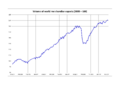
Volume of world merchandise exports

See also
 In Spanish: Comercio internacional para niños
- Index of international trade articles
- Export control
- Free trade
- Free-trade area
- Import
- International business
- International trade law
- Internationalization
- Mercantilism
- Panama Canal
- Suez Canal
- Tariff
- Trade bloc
- Trade finance
- United Nations Conference on Trade and Development (UNCTAD)
