
Korea Deposit Insurance Corporation facts for kids
| 예금보험공사 Yegeum Bohum Gongsa |
|
 |
|
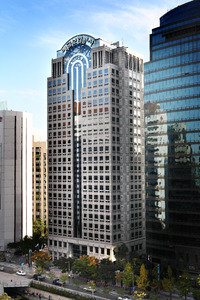 KDIC headquarter along Cheonggyecheon in Downtown Seoul |
|
| Agency overview | |
|---|---|
| Formed | June 1, 1996 |
| Headquarters | Jung District, Seoul, South Korea 37°34′07″N 126°58′51″E / 37.5685087°N 126.9807429°E |
| Agency executive |
|
| Parent agency | Financial Services Commission |
| Korean name | |
| Hangul |
예금보험공사
|
| Hanja | |
| Revised Romanization | Yegeum Bohum Gongsa |
| McCune–Reischauer | Yegŭm pohŏm kongsa |
The Korea Deposit Insurance Corporation (KDIC) is a special organization in South Korea. It was created in 1996 to keep your money safe in banks and other financial places. KDIC helps make sure the financial system stays strong and stable.
Its main jobs include managing insurance, watching for risks, helping solve problems when banks are in trouble, getting money back, and investigating issues.
Contents
How KDIC Started and Grew
The idea for KDIC began on December 29, 1995, when a law called the Depositor Protection Act was passed. This law was made to protect people's money in banks. KDIC officially started on June 1, 1996.
KDIC began its work of protecting deposits on January 1, 1997. It started collecting special payments, called deposit insurance premiums, from banks a few months later.
Key Moments in KDIC's History
- 1998: KDIC started using special bonds to help manage its funds. All the money for deposit insurance was brought together under KDIC's control.
- 2001: A system called "Limited Coverage" was brought back. This means there's a set limit on how much money KDIC protects for each person.
- 2002: KDIC became a founding member of a big international group called the International Association of Deposit Insurers (IADI). This shows its role on a global stage.
- 2003: A new fund for deposit insurance was created. KDIC also started working with other similar organizations in different countries, like the Central Deposit Insurance Corporation (CDIC). They also agreed to work with the Financial Supervisory Service (FSS) to check on financial companies.
- 2004: Credit Unions were no longer covered by deposit insurance.
- 2006: KDIC hosted an international event and signed agreements to work with deposit insurance groups from Japan and Vietnam.
- 2007: KDIC signed an agreement with the United States Federal Deposit Insurance Corporation (FDIC).
- 2008: Money held in foreign currencies also became protected by KDIC.
- 2009: A "Target Fund System" started, which helps KDIC plan how much money it needs. Retirement savings plans also became protected.
- 2014: KDIC started using "Risk-based deposit insurance premiums." This means banks that are riskier pay a bit more for insurance. KDIC also got more power to check on financial companies and ask them to fix problems.
- 2015: Certain types of retirement savings (DC and IRP) got their own separate protection, up to KRW 50 million.
Laws That Guide KDIC
KDIC gets its power and rules from special laws. These laws help it do its job of protecting your money and keeping the financial system safe.
The Depositor Protection Act
This is the main law for KDIC, passed in December 1995. Its goal is to protect people who put money in banks. It also helps keep the financial system stable. This law makes sure that if a bank has problems, people can still get their money back.
The Special Act on the Management of Public Funds
This law was created in December 2000. It helps make sure that public money (money from the government and taxpayers) is used wisely and fairly. It also helps reduce the financial burden on citizens.
How KDIC Makes Decisions
KDIC has different groups that help it make important decisions and manage its work.
The Deposit Insurance Committee
This is the most important decision-making group at KDIC. It discusses and decides on all the big issues. It has seven members, including the President of KDIC, and important people from other government financial groups like the Financial Services Commission and the Bank of Korea.
The Board of Directors
The Board of Directors is in charge of running KDIC day-to-day. It includes the President, Vice President, and other directors. They make sure KDIC's plans are put into action.
KDIC's Structure
As of September 2010, KDIC had ten departments, five offices, and one bureau. It had 563 employees, including lawyers, researchers, and examiners.
What KDIC Does
Managing Money and Policies
KDIC creates rules for deposit insurance and manages the money it collects. This money is split into two main parts:
- The Deposit Insurance Fund Bond Redemption Fund: This fund was used to help fix financial problems after the 1997 East Asian financial crisis.
- The (New) Deposit Insurance Fund (DIF): This is the main fund that collects money from banks each year to protect deposits. In 2009, this fund collected about 1.24 trillion Korean Won.
Watching for Risks
KDIC keeps a close eye on financial companies. It checks them regularly to find any that might be having problems. If it finds issues, it asks the companies or other authorities to take action to prevent bigger problems.
Helping Banks in Trouble
If a financial company is struggling, KDIC helps it based on four main ideas:
- Least Cost: Find the cheapest way to solve the problem.
- Loss-Sharing: Make sure everyone involved shares the losses fairly.
- Self-Help Effort: Encourage the struggling company to try and fix its own problems.
- Transparency/Objectivity: Be clear and fair in all decisions.
KDIC can help in different ways, like paying back depositors directly or giving financial support to the struggling company. This support can include loans, buying assets, or investing money.
Solving Problems for Failed Banks
If a financial company completely fails, KDIC steps in to solve the problem in the least expensive way. KDIC uses different methods, such as:
- Deposit Payoff: Directly paying back depositors their insured money.
- Purchase & Assumption: Arranging for a healthy bank to buy the failed bank's good parts.
- Bridge Bank: Setting up a temporary bank to take over the failed bank's operations until a permanent solution is found.
As of June 2009, KDIC protected deposits in 320 financial institutions. The total amount of insured deposits was huge! The coverage limit is KRW 50 million (about USD 45,000) per depositor. This includes both the original money you put in and any interest earned.
Getting Public Money Back
KDIC works to get back public money that was used to help struggling financial institutions. KDIC can even have its staff manage these institutions or file lawsuits to get money back.
Investigations
KDIC investigates people who might be responsible for a financial company failing. This includes former or current employees. They also look into people who owe money and haven't paid it back, especially if they hid their assets. This helps KDIC get money back for damage claims.
How Your Deposits Are Protected
Types of Companies KDIC Insures
KDIC protects money in many different types of financial companies, including:
- Banks
- Financial investment companies
- Life and non-life insurance companies
- Merchant banks
- Mutual savings banks
At the end of 2009, KDIC protected products from 321 financial institutions.
What KDIC Covers
KDIC covers many common types of deposits, such as:
- Bank deposits
- Customer money for trading stocks
- Individual insurance policies
However, some things are not covered, like:
- Certificates of Deposit (CDs)
- RPs (Repurchase Agreements)
- Stocks and other securities
- CPs (Commercial Papers)
- Deposits made by the government or other insured financial institutions.
How Much KDIC Covers
KDIC protects up to 50 million Korean Won (about $42,823 USD) for each person. This amount is about 2.5 times the average income per person in Korea (as of 2009).
Insurance Payments
Financial companies pay a small fee, called an insurance premium, to KDIC. This fee is based on how much money they have in deposits. For example, in 2009, banks paid 0.08% of their deposits, while mutual savings banks paid 0.35%.
Working with Other Countries
MOUs
KDIC works with deposit insurance organizations around the world. It has signed special agreements, called MOUs, with nine other countries. These agreements help them share information and work together.
Seoul Guarantee Insurance Company
The Seoul Guarantee Insurance Company (SGIC) is a financial company in South Korea. It is the biggest provider of surety and trade credit insurance. This means it helps guarantee payments and protects against risks in trade.
SGIC is fully owned by KDIC. It was formed in 1998 when two other companies merged during the economic crisis in Korea.
Images for kids
-

Original logo of KDIC (1996–2016)
-
Look of the KDIC building with old logo


See also
- List of financial regulatory authorities by jurisdiction
