
Light Up (puzzle) facts for kids
This page is about the logic puzzle Light Up, published by Nikoli. For other uses of the term, see Light Up (disambiguation).

A Light Up puzzle that's not too hard. Can you solve it? (See the solution here)
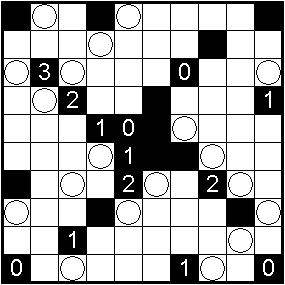
Light Up, also known as Akari, is a fun logic puzzle from Japan. Its Japanese name, bijutsukan, means "art gallery." This puzzle is published by a company called Nikoli, which is famous for creating many popular puzzles, including Sudoku.
Contents
How to Play Light Up
Light Up is played on a grid made of white and black squares. Your main goal is to place light bulbs in the white squares. When you place a bulb, it lights up its entire row and column.
Basic Rules for Placing Bulbs
- Light from a bulb travels straight up, down, left, and right.
- The light stops only when it hits a black square.
- A very important rule: No two light bulbs can shine on each other! This means if you place a bulb, you can't place another bulb in its line of sight (horizontally or vertically) unless there's a black square blocking the light.
- You must make sure that every single white square on the grid is lit up by at least one bulb.
Understanding Black Squares
- Some black squares have numbers on them, from 0 to 4.
- This number tells you exactly how many light bulbs must be placed right next to that black square (up, down, left, or right).
- For example, a black square with a "4" means you must place a bulb on all four sides of it.
- A black square with a "0" means you cannot place any bulbs next to it.
- Black squares without a number can have any number of bulbs next to them, or none at all.
- Bulbs placed diagonally (corner-to-corner) from a numbered black square do not count towards its number.
Tips for Solving Light Up Puzzles
Solving Light Up puzzles is like being a detective! You use clues to figure out where the bulbs go.
Starting Your Puzzle
- Look for "4"s: A great place to start is finding a black square with a "4". Since it needs four bulbs, you know exactly where to place them – one on each side!
- Cornered Numbers: Also, look for numbers like "3" against a wall or "2" in a corner. These often have only one way to place the bulbs around them because some sides are blocked.
Finding Obvious Bulb Spots
- After placing some bulbs, other numbered squares might become easier to solve.
- Sometimes, you'll find a white square that isn't lit yet. If there's only one possible spot where you can place a bulb to light it up without breaking any rules, then that's where the bulb goes!
Marking Empty Squares
- It's helpful to mark white squares where you know a bulb cannot go. You can use a small dot for this.
- Around "0"s: If a black square has a "0", you can put dots in all the white squares next to it, because no bulbs can be there.
- Avoiding Conflicts: If placing a bulb in a certain spot would break a rule (like shining on another bulb, or making it impossible to satisfy a numbered square), then you know that spot must be empty.
- For example, a bulb placed diagonally next to a "3" would block two of its sides. This would make it impossible to place three bulbs around the "3". So, you can always put dots in the diagonal squares around a "3".
Advanced Strategies
- Two "3"s Close By: If you see two black squares with "3"s that are one space apart, and nothing else is between them, there's a special trick. You must place a light bulb in the space between them. This helps avoid having two bulbs shine on each other.
- "1" and "2" Together: Another common pattern involves a "1" and a "2" diagonally next to each other. If one of the spaces next to the "2" (but not next to the "1") is empty or blocked, then the last bulb for the "2" must go in a specific spot. This then tells you that the other spaces around the "1" must be empty.
By using these strategies, you can light up the entire grid and solve the puzzle!

All content from Kiddle encyclopedia articles (including the article images and facts) can be freely used under Attribution-ShareAlike license, unless stated otherwise. Cite this article:
Light Up (puzzle) Facts for Kids. Kiddle Encyclopedia.