
Lind Houses facts for kids
Quick facts for kids |
|
|
Lind Houses
|
|
 |
|

 Location in Vermont

Location in the United States
|
|
| Location | Pleasant St., South Ryegate, Vermont |
|---|---|
| Area | 2 acres (0.81 ha) |
| Built | 1905 |
| Architectural style | Colonial Revival, Queen Anne |
| NRHP reference No. | 88001589 |
| Added to NRHP | September 27, 1988 |
The Lind Houses are a group of seven very similar homes located on Pleasant Street in South Ryegate, Vermont. These houses were built around 1905. They are a great example of homes built for workers during that time. In 1988, they were added to the National Register of Historic Places. This means they are important historical buildings.
Contents
What Do the Lind Houses Look Like?
The Lind Houses are found on the south side of South Ryegate village. They are on Pleasant Street, which connects Church Street to United States Route 302. All seven houses look almost exactly alike.
House Design and Features
Each house is a free-standing building made of wood. They are about two and a half stories tall. Their roofs have a pointed front section, called a gable. The outside walls are covered with horizontal wooden boards called clapboards.
Every house has a porch across the front. This porch has a gently sloping roof. The roof is held up by decorative posts. These posts have fancy brackets and square railings. The front of each house has three sections, and the main door is on the left side.
Back of the Houses
Behind each house, there is a single-story addition. This part of the house originally held outdoor toilets, also known as privies. The two houses at the far end of the row also have a small barn. These barns were used for carriages or storage.
The History of the Lind Houses
The Lind Houses were built around 1905 by a man named George E. Lind. He built them especially for immigrant workers. These workers came to the area to work in businesses that used granite stone.
George Lind's Vision
George Lind came to the United States from Germany in 1851. He cared a lot about the living conditions of immigrant workers. It's interesting that these houses were even nicer than Lind's own home nearby. He wanted to provide good homes for these workers.
Changes in Ownership
George Lind passed away in 1909. After his death, the South Ryegate Granite Works took over the houses. Over the years, many different owners have managed the properties. In the 1960s, the houses started to show their age. However, they were fixed up and improved in the 1980s. Today, they remain a well-preserved piece of history.
Images for kids
-
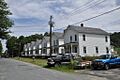
The Lind Houses in South Ryegate, Vermont.
