
Mackinnon's shrike facts for kids
Quick facts for kids Mackinnon's shrike |
|
|---|---|
.jpg) |
|
| Conservation status | |
Scientific classification  |
|
| Kingdom: | Animalia |
| Phylum: | Chordata |
| Class: | Aves |
| Order: | Passeriformes |
| Family: | Laniidae |
| Genus: | Lanius |
| Species: |
L. mackinnoni
|
| Binomial name | |
| Lanius mackinnoni Sharpe, 1891
|
|
| Script error: The function "autoWithCaption" does not exist. | |
Script error: No such module "Check for conflicting parameters".
The Mackinnon's shrike (Lanius mackinnoni) is a cool songbird found in parts of Africa. It's also known as the Mackinnon's fiscal. This bird belongs to the Laniidae family, which are often called "shrikes."
You can find this bird living in warm, wet montane forests (forests on mountains) and moist savanna areas. It's not considered an endangered animal. In fact, its numbers are actually growing! This might be because changes in its habitat, like forests being cleared, actually help it find new places to live. The bird is named after Archibald Donald MacKinnon.
What It Looks Like
The Mackinnon's shrike grows to be about 20 centimeters (8 inches) long. That's about the length of a standard pencil!
Adult male shrikes have a greyish-black head and back. They have a white stripe above their eye, like an eyebrow. Their shoulder feathers are white, and their wings are black. The tail is black with white edges. The underside of their body is white, sometimes with a slight yellowish-brown tint.
Female shrikes look very similar to the males. However, they have reddish-brown spots on their sides. Young shrikes are greyish-brown and have lots of stripes all over their body.
Where It Lives and Its Home
The Mackinnon's fiscal lives in the tropical, humid parts of Central Africa. It has a scattered range, meaning it's found in different areas that are not connected. For example, you can find it from the Obudu Plateau down to northern Angola. It also lives across northern Congo, the Ruwenzori mountains, and near Lake Victoria.
This bird likes to live on the edges of forests. It also enjoys clearings, areas where new plants are growing, and bushy spots. You can find it from sea level up to about 2,200 meters (7,200 feet) high.
Conservation Status
The Mackinnon's fiscal lives across a very large area. People often describe it as being common in many places. However, it's a bit harder to find in the eastern parts of its range.
Its population seems to be increasing. This is because it benefits from changes in its environment, like when forests are cleared. It does very well in areas where new plants are growing back. You can often spot it in farmland, villages, and even gardens.
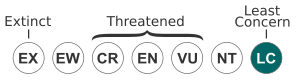
Because it has a wide range and its population is growing, the International Union for Conservation of Nature (IUCN) says it is a "least concern" species. This means it's not currently at risk of disappearing.
