
Mining methods of the Klondike Gold Rush facts for kids

Imagine a time when people rushed to a cold, distant land hoping to find gold! This was the Klondike Gold Rush, which happened in the late 1800s. People came from all over the world to search for gold in the Klondike region, which is now part of Canada's Yukon territory. Finding gold was a huge challenge, especially because the ground was often frozen solid. Miners had to use clever methods to dig out the gold and separate it from the dirt and rocks.
Contents
How Gold Was Found in the Klondike
During the Klondike Gold Rush, from 1896 to 1899, most gold was found deep in the ground. It was usually in gravel layers close to the bedrock, which is the solid rock beneath the soil. Getting the gold out involved two main steps. First, miners had to bring the gold-filled gravel to the surface. Second, they needed to separate the tiny gold pieces from the gravel. This separation always required a lot of water. Water was also useful for thawing the frozen ground and washing down gravel from hillsides.
Bringing Gold to the Surface: Mining Methods
To get the gold-rich dirt and gravel from the ground, miners used two main approaches. They either dug deep shafts into the earth or used powerful streams of water. Water could wash soil down a hill or even suck it up from below.
Digging for Gold: Underground Mining
Most of the gold was hidden deep underground. The ground in the Klondike was often permafrost, meaning it was frozen all year round. Miners had to thaw this frozen ground before they could dig. They would build a fire that burned all night long. This fire would soften the ground about 14 inches deep. Then, they could remove the thawed gravel. They repeated this process until they reached the gold.
Because the ground was frozen, the shafts they dug didn't need extra support. However, the fires could create bad gases, which miners had to remove. Later, they also started using steam to thaw the ground. Miners usually dug during the cold winter months. The cold air naturally flowed down the shafts, keeping the air fresh. Also, the freezing temperatures meant that water wouldn't fill up the shafts. The gold-filled gravel was piled up in a "dump" outside. This dump would be processed later in the summer. The gold was safe from thieves in the frozen gravel because it was invisible.
-
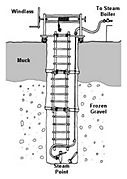
How miners used steam

-
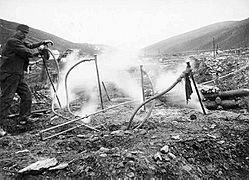
Thawing ground with steam in 1898

-
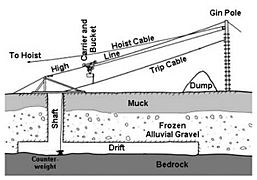
How miners dug shafts

-
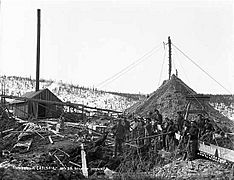
A steam plant, sluice, and dump around 1901

Using Water Power: Hydraulic Mining
Another method involved using strong jets of water to wash down parts of a hillside. This washed-down material could then be processed to find gold. These water jets were incredibly powerful. If gravity couldn't be used to move the gravel, miners used a "lift." This device used pressurized water to suck up a mix of water and gravel. This method could also be an alternative to digging shafts. Hydraulic mining was first used during the California Gold Rush and later at Nome.
-
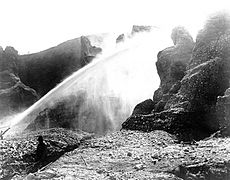
A jet of water washing down a hillside in 1898

-
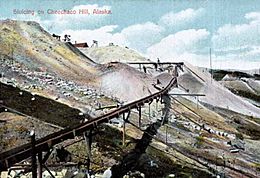
Mining with sluices on a hillside in 1898

-
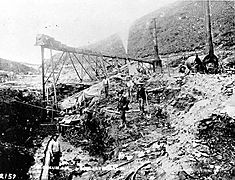
A hydraulic lift in 1898

Separating Gold from Gravel
All gold separation methods needed water. This meant they could only be used during the warmer summer months.
Panning for Gold
Panning was the simplest way to find gold. Miners would swirl water and gravel in a pan. The heavier gold would sink to the bottom. This method was mostly used to explore for gold, as it was very slow.
Rocker Boxes and Sluices
Faster ways to separate gold included using a rocker box or a sluice. Miners would put dirt and water into the box or sluice. By rocking the box or letting gravity do the work in a sluice, the heavy gold particles would settle. Lighter sand and fine dirt would flow away with the water.
Further Gold Purification
To make the gold even purer, miners sometimes used mercury. Mercury would stick to the gold but not to fine sand. A magnet could also be used to separate tiny magnetic sand particles from gold dust.
-
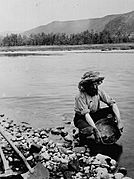
Panning for gold in 1898

-
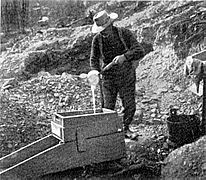
A rocker box in 1898

-
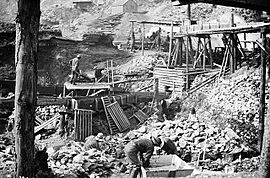
Sluices at Bonanza Creek in 1899

Big Machines: Later Gold Mining (1910-1950)
From 1910 to 1950, huge machines called dredges were used in the Klondike River valley. One dredge could do the work of 2,400 people! Only 10 to 12 people were needed to operate it. A dredge would create a pool of water around itself. It would dig up gravel from the front and drop it behind itself. Inside the dredge, sand and gold were separated from larger rocks. Then, the gold was separated from the sand. By swinging from side to side, a dredge could clear a wide area.
Today, miners still use a mix of hydraulic methods and large bulldozers to find gold.
-
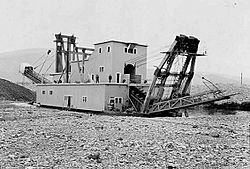
A dredge at Bear Creek in 1913
-
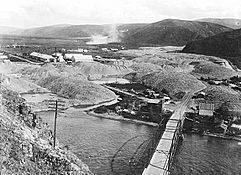
Sand piles left by a dredge in 1913


