
Pandora facts for kids

In Greek mythology, Pandora was the very first woman on Earth. The king of the gods, Zeus, asked the god Hephaestus to create her from earth. Other gods gave her special gifts, like beauty and charm. This is why her name, Pandora, means "all gifts" in Greek.
Zeus sent Pandora to live with a kind man named Epimetheus. As a wedding gift, Zeus gave them a mysterious jar. Today, this is often called Pandora's box. They were told very clearly not to open it.
However, Pandora was very curious. One day, she couldn't resist and opened the jar. All the bad things in the world had been trapped inside. They quickly escaped and spread across the entire Earth. Pandora realized what she had done. She quickly closed the jar. It was too late to keep evil from getting out. The only thing left inside the jar was hope. The word "jar" in the myth was sometimes mistranslated as "box." The phrase "Pandora's box" has become a common saying in the English language. It refers to something that will cause a lot of trouble.
The myth of Pandora is very old. There are several different Greek versions of the story.
Throughout history, the myth of Pandora has been interpreted in many different ways. She has been seen as a symbol of beauty, curiosity, and the source of human troubles. Sometimes, she is shown as a victim of the gods' plans, and other times as someone whose actions changed the world foreve
Pandora: A Moon of Saturn
Pandora is also the name of one of the many moons that orbit the giant ringed planet Saturn. It is a small moon, shaped a bit like a potato. Scientists discovered Pandora in October 1980. They used pictures taken by the Voyager 1 spacecraft. It was later officially named Pandora in 1985. It was named after the character from Greek mythology.
Pandora in Art
Artists have been inspired by Pandora's story for centuries. Images of Pandora first appeared on ancient Greek pottery as early as the 5th century BCE. Sometimes, she was shown rising from the earth, almost like an earth goddess.
Later, especially from the 18th century onwards, many painters and sculptors created their own versions of Pandora. They often showed her at the moment of her creation, receiving gifts from the gods, or opening her famous jar (or box). These artworks helped keep her story alive and popular.
Pandora's story has also been a popular subject for plays, poems, and operas. Writers and composers have explored her character and the meaning of her myth in many different ways.
In the 19th century, for instance, authors like Henry Wadsworth Longfellow wrote plays about Pandora.
Images for kids
-
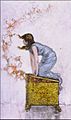
Pandora trying to close the box she has opened. At left, the evils of the world taunt her as they escape. Engraving, based on a painting by F.S. Church.
-
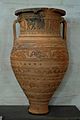
A pithos from Crete, around 675 BC (Louvre Museum)
-
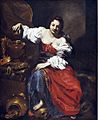
Nicolas Régnier: Allegory of Vanity—Pandora, around 1626
-
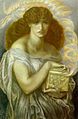
Jane Morris in the role, Dante Gabriel Rossetti, coloured chalks, 1879


.JPG)

See also
 In Spanish: Pandora para niños
