
Patsy Brown facts for kids
Patrick A. 'Patsy' Brown (born 1872 in Ireland, died 1958 in Boston, Massachusetts, United States) was a talented Irish-American craftsman. He was famous for making uilleann pipes, a special type of Irish bagpipes. Patsy came from Killorglin, County Kerry, Ireland. In 1892, he moved to the United States. He first lived in Chicago and then settled in the Dorchester area of Boston. Patsy might have worked as a bricklayer or an electrician. He made uilleann pipes from his cellar as a hobby, so he didn't make a huge number of them. However, his pipes had a very unique style. He likely made them from around 1910 until he passed away in 1958. People believe he played music for dancers in clubs around Dudley Square in Dorchester, just like many other Irish musicians of his time.

Contents
What Are Uilleann Pipes?
Uilleann pipes are a traditional Irish musical instrument. They are a type of bagpipe. Unlike Scottish bagpipes, which are played by blowing air into a bag, uilleann pipes are played by pumping air with your elbow. The word "uilleann" actually means "elbow" in Irish! These pipes have a softer, sweeter sound than other bagpipes. They are often used for traditional Irish music.
Patsy Brown's Unique Pipe Style
Patsy Brown's uilleann pipes had a very special design. His early pipes looked a lot like those made by the Taylor brothers, who were also famous pipe makers.
Early Designs
Patsy's first pipes had wide, rectangular keys along the back of the chanter. The chanter is the part of the pipe that plays the melody. These keys were operated by small touches that wrapped around to the front. The regulator keys, which play chords, also looked like the Taylor brothers' design. But Patsy put them in wooden blocks, not between metal plates. His keys were usually made of nickel-plated brass. Some even had chrome plating.
A Clever Source for Ivory
There's an interesting story about where Patsy got the ivory for his pipes. He supposedly got it from the elephant keepers at Boston's Franklin Park Zoo. The keepers would trim the tips of the elephants' tusks. This made the tusks blunt, keeping both the keepers and other elephants safe. These trimmed pieces of ivory then found their way to Patsy. He used them to decorate his beautiful pipes.
Later Pipe Styles
In his later years, Patsy's pipe-making style changed. He started using a mix of styles.
Böhm-Style Keys
He added Böhm-style keywork to the holes at the front of the chanter. This style is often seen on flutes. However, he kept the wide, flat, Taylor-style keys for the holes at the back. Some people think he might have repaired classical flutes sometimes. This could have given him ideas for new key designs.
Dealing with Age
Another idea is that his new style helped him as he got older. It might have been easier for his fingers, if they were stiff from arthritis, to close these new keys. On some of his chanters, the keys move around a single rod, just like on a flute. On others, his style was truly unique. Each key moved around its own rod, held by two posts above the tone hole. Not all of his chanters have this very special design.
Concert-Pitch Pipes
Patsy Brown is thought to have made only "concert-pitch" pipe sets. This means his pipes were tuned to the standard musical pitch used by most instruments. It also seems he always used a "popping valve" on his chanters. This is a small part that helps control the sound.
Other Pipe Makers in Boston
Patsy Brown wasn't the only uilleann pipe maker in Boston. Other makers like Ned White from Roxbury and someone named Green also worked around the same time.
Ned White's Style
Ned White's pipes were even more similar to the Taylor brothers' style than Patsy's. This might mean Ned was older and knew the Taylor brothers personally. Ned White is even mentioned in a famous book called "O'Neill's Irish Minstrels." Some of his pipe sets are still around today.
Teaching by Mail
It is said that Patsy Brown taught another pipe maker, Seán McAloon, how to make reeds. Reeds are small vibrating pieces that create the sound in the pipes. Patsy taught Seán how to do this through letters, which is called correspondence.
Images for kids
-
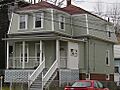
Patsy Brown's home in Dorchester, MA.
