
Pineda Palace facts for kids
Quick facts for kids Pineda Palace |
|
|---|---|
|
Palau Pineda
|
|

Pineda Palace
|
|
| General information | |
| Architectural style | Neoclassicism |
| Town or city | Valencia |
| Country | Spain |
| Coordinates | 39°28′44″N 0°22′43″W / 39.478931°N 0.378714°W |
| Construction started | April 7, 1728 |
| Completed | 1733 |
The Pineda Palace is a beautiful old building in Valencia, Spain. It was built a long time ago, starting in 1728. This palace is a great example of Neoclassical style, which means it looks grand and balanced. Today, it is used for important meetings and learning.
Contents
What's in a Name?
The palace is officially called "Palau Pineda" or "Palau del Intendente Pineda." This name comes from its first owner, Mr. Francisco Salvador de Pineda. He was a very important person in Valencia. He held the title of "Intendente General," which was like a chief administrator for the regions of Valencia and Murcia. He was also the "Justicia Mayor," a top legal official for the city.
A Palace Through Time
Building the Palace
The Pineda Palace was built between 1728 and 1733. Mr. Francisco Salvador de Pineda and his wife, Francisca de Paula Negrete, were the first to live there. Mr. Pineda was in charge of collecting taxes. He used some of these funds to build his grand new home. Because of this, he was asked to leave his job and the city of Valencia.
New Owners and Uses
Over the years, the palace changed hands many times. In 1902, a group called the "Padres Maristas" moved in. Later, in 1918, the "Congregación de Hermanas del Sagrado Corazón de Jesús y de los Santos Ángeles" bought it. During this time, the Pineda Palace became a convent. It also served as a home for older women and for young women studying or working in Valencia. The palace could house up to 60 people.
Surviving Challenges
The palace was lucky during the Spanish Civil War, as it was not damaged. However, a big flood in 1957 caused serious harm to the building. In 1980, the Generalitat Valenciana (the local government of Valencia) bought the palace. They decided to restore it to its former glory. The restoration work was done by Vicente González Móstoles and Alejandro Pons Romaní from 1990 to 1992.
Palace Design and Features
Outside the Palace
The outside of the Pineda Palace is built with reddish bricks. It has two floors with balconies. The design is very balanced and neat, which is typical of Neoclassical style. There are two small towers on each side. In the middle, you can see the main entrance. Above the door, there is a coat of arms belonging to the Pineda family. Even though it is old and damaged, you can still see the year 1732. This is thought to be the year the building was finished.
Inside and Around
The palace is shaped like a rectangle, about 23 by 34 meters. Inside, it has a main hall, a mezzanine (a floor between two main floors), two full floors, and an attic. There is also a garden at the back. This garden was added later and is now a terrace for a cafeteria. The building has been changed several times over the years. For example, some walls were moved when it was used as a school. A small tower was also added to the back.
Garden Art
In the garden area outside the palace, there is a sculpture. This sculpture was created by a famous painter named Joan de Joanes.
What Happens There Now?
Today, the Pineda Palace is a busy place. It has many classrooms and meeting rooms. These rooms are often used by the Generalitat Valenciana. Other groups that have their main offices in the palace also use them. Many educational and official events happen here. The Pineda Palace is currently the main office for two important organizations: the Universidad Internacional Menéndez Pelayo and the Institut Valencià d'Administració Pública.
Images for kids
-
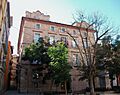
Pineda Palace
See also
 In Spanish: Palacio Pineda para niños
