
Florida Keys blackbead facts for kids
Quick facts for kids Florida Keys blackbead |
|
|---|---|
 |
|
| Showing emerging flowers | |
| Conservation status | |
Scientific classification  |
|
| Kingdom: | Plantae |
| Clade: | Tracheophytes |
| Clade: | Angiosperms |
| Clade: | Eudicots |
| Clade: | Rosids |
| Order: | Fabales |
| Family: | Fabaceae |
| Clade: | Mimosoid clade |
| Genus: | Pithecellobium |
| Species: |
P. keyense
|
| Binomial name | |
| Pithecellobium keyense Britton ex Britton & Rose
|
|
| Script error: The function "autoWithCaption" does not exist. | |

Script error: No such module "Check for conflicting parameters".
The Florida Keys blackbead (Pithecellobium keyense) is a cool flowering plant. It's also known as the Florida Key apes-earring. This plant belongs to the legume family, which is called Fabaceae. This family includes many plants like peas and beans!
Where It Lives
The Florida Keys blackbead grows naturally in several places. You can find it in The Bahamas, Belize, and Cuba. It also lives in parts of Mexico, especially in Quintana Roo and Yucatán. In the United States, it grows in Florida.
This plant likes to grow where there is sand or limestone. It often lives close to the ocean, in coastal areas. The Florida Keys blackbead is quite common in most of the places where it grows.
What It Looks Like
The Florida Keys blackbead can be a small tree or a shrub. A shrub is like a bushy plant that is smaller than a tree. Its leaves are special because they are "pinnately compound." This means each leaf has smaller parts called leaflets. It usually has 2 to 4 leaflets on each leaf.
The leaves stay green all year round. They also feel a bit tough and leathery. The plant produces flowers in groups called heads. These flowers can be white or pink. After the flowers, the plant grows long, curly bean pods as its fruit.
-
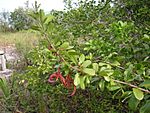
A fruiting specimen

See also
 In Spanish: Pithecellobium keyense para niños
