
Potter Stewart United States Courthouse facts for kids
Quick facts for kids Potter Stewart United States Courthouse |
|
|---|---|
 |
|
| Former names | United States Post Office and Courthouse |
| General information | |
| Architectural style | Art Moderne |
| Location | Cincinnati, Ohio |
| Address | 100 E. Fifth St. |
| Coordinates | 39°6′6″N 84°30′38″W / 39.10167°N 84.51056°W |
| Construction started | November 30, 1936 |
| Inaugurated | January 14, 1939 |
| Cost | $3,170,000 |
| Owner | General Services Administration, U.S. Government |
| Height | 116 ft. |
| Technical details | |
| Floor count | 12 |
| Floor area | 432,535 |
| Design and construction | |
| Architect | Louis A. Simon |
The Potter Stewart United States Courthouse is an important building in Cincinnati, Ohio. It serves as a courthouse and a federal building for the U.S. government.
This building is home to the main offices of the United States District Court for the Southern District of Ohio. It also houses the United States Court of Appeals for the Sixth Circuit. The courthouse was finished in 1938. In 1994, it was renamed after Supreme Court Justice Potter Stewart. In 2015, it was added to the National Register of Historic Places. This means it is recognized as a special historical place.
Contents
History of the Potter Stewart Courthouse

The Potter Stewart Courthouse was built because the U.S. government needed more space in Cincinnati. The federal offices in the city were growing. The previous federal building, built in 1885, was too small.
Construction on the new building started on November 30, 1936. It was officially opened in January 1939. When it first opened, it held 51 different government agencies.
Why a New Federal Building Was Needed
Cincinnati has had several federal buildings over the years. The first one was bought in 1851. It brought many scattered federal offices together. After 27 years, that building was sold.
The second federal building was the United States Custom House and Post Office. It was built on Fifth Street. This area was already important, visited by presidents like Abraham Lincoln. Even so, some business owners thought Fifth Street was too far from the city's business center.
Building the second courthouse took a long time. Congress approved it in 1872, but it wasn't finished until 1885. It cost over $5 million.
Building the Current Courthouse
About 50 years later, in the 1930s, the government needed even more space. The 1885 building, which housed 27 departments, was no longer big enough. So, a new building was planned.
The new courthouse was designed to have much more usable space. It had 485,000 square feet for offices, compared to 240,000 square feet in the old building. This was more than double the working area. The new building was also taller, with nine stories instead of five.
The new courthouse cost about $3.17 million. It was designed by architects from the Treasury Department, led by Louis A. Simon. The Great Lakes Construction Company built it. Work began in November 1936 with the demolition of the old building.
Architecture and Design
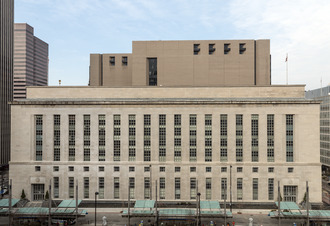
The Potter Stewart Courthouse is located in downtown Cincinnati. It sits between Walnut, East Fifth, and Main Streets. The building has nine stories and is shaped like a "U." Its main side faces south onto East Fifth Street.
The building's style is called Art Moderne. This style is known for its smooth surfaces, rounded corners, and horizontal lines. The outside walls are covered in limestone, which is a light-colored stone. The base of the building is made of dark granite.
Outside Features
The front of the building on East Fifth Street has 17 sections with windows. The corners of the building have special entrances with glass and aluminum doors. A decorative band, called a Greek key belt course, runs around the building at the fourth floor. There is also a carved design and a ledge at the top.
The sides of the building, facing east and west, are similar. They each have eight window sections and two entry doors. The Greek key design and carved details continue around these sides.
The back of the building (north side) has two limestone sections. The middle part is a lighter brick. This area is a "light court," which helps bring natural light into the building.
Inside the Courthouse
Inside, the building has long hallways that run from east to west. On the upper floors, these hallways connect to elevator lobbies. The hallways have tile floors, marble and plaster walls, and sound-absorbing ceilings. The original elevator doors and cabs are still there.
The main entrance lobbies on the first floor are very grand. They have two stories, with tile floors, marble walls, and plaster ceilings. These lobbies connect to a long corridor that used to be the postal service lobby.
The courthouse also has historic courtrooms on the sixth and eighth floors. Even though they have new carpet and ceiling tiles, their original wood paneling and details are still in place. These rooms keep their original large size and feel.
 This article incorporates public domain material from websites or documents of the General Services Administration.
